

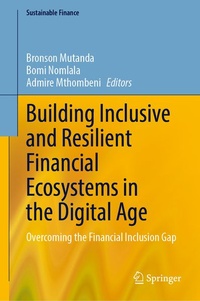
Building Inclusive and Resilient Financial Ecosystems in the Digital Age
Description
This book serves as a vital resource for policymakers, financial institutions, and stakeholders aiming to build an inclusive and resilient financial system tailored to the demands of the digital age. Given the pivotal role financial inclusion plays in realizing several United Nations Sustainable Development Goals such as reducing poverty, promoting economic growth and fostering gender equality, the strategies outlined in this book are both timely and essential. Through examining successful case studies and innovative approaches from around the world, the book offers practical insights into bridging the financial inclusion gap. Furthermore, it discusses the complexities of building a resilient financial ecosystem capable of withstanding the challenges posed by rapid digitalization, including cybersecurity threats, technological disruptions and evolving consumer expectations. Through a blend of theoretical frameworks and real-world examples, this book equips readers with the knowledge and tools necessary to navigate the intricacies of modern financial systems and drive meaningful progress toward a more inclusive and sustainable financial future.
More details
Persons
Dr. Bronson Mutanda is a Lecturer in the Department of Applied Business Sciences at Manicaland State University of Applied Sciences, Zimbabwe, and a Researcher at the University of KwaZulu-Natal, South Africa. With over 16 research papers published in high-impact, peer-reviewed journals, his research focuses on SME financing, financial inclusion, financial reporting, the informal sector, digital finance, personal financial management, and microfinancing. Mr. Mutanda is also an accomplished grant research project expert, having contributed to the INSETA grant project in South Africa.
Professor Bomi Cyril Nomlala is a Professor of Auditing at the University of KwaZulu-Natal, South Africa, and Director of the Self-Funded Teaching Programme. He holds a PhD in Accounting and has published extensively on financial capability, governance, ESG, and forensic auditing. Prof. Nomlala has successfully led large-scale research projects funded by INSETA, Liberty, and other national entities. His research interests focus on insurance transformation, investment behavior, and the intersection of digitalization and financial literacy. He has served on national academic panels, including the NRF CPRR and Y-Rated committees, and chaired program reviews for UNISA and CPUT.
Admire Mthombeni is a Postdoctoral Research Fellow in the Graduate School of Business and Leadership at the University of KwaZulu Natal, South Africa. He is also a Senior Lecturer at the Applied Business Sciences Department, Manicaland State University of Applied Sciences, Zimbabwe. His research focuses on Environmental Social Governance (ESG), Corporate Governance, Strategic Management, Sustainability and Social Responsibility in Business
Content
Chapter 1. What Level of Financial Inclusion Should Be Achieved? That Is the Question.- Chapter 2. Financial Inclusion in Selected Southern African Countries in the Digital Age: A Contextual Overview and Comparative Analysis.- Chapter 3. The Exploration of Factors Influencing Financial Inclusion in Eswatini.- Chapter 4. Bridging the Financial Divide: A Systematic Review of Mobile Banking Strategies for Expanding Access to Underserved Populations in South Africa.- Chapter 5. Digital Financial Literacy and Financial Inclusion: Evidence from Rural Households in Gokwe South District, Zimbabwe.- Chapter 6. Digital Transformation in the Microfinance Sector: Emerging Opportunities, Structural Challenges and Implications for Financial Inclusion.- Chapter 7. Can Technology Adoption and Usage Lead to Demise of Rural Savings Groups in Zimbabwe? Case of Umzingwane District, Zimbabwe.- Chapter 8. Artificial Intelligence and Machine Learning: Enhancing Financial Inclusion and Resilience.- Chapter 9. Fifth-Generation (5G) Networks, Internet of Things and the Future of Inclusive Financial Services.- Chapter 10. Blockchain and Distributed Ledger Technology: Applications for Financial Inclusion.- Chapter 11. Leveraging Blockchain and Distributed Ledger Technologies to Advance Financial Inclusion.- Chapter 12. Sustainable Cryptocurrency Adoption Strategies for Banks in Emerging Economies: A Bibliometric Analysis.- Chapter 13. Regulatory Frameworks for Financial Resilience and Inclusion in Southern Africa: Balancing Innovation and Protection.- Chapter 14. Bridging Regulatory Gaps: A Legal Appraisal of Financial System Resilience and Inclusion in Nigeria - Balancing Innovation with Protection under International Law.- Chapter 15. Developing a Resilient Financial Sector Workforce: The Role of Reskilling, Retraining and Continuous Learning.- Chapter 16. Financial Inclusion in Transition: Future Trends, Opportunities, and Policy Challenges in Africa.