

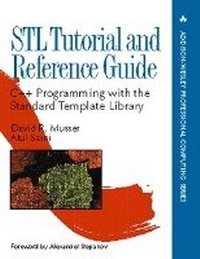
STL Tutorial and Reference Guide
C++ Programming with the Standard Template Library
Published on 11. March 1996
Book
Hardback
432 pages
978-0-201-63398-6 (ISBN)
Description
The Standard Template Library (STL) represents a breakthrough in C++ programming methodology. Comprising a set of C++ generic data structures and algorithms, STL provides reusable, interchangeable components adaptable to many different uses without sacrificing efficiency. Adopted by the ANSI/ISO C++ Standards Committee, STL is an important addition to every C++ programmer's portfolio of skills. This book introduces you to STL and provides the information and techniques you need to become a proficient STL programmer. The book includes a tutorial, a thorough description of each element of the library, numerous sample applications, and a comprehensive reference. You will find in-depth explanations of iterators, generic algorithms, containers, and function objects. Several larger, non-trivial applications, including a dictionary lookup program, demonstrate how to put STL's power and flexibility to work. The book will also show you how to integrate STL with object-oriented programming techniques, while the comprehensive and detailed STL reference guide will be a constant and convenient companion as you learn to work with the library. 0201633981B04062001
More details
Language
English
Place of publication
Boston
United States
Publishing group
Pearson Education (US)
Target group
College/higher education
Dimensions
Height: 241 mm
Width: 191 mm
Thickness: 33 mm
Weight
890 gr
ISBN-13
978-0-201-63398-6 (9780201633986)
Copyright in bibliographic data and cover images is held by Nielsen Book Services Limited or by the publishers or by their respective licensors: all rights reserved.
Schweitzer Classification
Other editions
New editions
David R. Musser | Gillmer J. Derge | Atul Saini
STL Tutorial and Reference Guide
C++ Programming with the Standard Template Library (paperback)
Book
05/2010
2nd Edition
Addison Wesley
€41.68
Article is exhausted; no reprint
David R. Musser | Gillmer J. Derge | Atul Saini
STL Tutorial and Reference Guide
C++ Programming with the Standard Template Library
Book
04/2001
2nd Edition
Addison Wesley
€49.51
Article is exhausted; no reprint
Persons
David R. Musser, currently of Rensselaer Polytechnic Institute, has been involved with STL almost from its inception. Collaborating with its creator, Alexander Stepanov, he helped develop the first implementation and contributed to STL's inclusion in the ANSI/ISO C++ standard.
Atul Saini is President and CEO of Modena Software Incorporated, which distributes STL++, the first commercial STL product.
0201633981AB04062001
Atul Saini is President and CEO of Modena Software Incorporated, which distributes STL++, the first commercial STL product.
0201633981AB04062001
Content
Foreword. Preface. I. A TUTORIAL INTRODUCTION TO STL. 1. Introduction. Who Should Read This Book. What Generic Programming Is and Why Its Important. How C++ Templates Enable Generic Programming. Understanding STLs Performance Guarantees. STL Header Files. Conventions Used in Examples. 2. Overview of STL Components. Containers. Generic Algorithms. Iterators. Function Objects. Adaptors. Allocators. 3. How STL Differs from Other Libraries. Extensibility. Component Interchangeability. Algorithm/Container Compatibility. 4. Iterators. Input Iterators. Output Iterators. Forward Iterators. Bidirectional Iterators. Random Access Iterators. The STL Iterator Hierarchy: Combining Algorithms and Containers Efficiently. Revisiting Input and Output: Stream Iterators. Specification of Iterator Categories Required by STL Algorithms. Designing Generic Algorithms. Why Some Algorithms Require More Powerful Iterators. Choosing the Right Algorithm. Constant Versus Mutable Iterator Types. Iterator Categories Provided by STL Containers. 5. Generic Algorithms. Basic Algorithm Organization in STL. Nonmutating Sequence Algorithms. Mutating Sequence Algorithms. Sorting-Related Algorithms. Generalized Numeric Algorithms. 6. Sequence Containers. Vectors. Deques. Lists. 7. Sorted Associative Containers. Sets and Multisets. Maps and Multimaps. 8. Function Objects. Example: Function Objects That Do Comparisons. How Function Objects Differ from Function Pointers. STL-Provided Function Objects. 9. Container Adaptors. Stack Container Adaptor. Queue Container Adaptor. Priority Queue Container Adaptor. 10. Iterator Adaptors. Reverse Iterators. Insert Iterators. 11. Function Adaptors. Negators. Binders. Adaptors for Pointers to Functions. II. PUTTING IT TOGETHER: EXAMPLE PROGRAMS. 12. A Program for Searching a Dictionary. Finding Anagrams of a Given Word. Interacting with the Standard I/O Streams. Searching the Dictionary. Generating Permutations. How Fast Is It? 13. A Program for Finding All Anagram Groups. Finding Anagram Groups. Defining a Data Structure to Work with STL. Creating Function Objects for Comparisons. The Complete Anagram Group Finding Program. Reading the Dictionary into a Vector of PS Objects. Using a Comparison Object to Sort Word Pairs. Using an Equality Predicate Object to Search for Adjacent Equal Elements. Using a Function Adaptor to Obtain a Predicate Object. Copying the Anagram Group to the Output Stream. Output of the Anagram Program. 14. A Better Anagram Program: Using the List and Map Containers. A Data Structure Holding Pairs of Iterators. Storing Information in a Map of Lists. Outputting the Anagram Groups in Order of Size. A Better Anagram Program. Output of the Program. Why Use a Map Container? 15. A Faster Anagram Program: Using Multimaps. Finding Anagram Groups, Version 3. Declaration of the Multimap. Reading the Dictionary into the Multimap. Finding the Anagram Groups in the Multimap. Outputting the Anagram Groups in Order of Size. Output of the Program. How Fast Is It? Note on a Compiler Problem. 16. Defining an Iterator Class. A New Kind of Iterator: Counting Iterator. A Counting Iterator Class. 17. Combining STL with Object-Oriented Programming. Using Inheritance and Virtual Functions. Avoiding "Code Bloat" from Container Instances. III. STL REFERENCE GUIDE. 18. Iterator Reference Guide. Input Iterator Requirements. Output Iterator Requirements. Forward Iterator Requirements. Bidirectional Iterator Requirements. Random Access Iterator Requirements. Istream Iterators. Ostream Iterators. Reverse Iterators. Back Insert Iterators. Front Insert Iterators. Insert Iterators. 19. Container Reference Guide. Requirements. Organization of the Container Class Descriptions. Vector. Deque. List. Set. Multiset. Map. Multimap. Stack Container Adaptor. Queue Container Adaptor. Priority Queue Container Adaptor. 20. Generic Algorithm Reference Guide. Organization of the Algorithm Descriptions. Nonmutating Sequence Algorithm Overview. For Each. Find. Adjacent Find. Count. Mismatch. Equal. Search. Mutating Sequence Algorithm Overview. Copy. Swap. Transform. Replace. Fill. Generate. Remove. Unique. Reverse. Rotate. Random Shuffle. Partition. Sorting-Related Algorithms Overview. Sort. Nth Element. Binary Search. Merge. Set Operations on Sorted Structures. Heap Operations. Min and Max. Lexicographical Comparison. Permutation Generators. Generalized Numeric Algorithms Overview. Accumulate. Inner Product. Partial Sum. Adjacent Difference. 21. Function Object and Function Adaptor Reference Guide. Requirements. Arithmetic Operations. Comparison Operations. Logical Operations. Negator Adaptors. Binder Adaptors. Adaptors for Pointers to Functions. 22. Allocator Reference Guide. Introduction. The Default Allocator Interface. Custom Allocators. Appendix A. Non-STL Include Files Used in Example Programs. File Used in "Anagram Finding" Examples in Chapters 13 and 14. Files Used in "Shape Example" in Chapter 17. Appendix B. How to Obtain STL Source Code and Related Files. Internet Address for HP Reference Implementation of STL. World Wide Web Address for Source Code for Examples in this Book. Other World Wide Web Resources. Other Related STL and C++ Documents. STL Compliant Vendors. References. Index.