

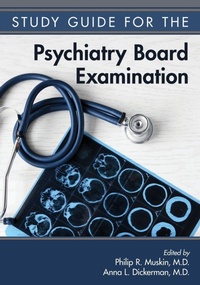
Study Guide for the Psychiatry Board Examination
Published on 12. June 2016
Book
Paperback/Softback
498 pages
978-1-61537-033-7 (ISBN)
Description
Psychiatrists and residents are faced with the
important-but what may feel overwhelming-task of refreshing their knowledge
of the whole of psychiatric practice, typically while remaining engaged in
full-time clinical activity. Psychiatrists will find the logical structure,
substantive questions, and thorough explanations provided by the Study
Guide for the Psychiatry Board Examination to be as reassuring as
they are educational. Although readers are advised to consult a range of
resources in preparation for the examination, this guide is indispensable.
It is the first and only guide to reflect the revisions contained in DSM-5,
and it will ably assume a primary role in the study and review process.
The guide is designed for maximum usefulness, with specific features
and attributes to support knowledge recall and successful examination performance.
* The authors are from a cross-section of accomplished students,
fellows, and junior and senior faculty, all of whom have faced or will face
the board examination and who understand its importance to the
profession.
* Topics were determined by the American Board of Psychiatry
and Neurology Certification Examination in Psychiatry 2015 Content
Blueprint.
* The approximately 400 questions were formulated from
information extracted from widely available American Psychiatric Publishing
textbooks and accurately reflect the accepted psychiatric knowledge
base.
* Each multiple choice question is followed by an explanation of
why the correct answer is correct and the others are incorrect, and every
question and explanation is referenced, directing the reader to the primary
material for more in-depth learning and study.
* The volume was designed
as a study guide for both the initial psychiatry board examination and the
recertification examination.
The process of working through the study
guide will allow the reader to identify areas of strength and weakness,
initiate further study, and test and retest knowledge, ultimately preparing
for the examination's rigors. Only the Study Guide for the Psychiatry
Board Examination offers support for the new, DSM-5-compatible
examination, and that alone renders it essential.
important-but what may feel overwhelming-task of refreshing their knowledge
of the whole of psychiatric practice, typically while remaining engaged in
full-time clinical activity. Psychiatrists will find the logical structure,
substantive questions, and thorough explanations provided by the Study
Guide for the Psychiatry Board Examination to be as reassuring as
they are educational. Although readers are advised to consult a range of
resources in preparation for the examination, this guide is indispensable.
It is the first and only guide to reflect the revisions contained in DSM-5,
and it will ably assume a primary role in the study and review process.
The guide is designed for maximum usefulness, with specific features
and attributes to support knowledge recall and successful examination performance.
* The authors are from a cross-section of accomplished students,
fellows, and junior and senior faculty, all of whom have faced or will face
the board examination and who understand its importance to the
profession.
* Topics were determined by the American Board of Psychiatry
and Neurology Certification Examination in Psychiatry 2015 Content
Blueprint.
* The approximately 400 questions were formulated from
information extracted from widely available American Psychiatric Publishing
textbooks and accurately reflect the accepted psychiatric knowledge
base.
* Each multiple choice question is followed by an explanation of
why the correct answer is correct and the others are incorrect, and every
question and explanation is referenced, directing the reader to the primary
material for more in-depth learning and study.
* The volume was designed
as a study guide for both the initial psychiatry board examination and the
recertification examination.
The process of working through the study
guide will allow the reader to identify areas of strength and weakness,
initiate further study, and test and retest knowledge, ultimately preparing
for the examination's rigors. Only the Study Guide for the Psychiatry
Board Examination offers support for the new, DSM-5-compatible
examination, and that alone renders it essential.
More details
Language
English
Place of publication
VA
United States
Target group
Professional and scholarly
US School Grade: College Graduate Student and over
Product notice
Paperback (trade)
Illustrations
2 Tables, unspecified
Dimensions
Height: 254 mm
Width: 178 mm
Thickness: 25 mm
Weight
853 gr
ISBN-13
978-1-61537-033-7 (9781615370337)
Copyright in bibliographic data and cover images is held by Nielsen Book Services Limited or by the publishers or by their respective licensors: all rights reserved.
Schweitzer Classification
Other editions
Additional editions
Philip R. Muskin | Anna L. Dickerman
The American Psychiatric Publishing Board Review Guide for Psychiatry
E-Book
04/2016
1st Edition
American Psychiatric Association Publishing
€72.49
Available for download
Previous edition

James A. Bourgeois | Robert E. Hales | Julie S. Young
The American Psychiatric Publishing Board Review Guide for Psychiatry
Book
05/2009
American Psychiatric Association Publishing
€153.01
Article exhausted; check for reprint
Persons
Philip R. Muskin, M.D., is Professor of Psychiatry
at Columbia University Medical Center, Chief of Consultation-Liaison
Psychiatry at New York-Presbyterian Hospital/Columbia Campus, and on the
Faculty of Columbia University Center for Psychoanalytic Training and
Research in New York, New York.
Anna L. Dickerman, M.D., is
Assistant Professor of Clinical Psychiatry at Weill Cornell Medical College
and an Assistant Attending Psychiatrist, Psychiatry Consultation-Liaison
Service at New York-Presbyterian Hospital/Weil Cornell Medical Center, New
York, New York.
at Columbia University Medical Center, Chief of Consultation-Liaison
Psychiatry at New York-Presbyterian Hospital/Columbia Campus, and on the
Faculty of Columbia University Center for Psychoanalytic Training and
Research in New York, New York.
Anna L. Dickerman, M.D., is
Assistant Professor of Clinical Psychiatry at Weill Cornell Medical College
and an Assistant Attending Psychiatrist, Psychiatry Consultation-Liaison
Service at New York-Presbyterian Hospital/Weil Cornell Medical Center, New
York, New York.
Content
Contributors
Preface
Part I: Questions
Chapter
1. Anthropology/Sociology/Ethology/Psychology
Chapter 2. Anxiety
Disorders
Chapter 3. Bipolar Disorders
Chapter 4.
Dangerousness
Chapter 5. Depressive Disorders
Chapter 6.
Development: Adulthood
Chapter 7. Development: Infancy Through
Adolescence
Chapter 8. Developmental Issues in Older Adults
Chapter
9. Diagnostic Procedures
Chapter 10. Disruptive Behavior
Disorders
Chapter 11. Dissociative Disorders
Chapter 12. Elimination
Disorders
Chapter 13. Epidemiology and Public Policy: Health Care
Economics/Public Policy Issues
Chapter 14. Feeding and Eating
Disorders
Chapter 15. Law
Chapter 16. Mental Status
Chapter 17.
Neurocognitive Disorders
Chapter 18. Neurodevelopmental
Disorders
Chapter 19. Nonpharmacological Somatic Treatments
Chapter
20. Obsessive-Compulsive and Related Disorders
Chapter 21. Paraphilic
Disorders
Chapter 22. Personality Disorders
Chapter 23. Principles
of Psychopharmacology
Chapter 24. Professionalism
Chapter 25.
Psychiatric Consultation
Chapter 26. Psychiatric Interview
Chapter
27. Psychoanalysis
Chapter 28. Psychological Testing
Chapter 29.
Psychopharmacology
Chapter 30. Psychosocial Interventions
Chapter
31. Psychotherapies
Chapter 32. Research/Biostatistics
Chapter 33.
Schizophrenia Spectrum and Other Psychotic Disorders
Chapter 34. Sexual
Dysfunction/Gender Dysphoria
Chapter 35. Sleep-Wake
Disorders
Chapter 36. Somatic Symptom and Related Disorders
Chapter
37. Special Topics: Seclusion/Risk Management/Abuse and Neglect
Chapter
38. Spirituality
Chapter 39. Substance-Related and Addictive
Disorders
Chapter 40. Suicidality
Chapter 41. Trauma- and
Stressor-Related Disorders
Part II: Answer Guide
Preface
Part I: Questions
Chapter
1. Anthropology/Sociology/Ethology/Psychology
Chapter 2. Anxiety
Disorders
Chapter 3. Bipolar Disorders
Chapter 4.
Dangerousness
Chapter 5. Depressive Disorders
Chapter 6.
Development: Adulthood
Chapter 7. Development: Infancy Through
Adolescence
Chapter 8. Developmental Issues in Older Adults
Chapter
9. Diagnostic Procedures
Chapter 10. Disruptive Behavior
Disorders
Chapter 11. Dissociative Disorders
Chapter 12. Elimination
Disorders
Chapter 13. Epidemiology and Public Policy: Health Care
Economics/Public Policy Issues
Chapter 14. Feeding and Eating
Disorders
Chapter 15. Law
Chapter 16. Mental Status
Chapter 17.
Neurocognitive Disorders
Chapter 18. Neurodevelopmental
Disorders
Chapter 19. Nonpharmacological Somatic Treatments
Chapter
20. Obsessive-Compulsive and Related Disorders
Chapter 21. Paraphilic
Disorders
Chapter 22. Personality Disorders
Chapter 23. Principles
of Psychopharmacology
Chapter 24. Professionalism
Chapter 25.
Psychiatric Consultation
Chapter 26. Psychiatric Interview
Chapter
27. Psychoanalysis
Chapter 28. Psychological Testing
Chapter 29.
Psychopharmacology
Chapter 30. Psychosocial Interventions
Chapter
31. Psychotherapies
Chapter 32. Research/Biostatistics
Chapter 33.
Schizophrenia Spectrum and Other Psychotic Disorders
Chapter 34. Sexual
Dysfunction/Gender Dysphoria
Chapter 35. Sleep-Wake
Disorders
Chapter 36. Somatic Symptom and Related Disorders
Chapter
37. Special Topics: Seclusion/Risk Management/Abuse and Neglect
Chapter
38. Spirituality
Chapter 39. Substance-Related and Addictive
Disorders
Chapter 40. Suicidality
Chapter 41. Trauma- and
Stressor-Related Disorders
Part II: Answer Guide