

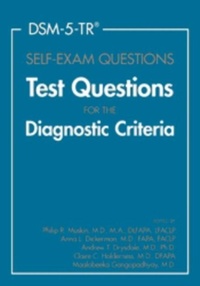
DSM-5-TR (R) Self-Exam Questions
Test Questions for the Diagnostic Criteria
Published on 2. December 2023
Book
Paperback/Softback
488 pages
978-1-61537-509-7 (ISBN)
Description
DSM-5-TR Self-Exam Questions: Test Questions for the
Diagnostic Criteria elucidates the Diagnostic and Statistical
Manual of Mental Disorders, Fifth Edition, Text Revision, through
self-exam questions designed to test the reader's knowledge of the new
edition's diagnostic criteria. Mental health professionals, ranging from
clinicians and students to psychiatric nurses and social workers, will
benefit from this substantive text's 400-plus questions. This book is a
"must have" for anyone seeking to fully understand the content of DSM-5-TR.
Some of the book's most beneficial features include the following:
* Self-exam questions and cases designed to test the reader's
knowledge of diagnoses and diagnostic criteria (e.g., the new diagnosis,
prolonged grief disorder).
* Questions about selected conceptual
components of Section III in DSM-5-TR-including the online assessment
measures, Cultural Formulation Interview, and alternative model of
personality disorders-enabling readers to learn about important diagnostic
considerations and tools, as well as potential future diagnostic
approaches.
* Short answers that explain the rationale for each correct
answer, with page references to content in DSM-5-TR for further
information.
* Answers containing important information on the
diagnostic classification, criteria sets, diagnoses, codes, severity,
dimension of diagnosis, and considerations of culture, age, and gender.
Straightforward, practical, and illustrative, DSM-5-TR Self-Exam
Questions: Test Questions for the Diagnostic Criteria will
successfully test and broaden the DSM-5-TR knowledge of all mental health
professionals.
Diagnostic Criteria elucidates the Diagnostic and Statistical
Manual of Mental Disorders, Fifth Edition, Text Revision, through
self-exam questions designed to test the reader's knowledge of the new
edition's diagnostic criteria. Mental health professionals, ranging from
clinicians and students to psychiatric nurses and social workers, will
benefit from this substantive text's 400-plus questions. This book is a
"must have" for anyone seeking to fully understand the content of DSM-5-TR.
Some of the book's most beneficial features include the following:
* Self-exam questions and cases designed to test the reader's
knowledge of diagnoses and diagnostic criteria (e.g., the new diagnosis,
prolonged grief disorder).
* Questions about selected conceptual
components of Section III in DSM-5-TR-including the online assessment
measures, Cultural Formulation Interview, and alternative model of
personality disorders-enabling readers to learn about important diagnostic
considerations and tools, as well as potential future diagnostic
approaches.
* Short answers that explain the rationale for each correct
answer, with page references to content in DSM-5-TR for further
information.
* Answers containing important information on the
diagnostic classification, criteria sets, diagnoses, codes, severity,
dimension of diagnosis, and considerations of culture, age, and gender.
Straightforward, practical, and illustrative, DSM-5-TR Self-Exam
Questions: Test Questions for the Diagnostic Criteria will
successfully test and broaden the DSM-5-TR knowledge of all mental health
professionals.
Reviews / Votes
The DSM is arguably the most influential book forcategorical diagnosis in psychiatry, and this book is an excellent companion
that allows one to challenge oneself to understand the intricacies in its
diagnostic structure. As opposed to just reading the DSM itself and
understanding it from an academic perspective, this companion challenges
readers to apply DSM categorization to common vignettes to understand
differential criteria. This book would be a worthy addition to the bookshelf
of a broad audience, right next to their copy of the DSM-5-TR. This updated
edition certainly justifies replacing the previous edition; the DSM-5-TR
changes with the times, and as such its companion books must as well. Not
only does it update the diagnoses, but it also has questions that
specifically focus on differences between older editions and the current
edition. -- John Frederick, MD * Doody *
More details
Language
English
Place of publication
VA
United States
Target group
Professional and scholarly
US School Grade: College Graduate Student and over
Product notice
Paperback (trade)
Illustrations
Not illustrated
Dimensions
Height: 179 mm
Width: 257 mm
Thickness: 24 mm
Weight
850 gr
ISBN-13
978-1-61537-509-7 (9781615375097)
Copyright in bibliographic data and cover images is held by Nielsen Book Services Limited or by the publishers or by their respective licensors: all rights reserved.
Schweitzer Classification
Other editions
Additional editions
Maalobeeka Gangopadhyay | Philip R. Muskin | Anna L. Dickerman
DSM-5-TR® Self-Exam Questions
Test Questions for the Diagnostic Criteria
E-Book
10/2023
American Psychiatric Association Publishing
€58.99
Available for download
Persons
Philip R. Muskin, M.D., M.A., DLFAPA, LFACLP, is
Professor of Psychiatry and Senior
Consultant in Consultation-Liaison
Psychiatry at Columbia University Irving Medical Center
in New
York.
Anna L. Dickerman, M.D., FAPA, FACLP, is Chief,
Consultation-Liaison Psychiatry Service,
Program Director,
Consultation-Liaison Psychiatry Fellowship; Associate
Attending
Psychiatrist at New York-Presbyterian Hospital; and Associate
Professor of Clinical Psychiatry
at Weill Cornell Medical College in New
York.
Andrew T. Drysdale, M.D., Ph.D., is Assistant in
Clinical, Department of Psychiatry, at
Columbia University Irving
Medical Center; Postdoctoral Clinical Fellow, Department of
Psychiatry,
at Columbia University Irving Medical Center; and Fellow at New York
State
Psychiatric Institute/Columbia University in New
York.
Claire C. Holderness, M.D., DFAPA, is Associate
Clinical Professor of Psychiatry at Columbia
University Vagelos College
of Physicians and Surgeons and Attending Psychiatrist
at New York State
Psychiatric Institute in New York.
Maalobeeka Gangopadhyay, M.D.,
is Associate Professor of Psychiatry at Columbia
University Irving
Medical Center; Director of Acute Services, Child and
Adolescent
Psychiatry, at New York-Presbyterian Morgan Stanley
Children's Hospital; and Medical
Director, Quality and Patient Safety
NYP-Columbia, Department of Psychiatry, at New
York-Presbyterian in New
York.
Professor of Psychiatry and Senior
Consultant in Consultation-Liaison
Psychiatry at Columbia University Irving Medical Center
in New
York.
Anna L. Dickerman, M.D., FAPA, FACLP, is Chief,
Consultation-Liaison Psychiatry Service,
Program Director,
Consultation-Liaison Psychiatry Fellowship; Associate
Attending
Psychiatrist at New York-Presbyterian Hospital; and Associate
Professor of Clinical Psychiatry
at Weill Cornell Medical College in New
York.
Andrew T. Drysdale, M.D., Ph.D., is Assistant in
Clinical, Department of Psychiatry, at
Columbia University Irving
Medical Center; Postdoctoral Clinical Fellow, Department of
Psychiatry,
at Columbia University Irving Medical Center; and Fellow at New York
State
Psychiatric Institute/Columbia University in New
York.
Claire C. Holderness, M.D., DFAPA, is Associate
Clinical Professor of Psychiatry at Columbia
University Vagelos College
of Physicians and Surgeons and Attending Psychiatrist
at New York State
Psychiatric Institute in New York.
Maalobeeka Gangopadhyay, M.D.,
is Associate Professor of Psychiatry at Columbia
University Irving
Medical Center; Director of Acute Services, Child and
Adolescent
Psychiatry, at New York-Presbyterian Morgan Stanley
Children's Hospital; and Medical
Director, Quality and Patient Safety
NYP-Columbia, Department of Psychiatry, at New
York-Presbyterian in New
York.
Content
Preface
Chapter 1. Neurodevelopmental Disorders
Chapter 2. Schizophrenia Spectrum and Other Psychiatric Disorders
Chapter 3. Bipolar and Related Disorders
Chapter 4. Depressive
Disorders
Chapter 5. Anxiety Disorders
Chapter 6.
Obsessive-Compulsive and Related Disorders
Chapter 7. Trauma- and
Stressor-Related Disorders
Chapter 8. Dissociative Disorders
Chapter 9. Somatic Symptom and Related Disorders
Chapter 10.
Feeding and Eating Disorders
Chapter 11. Elimination Disorders
Chapter 12. Sleep-Wake Disorders
Chapter 13. Sexual Dysfunctions
Chapter 14. Gender Dysphoria
Chapter 15. Disruptive,
Impulse-Control, and Conduct Disorders
Chapter 16. Substance-Related
and Addictive Disorders
Chapter 17. Neurocognitive Disorders
Chapter 18. Personality Disorders
Chapter 19. Paraphilic Disorders
Chapter 20. Medication-Induced Movement Disorders
Chapter 21.
Assessment Measures
Chapter 22. Culture and Psychiatric Diagnosis
(DSM-5-TR Section III)
Chapter 23. Alternative DSM-5 Model for
Personality Disorders (DSM-5 Section III)
Chapter 1. Neurodevelopmental Disorders
Chapter 2. Schizophrenia Spectrum and Other Psychiatric Disorders
Chapter 3. Bipolar and Related Disorders
Chapter 4. Depressive
Disorders
Chapter 5. Anxiety Disorders
Chapter 6.
Obsessive-Compulsive and Related Disorders
Chapter 7. Trauma- and
Stressor-Related Disorders
Chapter 8. Dissociative Disorders
Chapter 9. Somatic Symptom and Related Disorders
Chapter 10.
Feeding and Eating Disorders
Chapter 11. Elimination Disorders
Chapter 12. Sleep-Wake Disorders
Chapter 13. Sexual Dysfunctions
Chapter 14. Gender Dysphoria
Chapter 15. Disruptive,
Impulse-Control, and Conduct Disorders
Chapter 16. Substance-Related
and Addictive Disorders
Chapter 17. Neurocognitive Disorders
Chapter 18. Personality Disorders
Chapter 19. Paraphilic Disorders
Chapter 20. Medication-Induced Movement Disorders
Chapter 21.
Assessment Measures
Chapter 22. Culture and Psychiatric Diagnosis
(DSM-5-TR Section III)
Chapter 23. Alternative DSM-5 Model for
Personality Disorders (DSM-5 Section III)