

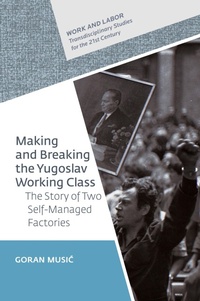
Making and Breaking the Yugoslav Working Class
The Story of Two Self-Managed Factories
Published on 30. April 2021
Book
Hardback
288 pages
978-963-386-339-8 (ISBN)
Description
Workers' self-management was one of the unique features of communist Yugoslavia. Goran Music has investigated the changing ways in which blue-collar workers perceived the recurring crises of the regime. Two self-managed metal enterprises, one in Serbia another in Slovenia, provide the frame of the analysis in the time span between 1945 and 1989. These two factories became famous for strikes in 1988 that evoked echoes in popular discourses in former Yugoslavia. Drawing on interviews, factory publications and other media, local archives, and secondary literature, Music analyzes the two cases, going beyond the cliches of political manipulation from the top and workers' intrinsic attraction to nationalism.
The author explains how, in the later phase of communist Yugoslavia, growing social inequalities among the workers and undemocratic practices inside the self-managed enterprises facilitated the spread of a nationalist and pro-market ideology on the shop floors. Yet rather than being a mass taken advantage of by populist leaders, the working class Music presents is one with agency and voice, a force that played an important role in shaping the fate of the country. The book thus seeks to open a debate on the social processes leading up to the dissolution of Yugoslavia.
The author explains how, in the later phase of communist Yugoslavia, growing social inequalities among the workers and undemocratic practices inside the self-managed enterprises facilitated the spread of a nationalist and pro-market ideology on the shop floors. Yet rather than being a mass taken advantage of by populist leaders, the working class Music presents is one with agency and voice, a force that played an important role in shaping the fate of the country. The book thus seeks to open a debate on the social processes leading up to the dissolution of Yugoslavia.
Reviews / Votes
"As Music describes, workers act through the shifting alliances between factory management, the party apex, and their own occupational communities-which are themselves segmented according to age, skill, gender, and origin. The result is a dense and lucid analysis that pays equal attention to the institutional changes, class relations, and the shifting common sense that framed Yugoslavia's labor politics from 1945 until 1990. Music's book is one of the most important recent contributions to the study of the political and moral economy of socialist Yugoslavia. It will shape discussions on class agency, hegemonic liberalism, and distributional conflicts in Southeastern Europe and beyond for years to come."https://www.degruyter.com/document/doi/10.1515/soeu-2021-0084/html -- Ivan Rajkovic * Comparative Southeast European Studies * "Brilliantly pedagogical in explaining self-management as theory and as practice, even to the freshest of beginners in economic history and theory, this book is an important puzzle piece for furthering our understanding of the dissolution of Socialist Yugoslavia, Music's work brings an innovative outlook from the very factory shopfloors, bringing the subjectivity back to the working classes and taking up the factory as level of analysis." -- Milica Popovic * Croatian Political Science Review * "Das vorliegende Buch ist nicht nur hoechst interessant und informativ, sondern auch konzeptionell ueberzeugend. Music hat ein in vielerlei Hinsicht wegweisendes Buch vorgelegt, das ein kraeftiges Plaedoyer fuer die Integration der 'Arbeiterklasse' in die Geschichte Jugoslawiens - und gerade auch seines Zerfalls - ist, und zwar nicht nur als Opfer, sondern auch Akteur dieser Geschichte." -- Ulf Brunnbauer * Suedost-Forschungen * "The book has a balanced understanding of change as an interaction between structure and agency, where neither has a negligible role. The author shows how the effective abandonment of the Yugoslav working class by the socialist regime's policies foreshadowed the social inequalities in the successor postsocialist states."
https://www.tandfonline.com/share/CTHFEAVHVIEGXQDABMV4?target=10.1080/09668136.2023.2266290 -- Menta Mora * Europe-Asia Studies * "L'ouvrage de Goran Music constitue donc une contribution importante a la comprehension de l'autogestion yougoslave dans l'entreprise, de son fonctionnement et de ses dysfonctionnements. L'ouvrage de Goran Music montre la persistance du pouvoir des directeurs d'entreprise et des cols blancs, ou l'eloignement des conseillers elus de leur base ouvriere. Mais il insiste aussi sur la maniere dont l'autogestion dissout l'unite de la classe ouvriere et favorise les corporatismes d'entreprise, qui peuvent alimenter a leur tour des recriminations de type nationaliste."
https://journals.openedition.org/balkanologie/4694 -- Xavier Bougarel * Balkanologie * "Goran Music hat ein umfangreiches und beeindruckendes Werk vorgelegt, dass mit scharfen Analysen unter anderem die Konkurrenz zwischen Unternehmen sowie die daraus mangelnde Solidaritaet unter Arbeiter:innen unterschiedlicher Betriebe herausarbeitet. Er zeigt auch, dass die Strukturen der Selbstverwaltung keine Organisationsformen fuer den Ausdruck ihrer Unzufriedenheit boten; der Streik wurde jenseits dieser Gremien organisiert. Dabei beweist er auch immer Talent fuer spannende Erzaehlungen und die Auswahl anschaulicher Interviewzitate." Mirjam Baumert https://kritisch-lesen.de/rezension/unruhe-in-der-selbstverwaltung -- Mirjam Baumert, kritisch-lesen.de
More details
Series
Language
English
Place of publication
Oxford
Hungary
Target group
Professional and scholarly
Academic
Product notice
sewn/stitched
Cloth over boards
Dimensions
Height: 235 mm
Width: 157 mm
Thickness: 20 mm
Weight
574 gr
ISBN-13
978-963-386-339-8 (9789633863398)
Copyright in bibliographic data and cover images is held by Nielsen Book Services Limited or by the publishers or by their respective licensors: all rights reserved.
Schweitzer Classification
Other editions
Additional editions
E-Book
03/2021
Central European University Press
€80.49
Available for download
Person
Goran Music is a research fellow at the Research Platform for the Study of Transformations and Eastern Europe, University of Vienna.
Content
Figures and Tables
Abbreviations
Acknowledgments
Introduction
Unfulfilled Expectations
Mighty Elites and Subservient Workers
(Re)Discovering Labor
Approaching Class and Nation in a Yugoslav Factory
Sources and Chapter Overview
Chapter 1. Two Roads to Self-managing Socialism
Two Blue-Collar Communities
Differing Origins
"Factories to the Workers"
Market Socialism
Losing Factory Unity
Chapter 2. Factory Structures and Everyday Life under Associated Labor
Reviving Revolution through Normative Acts
The More Things Change
Claiming Tito
The Factory as a Collective
Chapter 3. Shades of Blue-collar Workers
Proletariat in the Making
Who Creates Value?
Skill, Gender, and Place of Origin
Veterans and the Youth
Appendix 1
Chapter 4. The Dragging Crisis, 1979-1986
The Sudden Breakdown
The Party at an Impasse
TAM's Pushback of Associated Labor
IMR Tries to Catch Up
Chapter 5. Breaking the Pact: Workers, Liberals, and Nationalists against the Status Quo
Cutting out the Middlemen
The Stolen Golden Apples
The Diligent Ones
Appendix 2
Chapter 6. Mobilizations at the Bottom-Realignments at the Top, 1986-1988
Reaching Beyond the Factory Gates
A "Firm Hand" Inside Serbia
Bypassing the Working Class in Slovenia
Beggar Thy Neighbor
Chapter 7. Workers in the Streets
Two Outlets in Rakovica
Deus Ex Machina
Maribor's Blue-Collar Wrath
Post Festum
Conclusion
The Unsettled Working Class
Liberal and Collectivist Self-Management
In Search of Allies and Enemies
Unanticipated Changes
Bibliography
Index
Abbreviations
Acknowledgments
Introduction
Unfulfilled Expectations
Mighty Elites and Subservient Workers
(Re)Discovering Labor
Approaching Class and Nation in a Yugoslav Factory
Sources and Chapter Overview
Chapter 1. Two Roads to Self-managing Socialism
Two Blue-Collar Communities
Differing Origins
"Factories to the Workers"
Market Socialism
Losing Factory Unity
Chapter 2. Factory Structures and Everyday Life under Associated Labor
Reviving Revolution through Normative Acts
The More Things Change
Claiming Tito
The Factory as a Collective
Chapter 3. Shades of Blue-collar Workers
Proletariat in the Making
Who Creates Value?
Skill, Gender, and Place of Origin
Veterans and the Youth
Appendix 1
Chapter 4. The Dragging Crisis, 1979-1986
The Sudden Breakdown
The Party at an Impasse
TAM's Pushback of Associated Labor
IMR Tries to Catch Up
Chapter 5. Breaking the Pact: Workers, Liberals, and Nationalists against the Status Quo
Cutting out the Middlemen
The Stolen Golden Apples
The Diligent Ones
Appendix 2
Chapter 6. Mobilizations at the Bottom-Realignments at the Top, 1986-1988
Reaching Beyond the Factory Gates
A "Firm Hand" Inside Serbia
Bypassing the Working Class in Slovenia
Beggar Thy Neighbor
Chapter 7. Workers in the Streets
Two Outlets in Rakovica
Deus Ex Machina
Maribor's Blue-Collar Wrath
Post Festum
Conclusion
The Unsettled Working Class
Liberal and Collectivist Self-Management
In Search of Allies and Enemies
Unanticipated Changes
Bibliography
Index