

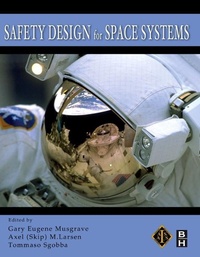
Safety Design for Space Systems
Published on 22. April 2009
Book
Hardback
992 pages
978-0-7506-8580-1 (ISBN)
Description
Progress in space safety lies in the acceptance of safety design and engineering as an integral part of the design and implementation process for new space systems. Safety must be seen as the principle design driver of utmost importance from the outset of the design process, which is only achieved through a culture change that moves all stakeholders toward front-end loaded safety concepts. This approach entails a common understanding and mastering of basic principles of safety design for space systems at all levels of the program organisation. Fully supported by the International Association for the Advancement of Space Safety (IAASS), written by the leading figures in the industry, with frontline experience from projects ranging from the Apollo missions, Skylab, the Space Shuttle and the International Space Station, this book provides a comprehensive reference for aerospace engineers in industry. It addresses each of the key elements that impact on space systems safety, including: the space environment (natural and induced); human physiology in space; human rating factors; emergency capabilities; launch propellants and oxidizer systems; life support systems; battery and fuel cell safety; nuclear power generators (NPG) safety; habitat activities; fire protection; safety-critical software development; collision avoidance systems design; operations and on-orbit maintenance.
More details
Language
English
Place of publication
Oxford
United Kingdom
Publishing group
Elsevier Science & Technology
Target group
Professional and scholarly
Aerospace engineers in industry, space agencies and consulting firms, and also be suitable for use as a reference for senior and graduate level courses. In terms of sales the market is expected to be aerospace and high technology companies, space agencies, consulting firms and the academic market in that order of importance
Product notice
sewn/stitched
Paper over boards
Dimensions
Height: 244 mm
Width: 200 mm
Thickness: 45 mm
Weight
2102 gr
ISBN-13
978-0-7506-8580-1 (9780750685801)
Copyright in bibliographic data and cover images is held by Nielsen Book Services Limited or by the publishers or by their respective licensors: all rights reserved.
Schweitzer Classification
Other editions
New editions
Tommaso Sgobba | Gary Eugene Musgrave | Gary Johnson
Safety Design for Space Systems
Book
08/2023
2nd Edition
Butterworth-Heinemann
€158.50
Shipment within 15-20 days
Additional editions
Gary Eugene Musgrave | Axel Larsen | Tommaso Sgobba
Safety Design for Space Systems
E-Book
03/2009
Butterworth-Heinemann
€175.00
Available for download
Persons
Dr. Gary Eugene Musgrave received his undergraduate training at Auburn University, where he received the Baccalaureate in Biological Sciences in 1969, and at the Georgia Institute of Technology, where he studied Electrical Engineering from 1971 until 1973. He received his graduate education at Auburn University, receiving the Master of Science in the field of Pharmacology/Toxicology from the School of Pharmacy in 1976, and the Doctor of Philosophy in the fields of Cardiovascular Physiology and Autonomic Neuropharmacology from the School of Veterinary Medicine in 1979. After completing his postdoctoral research, Dr. Musgrave was appointed Research Assistant Professor in the Department of Medicine at the Medical College of Virginia where he was Co-Investigator and the Engineering Project Director for a NASA sponsored investigation of the baroreflex regulation of blood pressure in astronauts during and after missions in space. This experiment ultimately was flown on the Spacelab "Space Life Sciences-1? mission. In 1982, Dr. Musgrave joined the NASA team at the Johnson Space Center in Houston, Texas, as an employee of the Management and Technical Services Company (MATSCO), a subsidiary of the General Electric Corporation, as the contractor manager for NASA's Detailed Science Objective Program, where he was responsible for the development, certification, testing, and flight support for numerous items of medical hardware flown on various Space Shuttle missions. Dr. Musgrave retired from NASA during 2008 and presently resides in Tennessee, where he works as a consultant and educator. He is a member of the International Association for the Advancement of Space Safety, and its Academic Committee, and is Chief Editor of the 1st edition of Safety Design for Space Systems. Tommaso Sgobba is Executive Director and Board Secretary of IAASS (International Association for the Advancement of Space Safety). Tommaso Sgobba has been IAASS first President in the period 2005-2013. Until June 2013 Tommaso Sgobba has been responsible for flight safety at the European Space Agency (ESA), including human-rated systems, spacecraft re-entries, space debris, use of nuclear power sources, and planetary protection. He joined the European Space Agency in 1989, after 13 years in the aeronautical industry. Initially he supported the developments of the Ariane 5 launcher, several earth observation and meteorological satellites, and the early phase of the European Hermes spaceplane. Later he became _Product Assurance and Safety Manager for all European manned missions on Shuttle, MIR station, and for the European research facilities of the International Space Station. He chaired for 10 years the ESA ISS Payload Safety Review Panel. He was also instrumental in setting up the ESA Re-entry Safety Review Panel. Tommaso Sgobba holds an M.S. in Aeronautical Engineering from the Polytechnic of Turin (Italy), where he was also professor of space system safety (1999-2001). He has published several articles and papers on space safety, and co-edited the text book "Safety Design for Space Systems?, published in 2009 by Elsevier, that was also published later in Chinese. He was the Editor-in-Chief of the books "Safety Design for Space Operations? (2013) and "Space Safety and Human Performance? (2017) also published by Elsevier. He is Managing Editor of the Journal of Space Safety Engineering and member of the editorial board of the Space Safety Magazine. Tommaso Sgobba is the inventor (patent pending) of the R-DBAS (Re-entry, Direct Broadcasting Alert System), to alert the air traffic of falling fragments from uncontrolled space system re-entry. Tommaso Sgobba received the NASA recognition for outstanding contribution to the International Space Station in 2004, and the prestigious NASA Space Flight Awareness (SFA) Award in 2007.
Content
1 Introduction to Space Safety2 The Space Environment: Natural and Induced3 Overview of Bioastronautics4 Basic Principles of Space Safety5 Human-Rating Concepts6 Life-Support Systems Safety7 Emergency Systems8 Collision Avoidance Systems9 Robotic-Systems Safety10 Meteoroid and Debris Protection11 Noise-Control Design12 Materials Safety13 Oxygen-Systems Safety14 Avionics Safety15 Software-System Safety16 Battery Safety17 Mechanical-Systems Safety18 Containment of Hazardous Materials19 Failure-Tolerance Design20 Propellant-Systems Safety21 Pyrotechnic Safety22 Extravehicular-Activity Safety23 Emergency, Caution, and Warning System24 Laser Safety25 Crew Training Safety: An Integrated Process26 Safety Considerations in the Ground Environment27 Fire Safety28 Safe-without-Services Design29 Probabilistic Risk Assessment with Emphasis on Design