

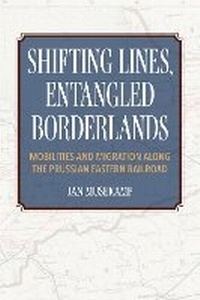
Shifting Lines, Entangled Borderlands
Mobilities and Migration Along the Prussian Eastern Railroad
Published on 5. March 2024
Book
Paperback/Softback
314 pages
978-0-253-06892-7 (ISBN)
Description
Tracing multiple mobilities, entangled borderlands, microhistory and space, and human and nonhuman actors, Jan Musekamp demonstrates how an inner-Prussian railroad line turned into a transnational force, overcoming borders and connecting Europeans in a time of rising nationalism.
Shifting Lines, Entangled Borderlands investigates the dichotomy between a globalizing world and tighter border control in nineteenth-century Central and Eastern Europe, focusing on the Royal Prussian Eastern Railroad (Ostbahn) between the 1830s and 1930s. The line was initially planned as a major internal modernizing project to connect Prussia's capital of Berlin to East Prussia's provincial capital of Koenigsberg (today's Kaliningrad). Soon, the Ostbahn connected to the growing Imperial Russian railroad network, thus becoming a backbone of European East-West transportation in trade, tourism, technological exchange, and migration. The First World War temporarily disrupted and reconfigured existing networks, adapting them to new political regimes and borders. However, World War II and its aftermath altered mobility patterns more permanently, dividing not only the Ostbahn tracks but the whole continent for decades to come.
From border towns and major cities to unique structures, such as stations or bridges, this volume analyzes the obvious and not-so-obvious nodes of the Central and Eastern European rail network-and the spaces in between.
Shifting Lines, Entangled Borderlands investigates the dichotomy between a globalizing world and tighter border control in nineteenth-century Central and Eastern Europe, focusing on the Royal Prussian Eastern Railroad (Ostbahn) between the 1830s and 1930s. The line was initially planned as a major internal modernizing project to connect Prussia's capital of Berlin to East Prussia's provincial capital of Koenigsberg (today's Kaliningrad). Soon, the Ostbahn connected to the growing Imperial Russian railroad network, thus becoming a backbone of European East-West transportation in trade, tourism, technological exchange, and migration. The First World War temporarily disrupted and reconfigured existing networks, adapting them to new political regimes and borders. However, World War II and its aftermath altered mobility patterns more permanently, dividing not only the Ostbahn tracks but the whole continent for decades to come.
From border towns and major cities to unique structures, such as stations or bridges, this volume analyzes the obvious and not-so-obvious nodes of the Central and Eastern European rail network-and the spaces in between.
Reviews / Votes
"Jan Musekamp skillfully tells the fascinating story of a multidimensional transportation corridor created by the railroad. He shows how technical revolution, railroad construction, and nation-state formation led to the industrialization of time and the production of a larger European space. He explains the transformation of the borderlands, the significance of trade and commerce, and how the architecture of railroad bridges combined international engineering know-how with the desire to advance certain historical narratives. The book highlights the dual nature of the railroad as a vehicle for social mobility and military mobilization, and the railroad's contribution to the expansion of transatlantic migration and the rise of modern mass tourism. In sum, this masterful book accomplishes nothing less than capturing the creation of a multidimensional space in Europe - a space that would be ruined in the catastrophes of the twentieth century."-Karl Schloegel, author of The Soviet Century"Shifting Lines, Entangled Borderlands is an exemplary blending of the histories of transnationalism, nationalism, culture, technology, and mobility. Drawing on conventional historical sources in five different languages, rail schedules, architectural and engineering plans, tourist guidebooks, and the memoirs of famous and ordinary people, the book uses seemingly nondescript railway towns and structures to provide groundbreaking insights into the transit points where different sorts of people have crossed political and social boundaries in the past two centuries. It is a significant contribution to the history of transnational migration."-Timothy H. Parsons, coeditor of Mapping Migration, Identity, and Space
"This book is important for its multi-faceted analysis of the politics, economics, and cultural forces driving the crucial innovation in modern travel in the nineteenth century. Railroad funding, the iconography of stations and bridges, anti-Semitism and anti-Polish politics, and the price of lentils all play a role. Musekamp thus offers an extraordinary depth to the history of mobility, politics, economics, culture, and migration in northeastern Europe."-Leslie Page Moch, author of Moving Europeans
More details
Language
English
Place of publication
Bloomington, IN
United States
Target group
Professional and scholarly
Product notice
Paperback (trade)
Illustrations
33 b&w illus.
Dimensions
Height: 235 mm
Width: 156 mm
Weight
485 gr
ISBN-13
978-0-253-06892-7 (9780253068927)
Copyright in bibliographic data and cover images is held by Nielsen Book Services Limited or by the publishers or by their respective licensors: all rights reserved.
Schweitzer Classification
Other editions
Additional editions
Jan Musekamp
Shifting Lines, Entangled Borderlands
Mobilities and Migration along the Prussian Eastern Railroad
E-Book
03/2024
Indiana University Press
€38.99
Available for download
Person
Jan Musekamp is currently a Visiting Associate Professor at the University of Pittsburgh. He previously taught Eastern European History at the European University Viadrina in Frankfurt an der Oder, Germany. His first book focused on forced migrations and cultural appropriation in the Polish border city of Szczecin between 1945 and 2005. His most current research project deals with the global migrations of Ukraine's German speakers, unfolding in a time of drastically changing migration policies and shifting ideas of borders, race, and belonging.
Content
Dedication
Acknowledgments
Note on Transliteration, Place Names, Dates, and Administrative Units
Introduction: The Ostbahn and European Mobilities in the Railroad Age
1. Berlin and the Ostbahn: Railroads as Vehicles of Change
2. Aleksandrow: A Border Station at the Center of Imperial Power and Polish Nationalism
3. The Vistula Bridge at Dirschau (Tczew): National in Form, Transnational in Content
4. Eydtkuhnen and Verzhbolovo: International Travel and a Continental Divide
5. Koenigsberg: At the Intersection of Land- and Seaborne Trade
6. Kaunas-Eydtkuhnen-New York: Emigration Routes
7. The First World War and its Aftermath: Cutting Lines, Creating New Links
Epilogue: An Interrupted European Corridor
Glossary of Place and River Names in Different Languages
Bibliography
Index
Acknowledgments
Note on Transliteration, Place Names, Dates, and Administrative Units
Introduction: The Ostbahn and European Mobilities in the Railroad Age
1. Berlin and the Ostbahn: Railroads as Vehicles of Change
2. Aleksandrow: A Border Station at the Center of Imperial Power and Polish Nationalism
3. The Vistula Bridge at Dirschau (Tczew): National in Form, Transnational in Content
4. Eydtkuhnen and Verzhbolovo: International Travel and a Continental Divide
5. Koenigsberg: At the Intersection of Land- and Seaborne Trade
6. Kaunas-Eydtkuhnen-New York: Emigration Routes
7. The First World War and its Aftermath: Cutting Lines, Creating New Links
Epilogue: An Interrupted European Corridor
Glossary of Place and River Names in Different Languages
Bibliography
Index