

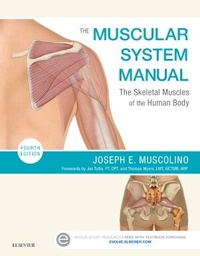
The Muscular System Manual
The Skeletal Muscles of the Human Body
4th Edition
Published on 15. March 2016
Book
Paperback/Softback
800 pages
978-0-323-32770-1 (ISBN)
Description
Joe Muscolino's The Muscular System Manual: The Skeletal Muscles of the Human Body, 4th Edition is an atlas of the muscles of the human body. This approachable, yet detailed, musculoskeletal anatomy manual provides both beginner and advanced students with a thorough understanding of skeletal muscles in a compartmentalized, customizable layout. Each muscle spread shows the individual muscle drawn over a photo of the human body, with an arrow to indicate the line of pull of the muscle, and explains: the muscle name, the origin of that name, Greek and Latin derivations, pronunciation, attachments, actions, eccentric contraction function, isometric contraction function, innervation to two levels of detail with predominant levels in bold, and arterial supply to two levels of detail. This new edition also features robust Evolve resources, an updated art program, and new chapter review and critical thinking questions that encourage you to apply what you have learned to prepare for practice.
UNIQUE! Overlay art, consisting of over 380 full-color anatomical illustrations of muscles, bones, and ligaments drawn over photographs, helps identify the positions of muscles and bones in the human body
UNIQUE! Electronic Muscle and Bone Review Program features a base photograph with a skeleton drawn in and a list of every muscle for each major region of the body so students can choose any combination of muscles and place them onto the illustration - allowing them to see not only the muscle attachments, but also the relationship among the muscles of the region
Complete muscle coverage in an easy-to-understand layout makes this text appropriate for novices to anatomy, as well as intermediate and advanced students
Content organized by body region and includes information on how muscles in that region function together and large drawings of the muscles of that region so you can go directly to the topic you are studying
Covers the methodology for each muscle with information for learning muscle actions to explain the reasoning behind each action - and encourage you to learn and not just memorize
A four-color, student-friendly design with sections clearly boxed throughout and checkboxes that help you keep track of what you need to learn and what you have mastered
Customizable format, with checkboxes and numbered lists in each muscle layout, presents basic muscle information for the beginning student in bold type and more advanced information in regular type
Palpation boxes include bulleted steps instructing how to palpate each muscle so you can apply this assessment skill in practice
Evolve website for instructors includes TEACH Resources, a Test Bank, and an image collection so instructors can easily access all of the materials they need to teach their course in one place - and track through the course management system provided via Evolve
Evolve website for students includes access to audio of the author reading aloud muscle names, attachments, and actions for the muscles covered in the book, labeling exercises, and more to enrich your learning experience
NEW! Chapter objectives summarize key points and give you a framework for what to expect as you read through each chapter
NEW! End-of-chapter review questions further reinforce material once you have read and studied the chapter
NEW! A critical thinking question at the end of each chapter engages you with the material and challenges you to apply information to real-world scenarios
NEW! Video clips demonstrating joint actions on Evolve bring to life the material presented in the Basic Kinesiology Terminology chapter, with live action video of the joint actions
NEW and UPDATED! Bony landmarks and more muscles added to the muscle program on Evolve so you can not only see even more muscle combinations, but also see the bony landmarks labeled for the region
UPDATED! Upgraded line drawings enhance your comprehension of each topic presented through visual representation
UNIQUE! Overlay art, consisting of over 380 full-color anatomical illustrations of muscles, bones, and ligaments drawn over photographs, helps identify the positions of muscles and bones in the human body
UNIQUE! Electronic Muscle and Bone Review Program features a base photograph with a skeleton drawn in and a list of every muscle for each major region of the body so students can choose any combination of muscles and place them onto the illustration - allowing them to see not only the muscle attachments, but also the relationship among the muscles of the region
Complete muscle coverage in an easy-to-understand layout makes this text appropriate for novices to anatomy, as well as intermediate and advanced students
Content organized by body region and includes information on how muscles in that region function together and large drawings of the muscles of that region so you can go directly to the topic you are studying
Covers the methodology for each muscle with information for learning muscle actions to explain the reasoning behind each action - and encourage you to learn and not just memorize
A four-color, student-friendly design with sections clearly boxed throughout and checkboxes that help you keep track of what you need to learn and what you have mastered
Customizable format, with checkboxes and numbered lists in each muscle layout, presents basic muscle information for the beginning student in bold type and more advanced information in regular type
Palpation boxes include bulleted steps instructing how to palpate each muscle so you can apply this assessment skill in practice
Evolve website for instructors includes TEACH Resources, a Test Bank, and an image collection so instructors can easily access all of the materials they need to teach their course in one place - and track through the course management system provided via Evolve
Evolve website for students includes access to audio of the author reading aloud muscle names, attachments, and actions for the muscles covered in the book, labeling exercises, and more to enrich your learning experience
NEW! Chapter objectives summarize key points and give you a framework for what to expect as you read through each chapter
NEW! End-of-chapter review questions further reinforce material once you have read and studied the chapter
NEW! A critical thinking question at the end of each chapter engages you with the material and challenges you to apply information to real-world scenarios
NEW! Video clips demonstrating joint actions on Evolve bring to life the material presented in the Basic Kinesiology Terminology chapter, with live action video of the joint actions
NEW and UPDATED! Bony landmarks and more muscles added to the muscle program on Evolve so you can not only see even more muscle combinations, but also see the bony landmarks labeled for the region
UPDATED! Upgraded line drawings enhance your comprehension of each topic presented through visual representation
More details
Edition
4th edition
Language
English
Place of publication
St Louis
United States
Publishing group
Elsevier - Health Sciences Division
Target group
College/higher education
Dimensions
Height: 276 mm
Width: 216 mm
Weight
1560 gr
ISBN-13
978-0-323-32770-1 (9780323327701)
Copyright in bibliographic data and cover images is held by Nielsen Book Services Limited or by the publishers or by their respective licensors: all rights reserved.
Schweitzer Classification
Other editions
New editions
Book
06/2023
5th Edition
Elsevier
€87.88
Shipment within 10-15 days
Additional editions
E-Book
04/2016
4th Edition
Mosby
€61.99
Available for download
Previous edition
Book
11/2009
3rd Edition
Mosby
€62.39
Article exhausted; check for reprint
Person
Dr. Muscolino is a licensed soft-tissue oriented chiropractic physician with a private practice in Stamford, CT. He has been in practice since 1985. He has taught A&P, kinesiology, and musculoskeletal anatomy and pathology courses at SUNY and the Connecticut Center for Massage Therapy (CCMT). Dr. Muscolino is also an approved provider by the National Certification Board for Therapeutic Massage and Bodywork (NCBTMB) for continuing education (CE) credit for massage therapists and bodyworkers and runs numerous advanced study workshops.
Content
Part 1: The Musculoskeletal System
1. Basic Kinesiology Terminology
2. The Skeletal System
3. How Muscles Function
Part 2: The Skeletal Muscles of the Upper Extremity
4. Muscles of the Shoulder Girdle Joints
5. Muscles of the Glenohumeral Joint
6. Muscles of the Elbow and Radioulnar Joints
7. Muscles of the Wrist Joint
8. Extrinsic Muscles of the Finger Joints
9. Intrinsic Muscles of the Finger Joints
Part 3: The Skeletal Muscles of the Axial Body
10. Muscles of the Spinal Joints
11. Muscles of the Rib Cage Joints
12. Muscles of the Temporomandibular Joints
13. Muscles of Facial Expression
Part 4: The Skeletal Muscles of the Lower Extremity
14. Muscles of the Hip Joint
15. Muscles of the Knee Joint
16. Muscles of the Ankle and Subtalar Joints
17. Extrinsic Muscles of the Toe Joints
18. Intrinsic Muscles of the Toe Joints
Part 5: Functional Mover Groups of Muscles
19. Functional Groups of Muscles
1. Basic Kinesiology Terminology
2. The Skeletal System
3. How Muscles Function
Part 2: The Skeletal Muscles of the Upper Extremity
4. Muscles of the Shoulder Girdle Joints
5. Muscles of the Glenohumeral Joint
6. Muscles of the Elbow and Radioulnar Joints
7. Muscles of the Wrist Joint
8. Extrinsic Muscles of the Finger Joints
9. Intrinsic Muscles of the Finger Joints
Part 3: The Skeletal Muscles of the Axial Body
10. Muscles of the Spinal Joints
11. Muscles of the Rib Cage Joints
12. Muscles of the Temporomandibular Joints
13. Muscles of Facial Expression
Part 4: The Skeletal Muscles of the Lower Extremity
14. Muscles of the Hip Joint
15. Muscles of the Knee Joint
16. Muscles of the Ankle and Subtalar Joints
17. Extrinsic Muscles of the Toe Joints
18. Intrinsic Muscles of the Toe Joints
Part 5: Functional Mover Groups of Muscles
19. Functional Groups of Muscles