

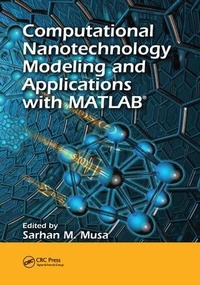
Computational Nanotechnology
Modeling and Applications with MATLAB (R)
1st Edition
Published on 12. October 2017
Book
Paperback/Softback
538 pages
978-1-138-07345-6 (ISBN)
Description
Applications of nanotechnology continue to fuel significant innovations in areas ranging from electronics, microcomputing, and biotechnology to medicine, consumer supplies, aerospace, and energy production. As progress in nanoscale science and engineering leads to the continued development of advanced materials and new devices, improved methods of modeling and simulation are required to achieve a more robust quantitative understanding of matter at the nanoscale.
Computational Nanotechnology: Modeling and Applications with MATLAB (R) provides expert insights into current and emerging methods, opportunities, and challenges associated with the computational techniques involved in nanoscale research. Written by, and for, those working in the interdisciplinary fields that comprise nanotechnology-including engineering, physics, chemistry, biology, and medicine-this book covers a broad spectrum of technical information, research ideas, and practical knowledge. It presents an introduction to computational methods in nanotechnology, including a closer look at the theory and modeling of two important nanoscale systems: molecular magnets and semiconductor quantum dots.
Topics covered include:
Modeling of nanoparticles and complex nano and MEMS systems
Theory associated with micromagnetics
Surface modeling of thin films
Computational techniques used to validate hypotheses that may not be accessible through traditional experimentation
Simulation methods for various nanotubes and modeling of carbon nanotube and silicon nanowire transistors
In regard to applications of computational nanotechnology in biology, contributors describe tracking of nanoscale structures in cells, effects of various forces on cellular behavior, and use of protein-coated gold nanoparticles to better understand protein-associated nanomaterials. Emphasizing the importance of MATLAB for biological simulations in nanomedicine, this wide-ranging survey of computational nanotechnology concludes by discussing future directions in the field, highlighting the importance of the algorithms, modeling software, and computational tools in the development of efficient nanoscale systems.
Computational Nanotechnology: Modeling and Applications with MATLAB (R) provides expert insights into current and emerging methods, opportunities, and challenges associated with the computational techniques involved in nanoscale research. Written by, and for, those working in the interdisciplinary fields that comprise nanotechnology-including engineering, physics, chemistry, biology, and medicine-this book covers a broad spectrum of technical information, research ideas, and practical knowledge. It presents an introduction to computational methods in nanotechnology, including a closer look at the theory and modeling of two important nanoscale systems: molecular magnets and semiconductor quantum dots.
Topics covered include:
Modeling of nanoparticles and complex nano and MEMS systems
Theory associated with micromagnetics
Surface modeling of thin films
Computational techniques used to validate hypotheses that may not be accessible through traditional experimentation
Simulation methods for various nanotubes and modeling of carbon nanotube and silicon nanowire transistors
In regard to applications of computational nanotechnology in biology, contributors describe tracking of nanoscale structures in cells, effects of various forces on cellular behavior, and use of protein-coated gold nanoparticles to better understand protein-associated nanomaterials. Emphasizing the importance of MATLAB for biological simulations in nanomedicine, this wide-ranging survey of computational nanotechnology concludes by discussing future directions in the field, highlighting the importance of the algorithms, modeling software, and computational tools in the development of efficient nanoscale systems.
More details
Series
Language
English
Place of publication
London
United Kingdom
Publishing group
Taylor & Francis Ltd
Target group
College/higher education
Professionals, researchers, and students in engineering, physics, chemistry, biology, and medicine, among other fields
Illustrations
45 s/w Tabellen, 281 s/w Abbildungen
45 Tables, black and white; 281 Illustrations, black and white
Dimensions
Height: 254 mm
Width: 178 mm
Weight
453 gr
ISBN-13
978-1-138-07345-6 (9781138073456)
Copyright in bibliographic data and cover images is held by Nielsen Book Services Limited or by the publishers or by their respective licensors: all rights reserved.
Schweitzer Classification
Other editions
Additional editions
E-Book
09/2018
1st Edition
CRC Press
€107.99
Available for download
E-Book
09/2018
1st Edition
CRC Press
€107.99
Available for download
Book
07/2011
1st Edition
CRC Press
€296.50
Shipment within 15-20 days
Person
Sarhan Musa received his Ph.D. in electrical engineering in 2001 from City University of New York. He is currently an associate professor in the engineering technology department of Prairie View A&M University, Texas. From 2009 to 2010, Dr. Musa was a visiting professor in the department of electrical computer engineering and also worked in the Nanoelectronic Systems Laboratory (NSL) at Rice University, Texas. His research interests include computational methods in nanotechnology, numerical modeling of electromagnetic systems, and computer communication networks. He currently serves on the Editorial Board of Journal of Modern Applied Science, and he is a senior member of the Institute of Electrical and Electronics Engineers (IEEE). He is also a 2010 Boeing Welliver Fellow.
Content
Introduction to Computational Methods in Nanotechnology. Computational Modeling of Nanoparticles. Micromagnetics: Finite Element Analysis of Nano- Sized Magnetic Materials Using MATLAB (R). System-Level Modeling of N/MEMS. Numerical Integrator for Continuum Equations of Surface Growth and Erosion. Configuration Optimizations and Photophysics Simulations of Single-Wall Nanotubes of Carbon, Silicon-Carbide, and Carbon-Nitride. MATLAB (R) Applications in Behavior Analysis of Systems Consisting of Carbon Nanotubes through Molecular Dynamics Simulation. Device and Circuit Modeling of Nano-CMOS. Computational and Experimental Approaches to Cellular and Subcellular Tracking at the Nanoscale. Computational Simulations of Nanoindentation and Nanoscratch. Modeling of Reversible Protein Conjugation on Nanoscale Surface. Computational Technology in Nanomedicine. Future Directions: Opportunities and Challenges. Appendices.