

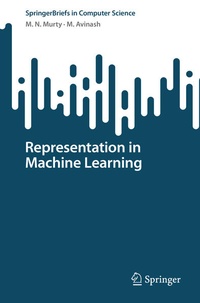
Representation in Machine Learning
Published on 21. January 2023
Book
Paperback/Softback
IX, 93 pages
978-981-19-7907-1 (ISBN)
Description
This book provides a concise but comprehensive guide to representation, which forms the core of Machine Learning (ML). State-of-the-art practical applications involve a number of challenges for the analysis of high-dimensional data. Unfortunately, many popular ML algorithms fail to perform, in both theory and practice, when they are confronted with the huge size of the underlying data. Solutions to this problem are aptly covered in the book.
In addition, the book covers a wide range of representation techniques that are important for academics and ML practitioners alike, such as Locality Sensitive Hashing (LSH), Distance Metrics and Fractional Norms, Principal Components (PCs), Random Projections and Autoencoders. Several experimental results are provided in the book to demonstrate the discussed techniques' effectiveness.
More details
Series
Edition
1st ed. 2023
Language
English
Place of publication
Singapore
Singapore
Target group
Professional and scholarly
Illustrations
1 s/w Abbildung
IX, 93 p. 1 illus.
Dimensions
Height: 235 mm
Width: 155 mm
Thickness: 7 mm
Weight
172 gr
ISBN-13
978-981-19-7907-1 (9789811979071)
DOI
10.1007/978-981-19-7908-8
Schweitzer Classification
Other editions
Additional editions
M. N. Murty | M. Avinash
Representation in Machine Learning
E-Book
01/2023
Springer
€58.84
Available for download
Persons
M Narasimha Murty is a prominent researcher in the areas of ML and AI. He has co-authored an introductory book on Pattern Recognition, published by Springer, that is widely used by teachers and researchers. He led the team that won the ACMKDD Cup in 2003. He has collaborated with and worked at several institutions in India, the USA and Europe.
Avinash M is a graduate student at the Indian Institute of Technology, Madras, India, whose main research interests include Signal Processing and ML. He was in the top 90 among the approximately 200,000 candidates taking the GATE (Graduate Aptitude Test in Engineering) examination in 2016 in India.
Content
1. Introduction.- 2. Representation.- 3. Nearest Neighbor Algorithms.- 4. Representation Using Linear Combinations.- 5. Non-Linear Schemes for Representation.- 6. Conclusions.