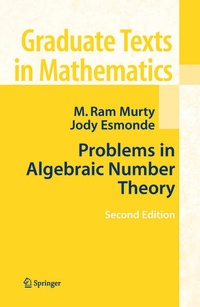
Asking how one does mathematical research is like asking how a composer creates a masterpiece. No one really knows. However, it is a recognized fact that problem solving plays an important role in training the mind of a researcher. It would not be an exaggeration to say that the ability to do mathematical research lies essentially asking "well-posed" questions. The approach taken by the authors in Problems in Algebraic Number Theory is based on the principle that questions focus and orient the mind. The book is a collection of about 500 problems in algebraic number theory, systematically arranged to reveal ideas and concepts in the evolution of the subject. While some problems are easy and straightforward, others are more difficult. For this new edition the authors added a chapter and revised several sections. The text is suitable for a first course in algebraic number theory with minimal supervision by the instructor. The exposition facilitates independent study, and students having taken a basic course in calculus, linear algebra, and abstract algebra will find these problems interesting and challenging. For the same reasons, it is ideal for non-specialists in acquiring a quick introduction to the subject.
Reviews / Votes
From the reviews of the second edition:
"Problems in Algebraic Number Theory is intended to be used by the students for independent study of the subject. It provides the reader with a large collection of problems (about 500) . . The reviewer thinks that the authors have done a fantastic job choosing the problems, which are perfectly arranged so the students can progressively move from topic to topic . . the book is an excellent resource for the instructor and the student as a companion to any algebraic number theory course." (Álvaro Lozano-Robledo, MathDL, May, 2005)
"This second edition is an expanded and revised version of the first edition. In particular, it contains an extra chapter on density theorems and L-Functions highlighting some of the analytic aspects of algebraic number theory. . the reviewer is certain that many students will benefit from this pathway into the fascinating realm of algebraic number theory." (Zentralblatt für Didaktik der Mathematik, August, 2005)
"This is the second edition of Problems in algebraic number theory. ... errors have been corrected . . The decision to expand the book by including a chapter on density theorems is most welcome." (Franz Lemmermeyer, Zentralblatt MATH, Vol. 1055)
"This is the second edition of an unusual introduction to algebraic number theory. . each chapter is written in straightforward textbook style. All chapters contain a very large number of problems. . it presents a good way of acquiring a working knowledge of basic algebraic number theory by using it for independent study or as supplementary reading." (Ch. Baxa, Monatshefte für Mathematik, Vol. 149 (4), 2006)
Series
Edition
Language
Place of publication
Target group
Professional and scholarly
Research
Edition type
Illustrations
Dimensions
Height: 241 mm
Width: 160 mm
Thickness: 26 mm
Weight
ISBN-13
978-0-387-22182-3 (9780387221823)
DOI
Schweitzer Classification
Sebastian M. Cioaba is Professor at the Department of Mathematical Sciences, University of Delaware, Newark, USA. After his undergraduate studies in mathematics and computer science at the University of Bucharest, Romania, he obtained his Ph.D. in Mathematics at Queen's University at Kingston, Canada. Following postdocs at UC San Diego and the University of Toronto, Sebastian started his teaching position at the University of Delaware in 2009. His research interests are in spectral graph theory, algebraic combinatorics, and their connections and applications to other areas of mathematics and science. He is on the editorial board of several journals including Discrete Mathematics, Linear Algebra and its Applications, and Electronic Journal of Linear Algebra. He has organized several conferences in algebraic combinatorics and spectral graph theory. Sebastian has supervised 5 Ph.D. students, 2 M.Sc. students, 3 undergraduate senior theses, and over 20 summer research students. He has published more than 60 papers, and his research has been supported by NSF, NSA, NSERC, Simons Foundation, IDex Bordeaux, and Japan Society for Promotion of Science.
M. Ram Murty is Queen's Research Chair and A.V. Douglas Distinguished University Professor at Queen's University, in Kingston, Ontario, Canada. He obtained his Ph.D. from Massachusetts Institute of Technology, USA, in 1980 and subsequently held positions at the Institute for Advanced Study in Princeton, Tata Institute for Fundamental Research in Mumbai, and McGill University in Montreal. He has authored more than 250 research papers and written more than a dozen mathematical textbooks. His monograph, Non-vanishing of L-functions and Applications, written jointly with Prof. V. Kumar Murty, won the 1996 Balaguer Prize. Ram is Fellow of the Royal Society of Canada, Fellow of the American Mathematical Society, and Fellow of the Indian National Science Academy, India. He also teaches Indian philosophy at Queen's University and has authored Indian Philosophy: An Introduction, published by Broadview Press.
Problems.- Elementary Number Theory.- Euclidean Rings.- Algebraic Numbers and Integers.- Integral Bases.- Dedekind Domains.- The Ideal Class Group.- Quadratic Reciprocity.- The Structure of Units.- Higher Reciprocity Laws.- Analytic Methods.- Density Theorems.- Solutions.- Elementary Number Theory.- Euclidean Rings.- Algebraic Numbers and Integers.- Integral Bases.- Dedekind Domains.- The Ideal Class Group.- Quadratic Reciprocity.- The Structure of Units.- Higher Reciprocity Laws.- Analytic Methods.- Density Theorems.