

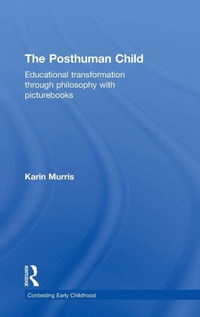
The Posthuman Child
Educational transformation through philosophy with picturebooks
1st Edition
Published on 4. April 2016
Book
Hardback
300 pages
978-1-138-85843-5 (ISBN)
Description
The Posthuman Child combats institutionalised ageist practices in primary, early childhood and teacher education. Grounded in a critical posthumanist perspective on the purpose of education, it provides a genealogy of psychology, sociology and philosophy of childhood in which dominant figurations of child and childhood are exposed as positioning child as epistemically and ontologically inferior. Entangled throughout this book are practical and theorised examples of philosophical work with student teachers, teachers, other practitioners and children (aged 3-11) from South Africa and Britain. These engage arguments about how children are routinely marginalised, discriminated against and denied, especially when the child is also female, black, lives in poverty and whose home language is not English. The book makes a distinctive contribution to the decolonisation of childhood discourses.
Underpinned by good quality picturebooks and other striking images, the book's radical proposal for transformation is to reconfigure the child as rich, resourceful and resilient through relationships with (non) human others, and explores the implications for literary and literacy education, teacher education, curriculum construction, implementation and assessment. It is essential reading for all who research, work and live with children.
Underpinned by good quality picturebooks and other striking images, the book's radical proposal for transformation is to reconfigure the child as rich, resourceful and resilient through relationships with (non) human others, and explores the implications for literary and literacy education, teacher education, curriculum construction, implementation and assessment. It is essential reading for all who research, work and live with children.
Reviews / Votes
"The Posthuman Child makes an important and timely contribution to the ongoing discussion of an educational vision rooted in life-centred values. In addition, the detailed illustrations and excerpts from students' conversations make Murris's scholarly book valuable. Her message is hopeful and inspirational in providing new directions for teaching and learning that affirm the lived experiences of children. This is a valuable text for educators, counsellors, education program planners, and researchers interested in working with early years and elementary school children."- Karen Magro, Jeunesse: Young People, Texts, CulturesMore details
Series
Language
English
Place of publication
London
United Kingdom
Publishing group
Taylor & Francis Ltd
Target group
College/higher education
Professional and scholarly
Illustrations
30 s/w Photographien bzw. Rasterbilder, 4 s/w Tabellen
4 Tables, black and white; 30 Halftones, black and white
Dimensions
Height: 240 mm
Width: 161 mm
Thickness: 21 mm
Weight
617 gr
ISBN-13
978-1-138-85843-5 (9781138858435)
Copyright in bibliographic data and cover images is held by Nielsen Book Services Limited or by the publishers or by their respective licensors: all rights reserved.
Schweitzer Classification
Other editions
Additional editions
Book
03/2016
1st Edition
Routledge
€106.20
Shipment within 10-20 days
E-Book
03/2016
Routledge
€59.49
Available for download
E-Book
03/2016
Routledge
€59.49
Available for download
Person
Karin Murris is Professor of Pedagogy and Philosophy at the School of Education, University of Cape Town, South Africa.
Content
Introduction 1. Laika PART I A posthumanist philosophical orientation 2. The Labyrinth: enacting three aims of education Diffractive pause: Diffractive Journal 3. This is not a child Diffractive pause: Statue-breast-infant-woman 4. Diffractive pause: An idea that needs legs and mouths and ears to spread Posthuman Child Diffractive pause: Liam's photos at/of his sister's wedding 5. Figurations of Child and Childhood Diffractive pause: Child-in-the-Making: Creating Bodymind Maps 6. Ontoepistemic Injustice and Listening without Organs Diffractive pause: How to read Granny and the Goldfish PART II Posthumanist intra-active pedagogies 7. Reading Reggio Emilia and Philosophy with Children diffractively through one another 8. Educator as Pregnant Stingray Diffractive pause: A pregnant stingray in South Africa 9. Destabilising Binaries through Picturebooks Diffractive pause: The Anthony-Browne-Destabilising-Binary-project 10. Decolonising Education: black and white elephants with guns Diffractive pause: (A)mazement