

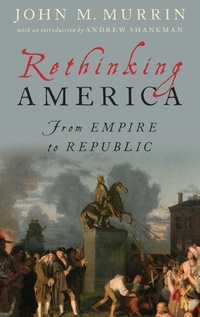
Rethinking America
From Empire to Republic
Published on 10. May 2018
Book
Hardback
424 pages
978-0-19-503871-2 (ISBN)
Description
For five decades John M. Murrin has been the consummate historian's historian. This volume brings together his seminal essays on the American Revolution, the United States Constitution, and the early American Republic. Collectively, these essays rethink fundamental questions regarding American identity, the reasons why colonists felt compelled to declare their independence, and the myriad ways that the American Revolution produced a profoundly transformative change in those who lived through it. They reconsider questions that have shaped the field for several generations and connect those questions to issues of central interest to historians working today. Collectively, the essays gathered here argue that the great historiographical schools that have long competed to explain the American Revolution must move towards a synthesis that allows the whole to be greater than the parts. The essays show how high politics and the study of constitutional and ideological questions--broadly the history of elites--must be considered in close conjunction with issues of economic inequality, class conflict, and racial division.
By bringing together different historiographical schools and a variety of perspectives in both Britain and the North American colonies, Rethinking America explains why what began as constitutional argument that virtually all expected would remain contained within the British Empire exploded into a truly subversive, destructive, and radical revolution that destroyed monarchy and aristocracy and replaced it with a rapidly transforming and wildly pulsing republic. The essays examining the period of the early American Republic discuss why the Founders' assumptions about what their Revolution would produce were profoundly different than the society that emerged from the American Revolution. In many ways, the outcome of the American Revolution put the new United States on a path to a violent and bloody civil war, as is shown by an essay directly comparing the American colonists of 1776 to the Confederate States of America in 1861.
A much anticipated work, this volume offers both groundbreaking and timeless analysis of the nation's critical first decades as it moved from empire to republic.
By bringing together different historiographical schools and a variety of perspectives in both Britain and the North American colonies, Rethinking America explains why what began as constitutional argument that virtually all expected would remain contained within the British Empire exploded into a truly subversive, destructive, and radical revolution that destroyed monarchy and aristocracy and replaced it with a rapidly transforming and wildly pulsing republic. The essays examining the period of the early American Republic discuss why the Founders' assumptions about what their Revolution would produce were profoundly different than the society that emerged from the American Revolution. In many ways, the outcome of the American Revolution put the new United States on a path to a violent and bloody civil war, as is shown by an essay directly comparing the American colonists of 1776 to the Confederate States of America in 1861.
A much anticipated work, this volume offers both groundbreaking and timeless analysis of the nation's critical first decades as it moved from empire to republic.
Reviews / Votes
Rethinking America will also be profitable reading for professional historians who - like this reviewer-might have read Murrin's articles at various stages of their research and career, and who, by reading them together in a book, will come to appreciate the unity, coherence, and straightforwardness of Murrin's scholarship. In any case, these essays - thought - provoking and imaginative in content, humorous and engaging in style - are well worth rereading * Jasper M. Trautsch, University of Regensburg, H-Nationalism * Murrin demonstrates substantial familiarity with the literature regarding several different colonies. He displays a confident grasp of the literature regarding contemporary England/Britain. He knows the early republic well. He also adduces evidence from outside these fields to good effect. All is tied together in a deeply thought-provoking way ... Graduate students in particular will profit from it. * Kevin R.C. Gutzman, American Historical Review * Rethinking America does not disappoint. Through Murrin's deep and thoughtful analyses, these essays challenge historians to continue rethinking early America in order to better understand their time and our own. * Heather Sommer, Origins: Current Events in Historical Perspective * Rethinking America reminds us of the power wielded by historians and their studies. It and Murrin both offer a compelling explanation for the transformative power of the American Revolution and suggests why it places so prominently in scholarship, political maneuvering, and in the public imagination. Rethinking America deserves significant praise and further critical attention in light of new developments in the field of early American history. At its core, the ten essays collected in Rethinking America explore how British North American colonists turned-citizens of a Republic developed ideas of how to act as British and American citizens. By virtue of its publication, this book asks historians to seriously consider Murrin's place in the pantheon of great historians yet still to test the endurance of his numerous insights. * Society for U.S. Intellectual History *More details
Language
English
Place of publication
New York
United States
Target group
Professional and scholarly
Product notice
sewn/stitched
Cloth over boards
Dimensions
Height: 244 mm
Width: 159 mm
Thickness: 38 mm
Weight
688 gr
ISBN-13
978-0-19-503871-2 (9780195038712)
Copyright in bibliographic data and cover images is held by Nielsen Book Services Limited or by the publishers or by their respective licensors: all rights reserved.
Schweitzer Classification
Other editions
Additional editions
E-Book
04/2018
1st Edition
OUP eBook
€18.99
Available for download
E-Book
04/2018
1st Edition
OUP eBook
€18.99
Available for download
Persons
John Murrin is one of the foremost scholars of early America and is the author of over 50 essays and the textbook Liberty, Equality, Power. He is a former President of the Society for Historians of the Early American Republic and was for over 30 years a professor of history at Princeton University.
Andrew Shankman, Associate Professor at Rutgers University-Camden, is the author of Original Intents: Hamilton, Jefferson, Madison, and the American Founding and Crucible of American Democracy: The Struggle to Fuse Egalitarianism in Jeffersonian Pennsylvania, and the editor of The World of the Revolutionary American Republic: Land, Labor, and the Conflict for a Continent and Anglicizing America: Empire, Revolution, Republic.
Andrew Shankman, Associate Professor at Rutgers University-Camden, is the author of Original Intents: Hamilton, Jefferson, Madison, and the American Founding and Crucible of American Democracy: The Struggle to Fuse Egalitarianism in Jeffersonian Pennsylvania, and the editor of The World of the Revolutionary American Republic: Land, Labor, and the Conflict for a Continent and Anglicizing America: Empire, Revolution, Republic.
Content
Preface and Acknowledgments
Introduction: The Revolutionary Republic of a Radical, Imperial, Whig: The Historical and Historiographical Imagination of John M. Murrin- Andrew Shankman
Part I: An Overview
Chapter 1: The Great Inversion, or, Court versus Country: A Comparison of the Revolution Settlements in England (1688-1721) and America (1776-1816)
Part II: Toward Revolution
Chapter 2: No Awakening, No Revolution? More Counterfactual Speculations
Chapter 3: The French and Indian War, the American Revolution, and the Counterfactual Hypothesis: Reflections on Lawrence Henry Gipson and John Shy
Chapter 4: Feudalism, Communalism, and the Yeoman Freeholder: The American Revolution Considered as a Social Accident (with Rowland Berthoff)
Chapter 5: 1776: The Countercyclical Revolution
Part III: Defining the Republic
Chapter 6: A Roof Without Walls: The Dilemma of American National Identity
Chapter 7: Fundamental Values, the Founding Fathers, and the Constitution
Chapter 8: The Making and Unmaking of an American Ruling Class (with Gary J. Kornblith)
Chapter 9: Escaping Perfidious Albion: Federalism, Fear of Aristocracy, and the Democratization of Corruption in Postrevolutionary America
Chapter 10: War, Revolution, and Nation-Making: The American Revolution versus the Civil War
Conclusion: Self-Immolation: Schools of Historiography and the Coming of the American Revolution
Introduction: The Revolutionary Republic of a Radical, Imperial, Whig: The Historical and Historiographical Imagination of John M. Murrin- Andrew Shankman
Part I: An Overview
Chapter 1: The Great Inversion, or, Court versus Country: A Comparison of the Revolution Settlements in England (1688-1721) and America (1776-1816)
Part II: Toward Revolution
Chapter 2: No Awakening, No Revolution? More Counterfactual Speculations
Chapter 3: The French and Indian War, the American Revolution, and the Counterfactual Hypothesis: Reflections on Lawrence Henry Gipson and John Shy
Chapter 4: Feudalism, Communalism, and the Yeoman Freeholder: The American Revolution Considered as a Social Accident (with Rowland Berthoff)
Chapter 5: 1776: The Countercyclical Revolution
Part III: Defining the Republic
Chapter 6: A Roof Without Walls: The Dilemma of American National Identity
Chapter 7: Fundamental Values, the Founding Fathers, and the Constitution
Chapter 8: The Making and Unmaking of an American Ruling Class (with Gary J. Kornblith)
Chapter 9: Escaping Perfidious Albion: Federalism, Fear of Aristocracy, and the Democratization of Corruption in Postrevolutionary America
Chapter 10: War, Revolution, and Nation-Making: The American Revolution versus the Civil War
Conclusion: Self-Immolation: Schools of Historiography and the Coming of the American Revolution