

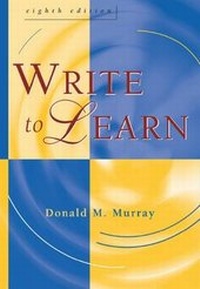
Write to Learn (with InfoTrac (R))
8th Edition
Published on 28. June 2004
Book
Paperback/Softback
336 pages
978-1-4130-0173-0 (ISBN)
Description
WRITE TO LEARN gives you a framework you can use to create original and compelling writing. Donald Murray, with his famous clear and succinct writing style, will show you how to move from an initial idea all the way to a final draft.
Reviews / Votes
PREFACE. THE VIEW FROM THE WRITER'S DESK. 1. Craft Not Magic. 2. Make Writing Easy. 3. Unlearn to Write. 4. Write Beside Writers. WRITE BEFORE WRITING. 5. Write Before Writing. 6. The Writer's Memory. 7. Take Note. 8. I Don't Have Anything to Say. RESEARCH FOR WRITING. 9. Outline Now or Later. 10. Plan Your Research. 11. Using the Internet by Lisa C. Miller. 12. Ask the Research Question. BEGIN WRITING. 13. Take Your Eye Off the Ball 14. The Writer's Eye. 15. The Focusing Line. 16. Read the Reader. KEEP WRITING. 17. Unblocking Writer's Block. 18. Begin a Discovery Draft. 19. Write Out Loud. 20. See Within the Draft. FINISH WRITING. 21. Your Friend ? The Deadline. 22. Writers Helping Writers. 23. Learning from Writers. 24. Revive a Dead Draft. 25. Revise. 26. Edit. WRITING AFTER GRADUATION. 27. You Want Me to Write What? 28. New Tasks, New Forms. 29. Explore Creative Nonfiction. 30. A Lifetime Apprenticeship. Index.More details
Edition
8th Revised edition
Language
English
Place of publication
Florence, KY
United States
Publishing group
Cengage Learning, Inc
Target group
College/higher education
Edition type
Revised edition
ISBN-13
978-1-4130-0173-0 (9781413001730)
Copyright in bibliographic data and cover images is held by Nielsen Book Services Limited or by the publishers or by their respective licensors: all rights reserved.
Schweitzer Classification
Person
Donald M. Murray was a Professor of English at the University of New Hampshire where he inaugurated a journalism program, helped establish a graduate program in Composition Studies, and served as director of Freshman English and English Department chairperson. He twice won awards for his teaching and was awarded honorary doctoral degrees by the University of New Hampshire in 1990, Fitchburg State College in 1992, and New Hampshire College in 1997. As a journalist, Murray won a number of awards including the Pulitzer Prize for editorial writing in the _Boston Herald_ in 1954. He was an editor of _Time_ and has served as writing coach for several newspapers, including the _Boston Globe_ and the _Providence Journal_. In 1991 Boston magazine and in 1996 _Improper Bostonian_ magazine selected him best columnist in Boston. In 1997 the University of New Hampshire opened the Donald M. Murray Journalism Library. He received recognition for Lifetime Achievement during the New Hampshire Literary Awards in 2001. In 2003 _Writing on the Edge_ established the Donald M. Murray Prize. This award is given to the author of the best work of creative nonfiction on the subject of writing published the previous year.
Content
PREFACE. THE VIEW FROM THE WRITER"S DESK. 1. Craft Not Magic. 2. Make Writing Easy. 3. Unlearn to Write. 4. Write Beside Writers. WRITE BEFORE WRITING. 5. Write Before Writing. 6. The Writer"s Memory. 7. Take Note. 8. I Don"t Have Anything to Say. RESEARCH FOR WRITING. 9. Outline Now or Later. 10. Plan Your Research. 11. Using the Internet by Lisa C. Miller. 12. Ask the Research Question. BEGIN WRITING. 13. Take Your Eye Off the Ball 14. The Writer"s Eye. 15. The Focusing Line. 16. Read the Reader. KEEP WRITING. 17. Unblocking Writer"s Block. 18. Begin a Discovery Draft. 19. Write Out Loud. 20. See Within the Draft. FINISH WRITING. 21. Your Friend - The Deadline. 22. Writers Helping Writers. 23. Learning from Writers. 24. Revive a Dead Draft. 25. Revise. 26. Edit. WRITING AFTER GRADUATION. 27. You Want Me to Write What? 28. New Tasks, New Forms. 29. Explore Creative Nonfiction. 30. A Lifetime Apprenticeship. Index.