

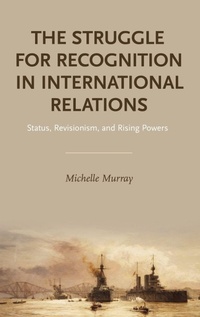
The Struggle for Recognition in International Relations
Status, Revisionism, and Rising Powers
Published on 20. December 2018
Book
Hardback
280 pages
978-0-19-087890-0 (ISBN)
Description
How can established powers manage the peaceful rise of new great powers? With The Struggle for Recognition in International Relations, Michelle Murray offers a new answer to this perennial question in international relations, arguing that power transitions are principally social phenomena whereby rising powers struggle to obtain recognition as world powers. At the center of great power identity formation is the acquisition of particular symbolic capabilities-such as battleships, aircraft carriers or nuclear weapons-that are representative of great power status and which allow rising powers to experience their uncertain social status as a brute fact. When a rising power is recognized, this power acquisition is considered legitimate and its status in the international order secured, leading to a peaceful power transition. If a rising power is misrecognized, its assertive foreign policy is perceived to be for revisionist purposes, which must be contained by the established powers. Revisionism-rather than the product of a material power structure that encourages aggression or domestic political struggles-is a social construct that emerges through a rising power's social interactions with the established powers as it attempts to gain recognition of its identity.
To highlight the explanatory reach of the argument, Murray compares the United States and Imperial Germany's contemporaneous rise to world power status at the turn of the twentieth century. Whereas successful acts of recognition constructed American expansionism as legitimate thereby facilitating its peaceful rise, ongoing misrecognition increased German status insecurity, constructing it as a revisionist threat to the international order.
The question of peaceful power transition has taken on increased salience in recent years with the emergence of China as an economic and military rival of the United States. Highlighting the social dynamics of power transitions, The Struggle for Recognition in International Relations offers a powerful new framework through which to understand the rise of China and how the United States can facilitate its peaceful rise.
To highlight the explanatory reach of the argument, Murray compares the United States and Imperial Germany's contemporaneous rise to world power status at the turn of the twentieth century. Whereas successful acts of recognition constructed American expansionism as legitimate thereby facilitating its peaceful rise, ongoing misrecognition increased German status insecurity, constructing it as a revisionist threat to the international order.
The question of peaceful power transition has taken on increased salience in recent years with the emergence of China as an economic and military rival of the United States. Highlighting the social dynamics of power transitions, The Struggle for Recognition in International Relations offers a powerful new framework through which to understand the rise of China and how the United States can facilitate its peaceful rise.
Reviews / Votes
The book(s) under review offer new inspirations to address these enduring challenges facing the international order. * Ziyuan Wang, China International Strategy Review *More details
Language
English
Place of publication
New York
United States
Target group
College/higher education
Dimensions
Height: 240 mm
Width: 161 mm
Thickness: 20 mm
Weight
584 gr
ISBN-13
978-0-19-087890-0 (9780190878900)
Copyright in bibliographic data and cover images is held by Nielsen Book Services Limited or by the publishers or by their respective licensors: all rights reserved.
Schweitzer Classification
Other editions
Additional editions
Michelle Murray
The Struggle for Recognition in International Relations
Status, Revisionism, and Rising Powers
E-Book
11/2018
OUP eBook
€46.99
Available for download
Michelle Murray
The Struggle for Recognition in International Relations
Status, Revisionism, and Rising Powers
E-Book
11/2018
OUP eBook
€36.99
Available for download
Person
Michelle Murray is Assistant Professor of Politics at Bard College. Her principal research and teaching interests lie at the intersection of international relations theory, security studies, and diplomatic history.
Content
Table of Contents
Chapter 1 - Introduction: The Problem of Rising Powers in International Politics
Chapter 2 - The Struggle for Recognition: State Identity and the Problem of Social Uncertainty in International Politics
Chapter 3 - The Social Construction of Revisionism: (Mis)Recognition and the Struggle for Major Power Status
Chapter 4 - Weltpolitik: The German Aspiration of World Power Status
Chapter 5 - Recognition Refused: The Tragedy of German Naval Ambition before the First World War
Chapter 6 - Looking Outward: The American Aspiration for World Power Status
Chapter 7 - Recognition and Rapprochement: America's Peaceful Rise
Chapter 8 - Conclusion: Rising Powers and the Future of the International Order
Notes
References
Index
Chapter 1 - Introduction: The Problem of Rising Powers in International Politics
Chapter 2 - The Struggle for Recognition: State Identity and the Problem of Social Uncertainty in International Politics
Chapter 3 - The Social Construction of Revisionism: (Mis)Recognition and the Struggle for Major Power Status
Chapter 4 - Weltpolitik: The German Aspiration of World Power Status
Chapter 5 - Recognition Refused: The Tragedy of German Naval Ambition before the First World War
Chapter 6 - Looking Outward: The American Aspiration for World Power Status
Chapter 7 - Recognition and Rapprochement: America's Peaceful Rise
Chapter 8 - Conclusion: Rising Powers and the Future of the International Order
Notes
References
Index