

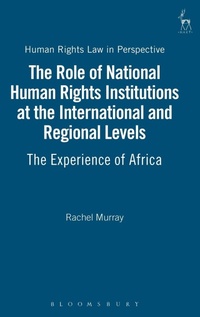
The Role of National Human Rights Institutions at the International and Regional Levels
The Experience of Africa
Published on 22. June 2007
Book
Hardback
149 pages
978-1-84113-394-2 (ISBN)
Description
National Human Rights Institutions (NHRIs), defined by the UN as bodies established to promote and protect human rights, have increased in number since the General Assembly adopted principles governing their effectiveness in 1993. The UN and others have encouraged states to set up such institutions as an indication of their commitment to human rights, and now over 20 such institutions exist in Africa and many more will follow. These institutions have taken various forms including ombudsmen, commissions, or a combination of the two. They differ in terms of how they are established; some by constitution, some by legislation and some by decree. These NHRIs have varying functions, usually both promotional and protective, such as giving advice to government, parliament, and others, making recommendations on compliance with human rights standards, awareness raising, and analysis of law and policy. Despite the considerable variations in the method of their creation, powers and composition, most of these institutions have chosen or indeed been mandated, to become involved in international and regional fora.
This book examines these institutions in the African region, the way in which they use the international and regional fora, the effectiveness of their contributions and how they are able to participate.
This book examines these institutions in the African region, the way in which they use the international and regional fora, the effectiveness of their contributions and how they are able to participate.
Reviews / Votes
This book is an excellent piece for the busy practitioner, students and bureaucrats who want to find what they want in an instant without having to scan through voluminous material...It is written in such a way that both the lay person and the most sophisticated professional will be able to follow...a book one must have on one's desk or bookshelf. It is a useful tool for activists and lobbyists of human rights, including NGOs, academics, NHRIs, government officials, international organisations, students and others. Michelo Hansungule African Human Rights Law Journal Vol 7, No 2, 2007 While much has indeed been written about elements of the domestic functioning of NHRIs, little careful analysis has been undertaken concerning the increasingly important role of these institutions within the UN treaty body system and before the African Commission on Human and Peoples' Rights (African Commission). Murray's book fills this gap...In NHRIs, Murray both takes a step back and reflects on the emerging practice of NHRIs' ad hoc participation in international fora, and takes a leap forward towards the formulation of a clear and coherent theory of this phenomenon. The book is a pleasure to read. Its sober and concise use of language makes the book accessible. Its analyses are accurate and thoroughly substantiated. The addition of five appendices containing the most relevant legal instruments enhances the user-friendly nature of the text. Frans Viljoen Leiden Journal of International Law 22-1, 2009 ...a useful starting point for those interested in learning key elements and themes on the place and future of NHRIs. M. A. Stein The Cambridge Law Journal Dr Murray has written a readable discourse on how the NHRIs in Africa operate vis-a-vis the state in which they are located, whom they advise domestically, and, in respect to international regional for a where they have a voice, reception of their input on compliance, shortcomings and recommendations...Every aspect concerning NHRIs is covered in this relatively short book. A good index is included that will help scholars retrace their steps. David Turack Journal of Third World Studies Fall 2008 In her book, Murray delivers a very engaging and innovative presentation of a topic that so far has only insufficiently been discussed in legal literature. She masters the challenge of writing a book that will most probably be a valuable read for quite a few more years to come, despite dealing with legal arrangements and institutions of a rather short half-life. The book is extremely thought provoking and does not shy away from taking controversial standpoints. As it rightly makes clear, NHRIs cannot be a substitute for the development of civil society in human rights matters. Lukas Knott International and European Law Book Reviews Online 2011More details
Series
Language
English
Place of publication
Oxford
United Kingdom
Publishing group
Bloomsbury Publishing PLC
Target group
Professional and scholarly
Dimensions
Height: 240 mm
Width: 161 mm
Thickness: 13 mm
Weight
394 gr
ISBN-13
978-1-84113-394-2 (9781841133942)
Copyright in bibliographic data and cover images is held by Nielsen Book Services Limited or by the publishers or by their respective licensors: all rights reserved.
Schweitzer Classification
Other editions
Additional editions
Rachel Murray
The Role of National Human Rights Institutions at the International and Regional Levels
The Experience of Africa
E-Book
06/2007
1st Edition
Hart Publishing
€94.49
Available for download
Person
Rachel Murray is a Professor of Law at the University of Bristol.
Content
Chapter 1: The Role of National Human Rights Institutions at the International and Regional Levels Chapter 2: Legitimacy of NHRI Participation Chapter 3: The Role of NHRIs in the United Nations Chapter 4: NHRIs at the Regional Level Chapter 5: NHRIs as State or Non-State Actors Chapter 6: Ensuring the Accountability of NHRIs: What Role for the International and Regional Bodies? Chapter 7: Conclusion