

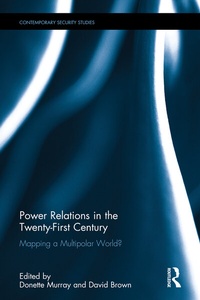
Power Relations in the Twenty-First Century
Mapping a Multipolar World?
1st Edition
Published on 21. September 2017
Book
Hardback
226 pages
978-0-415-73015-0 (ISBN)
Description
This volume critiques contemporary power trends by examining key bilateral dynamics between five putative 'poles' of the multipolar order in the twenty-first century.
Written by emerging scholars and established academics, this work provides a timely and authoritative analysis of one of the most controversial and compelling security debates of the twenty-first century. Adopting a detailed case study approach, the volume examines contemporary great power relations between the US, China, Russia, India and the EU. Each chapter explores the essential nature and characteristics of individual inter-state relationships in order to explicate and appraise the empirical evidence for a putative multipolar order. The volume aims to deepen understanding of power trends and critically assess the individual inter-dynamics at play. In doing so, it critiques the various models offered, such as the hub and spoke model (with the US remaining as the primary actor) and Zakaria's 'networked' model, as part of a purported 'post-American world'. The work places each of the individual relationships into a wider strategic and political context, in relation to the continued international turbulence and change that has seemed even more prominent in recent times, taking into account the twin challenges of Brexit and the presidency of Donald Trump. It concludes by returning the focus to the central questions of if, how and when a post-American, multipolar world could develop.
This volume will be of much interest to students of global security, foreign policy, and IR in general.
Written by emerging scholars and established academics, this work provides a timely and authoritative analysis of one of the most controversial and compelling security debates of the twenty-first century. Adopting a detailed case study approach, the volume examines contemporary great power relations between the US, China, Russia, India and the EU. Each chapter explores the essential nature and characteristics of individual inter-state relationships in order to explicate and appraise the empirical evidence for a putative multipolar order. The volume aims to deepen understanding of power trends and critically assess the individual inter-dynamics at play. In doing so, it critiques the various models offered, such as the hub and spoke model (with the US remaining as the primary actor) and Zakaria's 'networked' model, as part of a purported 'post-American world'. The work places each of the individual relationships into a wider strategic and political context, in relation to the continued international turbulence and change that has seemed even more prominent in recent times, taking into account the twin challenges of Brexit and the presidency of Donald Trump. It concludes by returning the focus to the central questions of if, how and when a post-American, multipolar world could develop.
This volume will be of much interest to students of global security, foreign policy, and IR in general.
More details
Series
Language
English
Place of publication
London
United Kingdom
Publishing group
Taylor & Francis Ltd
Target group
College/higher education
Professional and scholarly
Illustrations
2 s/w Zeichnungen, 1 s/w Tabelle
1 Tables, black and white; 2 Line drawings, black and white
Dimensions
Height: 234 mm
Width: 156 mm
Weight
780 gr
ISBN-13
978-0-415-73015-0 (9780415730150)
Copyright in bibliographic data and cover images is held by Nielsen Book Services Limited or by the publishers or by their respective licensors: all rights reserved.
Schweitzer Classification
Other editions
Additional editions
Book
08/2020
1st Edition
Routledge
€65.30
Shipment within 15-20 days
E-Book
09/2017
Routledge
€59.49
Available for download
E-Book
09/2017
Routledge
€59.49
Available for download
Persons
Donette Murray is Senior Lecturer at the Royal Military Academy Sandhurst, UK, and the author of several books, including US Foreign Policy and Iran (Routledge, 2009) and George W. Bush's Foreign Policies (Routledge, 2017).
David Brown is Senior Lecturer at the Royal Military Academy, Sandhurst, UK, and author/editor of several books, including Unsteady Foundations: The European Union, counter-terrorism and police co-operation 1991-2007 (2010) and George W. Bush's Foreign Policies (Routledge, 2017).
David Brown is Senior Lecturer at the Royal Military Academy, Sandhurst, UK, and author/editor of several books, including Unsteady Foundations: The European Union, counter-terrorism and police co-operation 1991-2007 (2010) and George W. Bush's Foreign Policies (Routledge, 2017).
Content
Introduction: The Perpetual Preoccupation with Power, David Brown 1. US-China, Michael Beckley 2. US-India, Daniel Twining 3. US-Russia, Robert Singh 4. US-EU, Stefan Froehlich 5 China-Russia, Simon Saradzhyan and Ali Wyne 6. China-India, Shashank Joshi 7. China-EU, Andrew Cottey 8. Russia-India, Natasha Kuhrt and Yulia Kiseleva 9. Russia-EU, Kevork Oskanian 10. EU-India, David Brown Conclusion: Brave New World, Donette Murray