

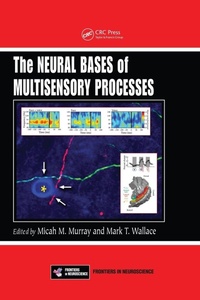
The Neural Bases of Multisensory Processes
1st Edition
Published on 25. August 2011
Book
Hardback
810 pages
978-1-4398-1217-4 (ISBN)
Description
It has become accepted in the neuroscience community that perception and performance are quintessentially multisensory by nature. Using the full palette of modern brain imaging and neuroscience methods, The Neural Bases of Multisensory Processes details current understanding in the neural bases for these phenomena as studied across species, stages of development, and clinical statuses.
Organized thematically into nine sub-sections, the book is a collection of contributions by leading scientists in the field. Chapters build generally from basic to applied, allowing readers to ascertain how fundamental science informs the clinical and applied sciences.
Topics discussed include:
Anatomy, essential for understanding the neural substrates of multisensory processing
Neurophysiological bases and how multisensory stimuli can dramatically change the encoding processes for sensory information
Combinatorial principles and modeling, focusing on efforts to gain a better mechanistic handle on multisensory operations and their network dynamics
Development and plasticity
Clinical manifestations and how perception and action are affected by altered sensory experience
Attention and spatial representations
The last sections of the book focus on naturalistic multisensory processes in three separate contexts: motion signals, multisensory contributions to the perception and generation of communication signals, and how the perception of flavor is generated. The text provides a solid introduction for newcomers and a strong overview of the current state of the field for experts.
Organized thematically into nine sub-sections, the book is a collection of contributions by leading scientists in the field. Chapters build generally from basic to applied, allowing readers to ascertain how fundamental science informs the clinical and applied sciences.
Topics discussed include:
Anatomy, essential for understanding the neural substrates of multisensory processing
Neurophysiological bases and how multisensory stimuli can dramatically change the encoding processes for sensory information
Combinatorial principles and modeling, focusing on efforts to gain a better mechanistic handle on multisensory operations and their network dynamics
Development and plasticity
Clinical manifestations and how perception and action are affected by altered sensory experience
Attention and spatial representations
The last sections of the book focus on naturalistic multisensory processes in three separate contexts: motion signals, multisensory contributions to the perception and generation of communication signals, and how the perception of flavor is generated. The text provides a solid introduction for newcomers and a strong overview of the current state of the field for experts.
More details
Series
Language
English
Place of publication
Bosa Roca
United States
Publishing group
Taylor & Francis Inc
Target group
College/higher education
Neuroscientists.
Product notice
Paper over boards
Illustrations
157 s/w Abbildungen, 20 farbige Abbildungen, 3 s/w Tabellen
3 Tables, black and white; 20 Illustrations, color; 157 Illustrations, black and white
Dimensions
Height: 260 mm
Width: 183 mm
Thickness: 48 mm
Weight
1689 gr
ISBN-13
978-1-4398-1217-4 (9781439812174)
Copyright in bibliographic data and cover images is held by Nielsen Book Services Limited or by the publishers or by their respective licensors: all rights reserved.
Schweitzer Classification
Other editions
Additional editions
Micah M. Murray | Mark T. Wallace
The Neural Bases of Multisensory Processes
E-Book
08/2011
1st Edition
CRC Press
€264.99
Available for download
Micah M. Murray | Mark T. Wallace
The Neural Bases of Multisensory Processes
E-Book
08/2011
CRC Press
€264.99
Available for download
Persons
Micah M. Murray has received awards for his research from the Leenaards Foundation (2005 Prize for the Promotion of Scientific Research), the faculty of Biology and Medicine at the University of Lausanne (2008 Young Investigator Prize), and from the Swiss National Science Foundation (bonus of excellence in research). His research has been widely covered by the national and international media and he has authored more than 80 articles and book chapters. His group's research primarily focuses on multisensory interactions, object recognition, learning and plasticity, electroencephalogram-correlated functional MRI (EEG/fMRI) methodological developments, and systems/cognitive neuroscience in general. Research in his group combines psychophysics, EEG, fMRI, and transcranial magnetic simulation in healthy and clinical populations.
Mark T. Wallace has received a number of awards for both research and teaching, including the Faculty Excellence Award of Wake Forest University and the Outstanding Young Investigator in the Basic Sciences. He has an established record of research funding from the National Institutes of Health and is the author of more than 125 research presentations and publications. He currently serves on the editorial board of several journals including Brain Topography, Cognitive Processes, and Frontiers in Integrative Neuroscience. His work has employed a multidisciplinary approach to examining multisensory processing, and focuses upon the neural architecture of multisensory integration, its development, and its role in guiding human perception and performance.
Mark T. Wallace has received a number of awards for both research and teaching, including the Faculty Excellence Award of Wake Forest University and the Outstanding Young Investigator in the Basic Sciences. He has an established record of research funding from the National Institutes of Health and is the author of more than 125 research presentations and publications. He currently serves on the editorial board of several journals including Brain Topography, Cognitive Processes, and Frontiers in Integrative Neuroscience. His work has employed a multidisciplinary approach to examining multisensory processing, and focuses upon the neural architecture of multisensory integration, its development, and its role in guiding human perception and performance.
Content
Anatomy. Neurophysiological Bases. Combinatorial Principles and Modeling. Development and Plasticity Clinical Manifestations. Attention and Spatial Representations. Naturalistic Multisensory Processes: Motion Signals. Naturalistic Multisensory Processes: Communication Signals. Naturalistic Multisensory Processes: Flavor. Index.