

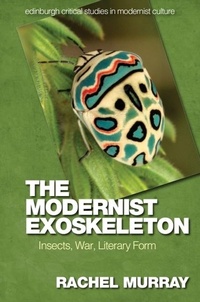
The Modernist Exoskeleton
Insects, War, Literary Form
Published on 3. March 2022
Book
Paperback/Softback
224 pages
978-1-4744-5820-7 (ISBN)
Description
Argues for the importance of insects to modernism's formal innovations
Uses the idea of the insect as a key to modernist writers' engagement with questions of politics, psychology, life, and literary formProvides in-depth analysis of lesser-known modernist narratives, such as H.D.'s Asphodel and Lewis's Snooty Baronet, as well as new readings of canonical texts - including D. H. Lawrence's Lady Chatterley's Lover and Samuel Beckett's TrilogyExplores the influence of popular scientific writing on modernist aestheticsReveals the attentiveness of modernist writers to nonhuman life, thus forging new lines of connection between modernism and literary animal studies
Focusing on the writing of Wyndham Lewis, D. H. Lawrence, H.D. and Samuel Beckett, this book uncovers a shared fascination with the aesthetic possibilities of the insect body - its adaptive powers, distinct stages of growth and swarming formations. Through a series of close readings, it proposes that the figure of the exoskeleton, which functions both as a protective outer layer and as a site of encounter, can enhance our understanding of modernism's engagement with nonhuman life, as well as its questioning of the boundaries of the human.
Uses the idea of the insect as a key to modernist writers' engagement with questions of politics, psychology, life, and literary formProvides in-depth analysis of lesser-known modernist narratives, such as H.D.'s Asphodel and Lewis's Snooty Baronet, as well as new readings of canonical texts - including D. H. Lawrence's Lady Chatterley's Lover and Samuel Beckett's TrilogyExplores the influence of popular scientific writing on modernist aestheticsReveals the attentiveness of modernist writers to nonhuman life, thus forging new lines of connection between modernism and literary animal studies
Focusing on the writing of Wyndham Lewis, D. H. Lawrence, H.D. and Samuel Beckett, this book uncovers a shared fascination with the aesthetic possibilities of the insect body - its adaptive powers, distinct stages of growth and swarming formations. Through a series of close readings, it proposes that the figure of the exoskeleton, which functions both as a protective outer layer and as a site of encounter, can enhance our understanding of modernism's engagement with nonhuman life, as well as its questioning of the boundaries of the human.
Reviews / Votes
For Murray, we must grapple with the ways in which modernist insects inscribe "a new kind of human existence" and a vision of the "self" that is "more aware of its surroundings, more receptive to other ways of being, more conscious of its frailty," while testing this against later writing that offers a more sustained dismantling of the carapace of individual identity (174). -- Derek Ryan * Modernism/modernity, Volume 29, Number 2, April 2022, pp. 431-436 * Murray's study is thorough without being exhaustive, and perceptive without being over-analytical. It provides the reader with a unique set of insights into key modernist authors and leaves a clear sense of how such an analysis might be extended to others. [...] After reading it, you will be seeing insects everywhere in art and literature. -- Joe Darlington * The Cambridge Quarterly * In this witty and provocative study, Rachel Murray writes with gusto about the creepy crawly underworld of bugs, showing a Joycean relish for the way these creatures have infested the English language with a multitude of insectile puns and metaphors. Her work reveals a dimension of modernism that few scholars have addressed and demonstrates how attention to the entomological can transform our understanding of the works concerned. -- Maud Ellmann, University of ChicagoMore details
Series
Language
English
Place of publication
Edinburgh
United Kingdom
Target group
College/higher education
Product notice
Paperback (trade)
Unsewn / adhesive bound
Illustrations
14 black and white illustrations
Dimensions
Height: 234 mm
Width: 156 mm
Thickness: 12 mm
Weight
322 gr
ISBN-13
978-1-4744-5820-7 (9781474458207)
Copyright in bibliographic data and cover images is held by Nielsen Book Services Limited or by the publishers or by their respective licensors: all rights reserved.
Schweitzer Classification
Other editions
Additional editions
E-Book
03/2020
Edinburgh University Press
€21.49
Available for download
Person
Rachel Murray is lecturer in English at Loughborough University. She is the author of several book chapters and articles in refereed journals including 'Insects in Language and Literature', A Cultural History of Insects, eds. Gene Kritsky, Vazrick Nasari (Bloomsbury, 2019); 'Beelines: Joyce's Apian Aesthetics', Humanities Special Issue: James Joyce, Animals, and the Non Human, Vol. 6, No. 2 (June 2017), pp. 1-14 and 'Vermicular Origins: The Creative Evolution of Samuel Beckett's Worm' [Winner of the 2016 BSLS/JLS Early Career Essay Prize], Journal of Literature and Science, Vol. 9, No. 2 (2016), pp. 19-35.
Content
List of illustrationsIntroduction
1. Shell Bursts: Wyndham Lewis
2. Formication: D. H. Lawrence
3. Cocoon States: H.D.
4. Larval Forms: Samuel Beckett
Conclusion Bibliography Index
1. Shell Bursts: Wyndham Lewis
2. Formication: D. H. Lawrence
3. Cocoon States: H.D.
4. Larval Forms: Samuel Beckett
Conclusion Bibliography Index