

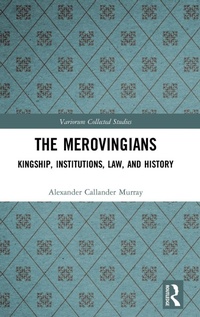
The Merovingians
Kingship, Institutions, Law, and History
1st Edition
Published on 18. May 2022
Book
Hardback
384 pages
978-1-032-05423-0 (ISBN)
Description
The studies collected here cover a period of about 33 years, from 1986 to 2019, and represent a sustained effort to understand the institutions of the Merovingian kingdom and its history. There has long been a predisposition to cast the Merovingian period in the dark colours of barbarism or to treat it with reference to personal relationships and archaic institutions. The present volume, instead, recognizes the Merovingian world not as an archaic, primitive intrusion on the Mediterranean civilization of the Roman Empire but simply as a participant in the wider commonwealth that existed before and remained after the dissolution of the western imperial system; in so doing, it serves to refute the scholarly tendency to primitivize Merovingian governance, its underlying institutions, and the broader culture upon which these rested.
The collection is divided into four parts. Part I considers the question of whether Merovingian kingship should be viewed as a species of archaic, 'sacral' kingship. Part II, on institutions, has chapters that deal with various offices (the grafio and centenarius), public institutions (especially immunity and public security), and the broader makeup of the Merovingian state system. Part III, on charters, procedure, and law, has chapters on the profile of the charter evidence as now presented in the new MGH edition of the Merovingian diplomas and one on particular procedures before the royal tribunal, mistakenly referred to in scholarship as 'fictitious' trials; a final chapter provides a reflection on, and basic guide to, the law in general of the successor kingdoms, with an eye to the evidence of Merovingian Gaul. Part IV, a slight change of pace, deals with historiography, both the modern variety (Reinhard Wenskus) and the Merovingian (Gregory of Tours). All chapters deal extensively with the historiography of their subjects.
This book will appeal to students and scholars alike interested in Early Medieval European history, Merovingian history, Early Medieval law and society, Early Medieval historiography, and the influence of Merovingian law and governance on later centuries. (CS 1104).
The collection is divided into four parts. Part I considers the question of whether Merovingian kingship should be viewed as a species of archaic, 'sacral' kingship. Part II, on institutions, has chapters that deal with various offices (the grafio and centenarius), public institutions (especially immunity and public security), and the broader makeup of the Merovingian state system. Part III, on charters, procedure, and law, has chapters on the profile of the charter evidence as now presented in the new MGH edition of the Merovingian diplomas and one on particular procedures before the royal tribunal, mistakenly referred to in scholarship as 'fictitious' trials; a final chapter provides a reflection on, and basic guide to, the law in general of the successor kingdoms, with an eye to the evidence of Merovingian Gaul. Part IV, a slight change of pace, deals with historiography, both the modern variety (Reinhard Wenskus) and the Merovingian (Gregory of Tours). All chapters deal extensively with the historiography of their subjects.
This book will appeal to students and scholars alike interested in Early Medieval European history, Merovingian history, Early Medieval law and society, Early Medieval historiography, and the influence of Merovingian law and governance on later centuries. (CS 1104).
More details
Series
Language
English
Place of publication
London
United Kingdom
Publishing group
Taylor & Francis Ltd
Target group
College/higher education
Illustrations
9 s/w Abbildungen, 4 s/w Photographien bzw. Rasterbilder, 5 s/w Zeichnungen, 1 s/w Tabelle
1 Tables, black and white; 5 Line drawings, black and white; 4 Halftones, black and white; 9 Illustrations, black and white
Dimensions
Height: 240 mm
Width: 161 mm
Thickness: 26 mm
Weight
766 gr
ISBN-13
978-1-032-05423-0 (9781032054230)
Copyright in bibliographic data and cover images is held by Nielsen Book Services Limited or by the publishers or by their respective licensors: all rights reserved.
Schweitzer Classification
Other editions
Additional editions
Book
05/2024
1st Edition
Routledge
€64.40
Shipment within 10-20 days
E-Book
05/2022
1st Edition
Routledge
€55.49
Available for download
E-Book
05/2022
1st Edition
Routledge
€55.49
Available for download
Person
Alexander Callander Murray is Professor of History Emeritus, University of Toronto, Canada. He is the author of Germanic Kinship Structure: Studies in Law and Society in Antiquity and the Early Middle Ages (1983); editor of After Rome's Fall: Narrators and Sources of Early Medieval History, Essays Presented to Walter Goffart (1998) and A Companion to Gregory of Tours (2016); and editor/translator of From Roman to Merovingian Gaul: A Reader (2000) and Gregory of Tours: The Merovingians (2006).
Content
1. Post vocantur Merohingii: Fredegar, Merovech, and 'Sacral Kingship' / 2. Gregory of Tours (Hist. II 10) and Fredegar (Chron. III 9) on the Paganism of the Franks: The Relation of the Texts and What They Say / 3. The Position of the Grafio in the Constitutional History of Merovingian Gaul / 4. From Roman to Frankish Gaul: Centenarii and Centenae in the Administration of the Merovingian Kingdom / 5. Immunity, Nobility and the Edict of Paris / 6. Merovingian Immunity Revisited / 7. The Merovingian State and Administration in the Times of Gregory of Tours / 8. Review Article: The New MGH Edition of the Charters of the Merovingian Kings / 9. So-called Fictitious Trials in the Merovingian Placita / 10. The Law of the Post-Roman Kingdoms / 11. Reinhard Wenskus on 'Ethnogenesis,' Ethnicity, and the Origin of the Franks / 12. The Composition of the Histories of Gregory of Tours and Its Bearing on the Political Narrative