

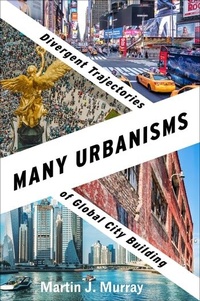
Many Urbanisms
Divergent Trajectories of Global City Building
Published on 15. February 2022
Book
Paperback/Softback
392 pages
978-0-231-20407-1 (ISBN)
Description
Winner, 2023 Choice Outstanding Academic Title
Now, for the first time in history, the majority of the world's population lives in cities. But urbanization is accelerating in some places and slowing down in others. The sprawling megacities of Asia and Africa, as well as many other smaller and medium-sized cities throughout the "Global South," are expected to continue growing. At the same time, older industrial cities in wealthier countries are experiencing protracted socioeconomic decline. Nonetheless, mainstream urban studies continues to treat a handful of superstar cities in Europe and North America as the exemplars of world urbanism, even though current global growth and development represent a dramatic break with past patterns.
Martin J. Murray offers a groundbreaking guide to the multiplicity, heterogeneity, and complexity of contemporary global urbanism. He identifies and traces four distinct pathways that characterize cities today: tourist-entertainment cities with world-class aspirations; struggling postindustrial cities; megacities experiencing hypergrowth; and "instant cities," or master-planned cities built from scratch. Murray shows how these different types of cities respond to different pressures and logics rather than progressing through the stages of a predetermined linear path. He highlights new spatial patterns of urbanization that have undermined conventional understandings of the city, exploring the emergence of polycentric, fragmented, haphazard, and unbounded metropolises. Such cities, he argues, should not be seen as deviations from a norm but rather as alternatives within a constellation of urban possibility. Innovative and wide-ranging, Many Urbanisms offers ways to understand the disparate forms of global cities today on their own terms.
Now, for the first time in history, the majority of the world's population lives in cities. But urbanization is accelerating in some places and slowing down in others. The sprawling megacities of Asia and Africa, as well as many other smaller and medium-sized cities throughout the "Global South," are expected to continue growing. At the same time, older industrial cities in wealthier countries are experiencing protracted socioeconomic decline. Nonetheless, mainstream urban studies continues to treat a handful of superstar cities in Europe and North America as the exemplars of world urbanism, even though current global growth and development represent a dramatic break with past patterns.
Martin J. Murray offers a groundbreaking guide to the multiplicity, heterogeneity, and complexity of contemporary global urbanism. He identifies and traces four distinct pathways that characterize cities today: tourist-entertainment cities with world-class aspirations; struggling postindustrial cities; megacities experiencing hypergrowth; and "instant cities," or master-planned cities built from scratch. Murray shows how these different types of cities respond to different pressures and logics rather than progressing through the stages of a predetermined linear path. He highlights new spatial patterns of urbanization that have undermined conventional understandings of the city, exploring the emergence of polycentric, fragmented, haphazard, and unbounded metropolises. Such cities, he argues, should not be seen as deviations from a norm but rather as alternatives within a constellation of urban possibility. Innovative and wide-ranging, Many Urbanisms offers ways to understand the disparate forms of global cities today on their own terms.
Reviews / Votes
Many Urbanisms is an excellent work of synthesis, and Murray is a gifted writer. In this book, he integrates a massive amount of urban theory literature in order to emphasize the differences between cities and to challenge the notion of a North to South order within contemporary urbanization. -- Jason Hackworth, author of <i>Manufacturing Decline: How Racism and the Conservative Movement Crush the American Rust Belt</i> This well-researched book makes an outstanding contribution to urban and policy studies...Highly recommended. * Choice * A fantastic and thoroughly enjoyable book. * Urbanities * Highly readable and sharply argued. * Contemporary Sociology * Makes significant steps to answer some of the issues regarding global urbanism. * Urban Design Journal * A nicely curated and staged presentation of the history of the theories and paradigms informing contemporary notions of the city and urbanization, including the moments and reasons key theories and paradigms were challenged and redirected. * Journal of the American Planning Association *More details
Language
English
Place of publication
New York
United States
Target group
Professional and scholarly
Product notice
Paperback (trade)
Illustrations
11 b&w photographs
Dimensions
Height: 235 mm
Width: 156 mm
ISBN-13
978-0-231-20407-1 (9780231204071)
Copyright in bibliographic data and cover images is held by Nielsen Book Services Limited or by the publishers or by their respective licensors: all rights reserved.
Schweitzer Classification
Other editions
Additional editions
E-Book
04/2022
1st Edition
Columbia University Press
€38.99
Available for download
Person
Martin J. Murray is a professor of urban planning in the Taubman College of Architecture and Urban Planning at the University of Michigan, where he is also an adjunct professor in the Department of Afroamerican and African Studies. His recent books include The Urbanism of Exception: The Dynamics of Global City Building in the Twenty-First Century (2017) and Panic City: Crime and the Fear Industries in Johannesburg (2020).
Content
Acknowledgments
Preface
Introduction: Rethinking Global Urbanism at the Start of the Twenty-First Century
Part I. Conventional Urban Theory at a Crossroads
1. The Narrow Preoccupations of Conventional Urban Studies
2. The Universalizing Pretensions of Mainstream Urban Studies: Generic Cities and the Convergence Thesis
Part II. Trajectories of Global Urbanism at the Start of the Twenty-First Century: A First Approximation
3. Globalizing Cities with World-Class Aspirations: The Emergence of the Postindustrial Tourist-Entertainment City
4. Struggling Postindustrial Cities in Decline
5. Sprawling Megacities of Hypergrowth: The Unplanned Urbanism of the Twenty-First Century
6. Building Cities on a Grand Scale: The Instant Urbanism of the Twenty-First Century
Part III. The Future of Urbanism
7. Conclusion: Urban Futures
Notes
Bibliography
Index
Preface
Introduction: Rethinking Global Urbanism at the Start of the Twenty-First Century
Part I. Conventional Urban Theory at a Crossroads
1. The Narrow Preoccupations of Conventional Urban Studies
2. The Universalizing Pretensions of Mainstream Urban Studies: Generic Cities and the Convergence Thesis
Part II. Trajectories of Global Urbanism at the Start of the Twenty-First Century: A First Approximation
3. Globalizing Cities with World-Class Aspirations: The Emergence of the Postindustrial Tourist-Entertainment City
4. Struggling Postindustrial Cities in Decline
5. Sprawling Megacities of Hypergrowth: The Unplanned Urbanism of the Twenty-First Century
6. Building Cities on a Grand Scale: The Instant Urbanism of the Twenty-First Century
Part III. The Future of Urbanism
7. Conclusion: Urban Futures
Notes
Bibliography
Index