

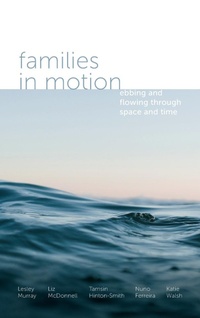
Families in Motion
Ebbing and Flowing Through Space and Time
Published on 25. October 2019
Book
Hardback
288 pages
978-1-78769-416-3 (ISBN)
Description
This
interdisciplinary edited collection will challenge the idea of the static
family that can be 'broken', and instead think of family as always 'on the
move', both conceptually and in practice. This dual approach to family is the unique
contribution of the book, which
offers new perspectives on the sociology and geography of the family, drawn
together by the shared lens of family mobilities. As such it brings together
insights from the diverse work of interdisciplinary academics working alone and
collaboratively on different aspects of family lives and relationships.
The central argument of the book is
that the concept of family is always in motion: a disruption in one aspect of
family relations, for example, the ending of the intimate relationship between
parents, is part of the ongoing project of family. In addition, families are
made through mobility and immobility in relation to people, communications,
objects and ideas. Contributions from a range of academics across disciplines consider
changes in family practices and the ways in which they are produced through
motion.
This book
seeks to understand families as always in motion; changing, adapting and
re-routed. Integral to this discussion is the spatiality and temporality of family,
that families are produced in different times and spaces. Families are also
made through interactions with material things, including non-human living
things and through the emotional ties and responses that determine their form
and practices.
interdisciplinary edited collection will challenge the idea of the static
family that can be 'broken', and instead think of family as always 'on the
move', both conceptually and in practice. This dual approach to family is the unique
contribution of the book, which
offers new perspectives on the sociology and geography of the family, drawn
together by the shared lens of family mobilities. As such it brings together
insights from the diverse work of interdisciplinary academics working alone and
collaboratively on different aspects of family lives and relationships.
The central argument of the book is
that the concept of family is always in motion: a disruption in one aspect of
family relations, for example, the ending of the intimate relationship between
parents, is part of the ongoing project of family. In addition, families are
made through mobility and immobility in relation to people, communications,
objects and ideas. Contributions from a range of academics across disciplines consider
changes in family practices and the ways in which they are produced through
motion.
This book
seeks to understand families as always in motion; changing, adapting and
re-routed. Integral to this discussion is the spatiality and temporality of family,
that families are produced in different times and spaces. Families are also
made through interactions with material things, including non-human living
things and through the emotional ties and responses that determine their form
and practices.
Reviews / Votes
Challenging the idea of a stable family, this volume brings together 14 chapters by social work, sociology, law, and other scholars from Europe, Australia, and the US, to explore the concept of the family as always in motion and the idea that movement and change are part of the ongoing constitution of family, focusing on the spatial and time aspects of family. They discuss how people move in and out of different contexts of family, become separated, and reconnect, in terms of fatherhood in family separations, prison, living together when an intimate relationship ends, and the way children of separated parents construct their home in the context of equal shared custody agreements; uneven motion and resistance in families, in terms of the role of information and communication technology in sustaining the mobility of transnational families, how family transitions offer opportunities for role redefinitions, strategies of resistance used by expectant mothers in response to the threat to their future relationship with unborn children, and everyday family practices like leisure activities; and aspects of family separations and how families are made, including absent fathers, children moving between two homes, what happens when families walk together, young people who have experienced foster care becoming parents, and the migration of Italian women in Morocco. -- Copyright 2019 * Portland, OR *More details
Language
English
Place of publication
Bingley
United Kingdom
Target group
Professional and scholarly
Dimensions
Height: 235 mm
Width: 157 mm
Thickness: 20 mm
Weight
571 gr
ISBN-13
978-1-78769-416-3 (9781787694163)
Copyright in bibliographic data and cover images is held by Nielsen Book Services Limited or by the publishers or by their respective licensors: all rights reserved.
Schweitzer Classification
Other editions
Additional editions
Lesley Murray | Liz McDonnell | Tamsin Hinton-Smith
Families in Motion
Ebbing and Flowing Through Space and Time
E-Book
10/2019
1st Edition
Emerald Publishing Limited
€86.49
Available for download
Persons
Lesley Murray is an Associate Professor in Sociology, University of Brighton, UK. Liz McDonnell is a Research Fellow and teaches on the MA in Gender studies at Sussex University, UK.
Tamsin Hinton-Smith is a Sociologist of Gender and Education, and a Senior Lecturer at the University of Sussex, UK.
Nuno Ferreira is a Professor of Law at the University of Sussex, UK.
Katie Walsh is Senior Lecturer in Human Geography at the University of Sussex, UK.
Tamsin Hinton-Smith is a Sociologist of Gender and Education, and a Senior Lecturer at the University of Sussex, UK.
Nuno Ferreira is a Professor of Law at the University of Sussex, UK.
Katie Walsh is Senior Lecturer in Human Geography at the University of Sussex, UK.
Content
1. Introduction; Lesley Murray, Liz McDonnell, Katie Walsh, Nuno Ferreira, and Tamsin Hinton-Smith Section 1: Moving Through Separation and Connection
2. Travelling Feelings: Narratives of Sustaining Love in Two Comparative Cultural Case Studies of Fathering During Family Separations; Alexandra Macht
3. 'Clinging on': Prison and the Changing Landscape of the Family; Marie Hutton
4. 'Living Together Apart' as Families in Transition; Liz Mcdonnell, Lesley Murray, Tamsin Hinton-Smith and Nuno Ferreira
5. 'The Sense of Space' of Children Living in Stepfamilies in Belgium; Laura Merla and Berengere Nobels
Section 2: Uneven Motions and Resistance
6. The Roles of ICTs in Sustaining the Mobilities of Transnational Families; Sondra Cuban
7. Life Course Transitions as Liminal Zones; Bella Marckmann
8. Jumping Through Hoops: Families' Experiences of Pre-Birth Child Protection; Ariane Critchley
9. Families and Flow: The Temporalities of Everyday Family Practices; Clare Holdsworth
Section 3: Traces and Potentialities
10. Losing A Father in a Demolished Ex-Industrial Landscape: A Researcher's Emotional Geography; Lisa Taylor
11. Children in Motion: Doing Family Across Two Households; Rakel Berman
12. Families on-Foot: Assembling Motherhood and Childhood Through Care and Play; Susannah Clement
13. Reconciling Past Family Disruption and Transitional Flux into the Present: Foster Care-Experienced Youths' Parenting Narratives; Caroline Cresswell
14. Moving to be a Family: The Case of Italian Women in Morocco; Maria Giovanna Cassa
2. Travelling Feelings: Narratives of Sustaining Love in Two Comparative Cultural Case Studies of Fathering During Family Separations; Alexandra Macht
3. 'Clinging on': Prison and the Changing Landscape of the Family; Marie Hutton
4. 'Living Together Apart' as Families in Transition; Liz Mcdonnell, Lesley Murray, Tamsin Hinton-Smith and Nuno Ferreira
5. 'The Sense of Space' of Children Living in Stepfamilies in Belgium; Laura Merla and Berengere Nobels
Section 2: Uneven Motions and Resistance
6. The Roles of ICTs in Sustaining the Mobilities of Transnational Families; Sondra Cuban
7. Life Course Transitions as Liminal Zones; Bella Marckmann
8. Jumping Through Hoops: Families' Experiences of Pre-Birth Child Protection; Ariane Critchley
9. Families and Flow: The Temporalities of Everyday Family Practices; Clare Holdsworth
Section 3: Traces and Potentialities
10. Losing A Father in a Demolished Ex-Industrial Landscape: A Researcher's Emotional Geography; Lisa Taylor
11. Children in Motion: Doing Family Across Two Households; Rakel Berman
12. Families on-Foot: Assembling Motherhood and Childhood Through Care and Play; Susannah Clement
13. Reconciling Past Family Disruption and Transitional Flux into the Present: Foster Care-Experienced Youths' Parenting Narratives; Caroline Cresswell
14. Moving to be a Family: The Case of Italian Women in Morocco; Maria Giovanna Cassa