

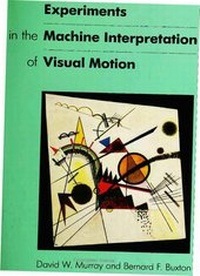
Experiments in the Machine Interpretation of Visual Motion
Published on 27. September 1990
Book
Hardback
262 pages
978-0-262-13263-3 (ISBN)
Description
If robots are to act intelligently in everyday environments, they must
have a perception of motion and its consequences. This book describes experimental
advances made in the interpretation of visual motion over the last few years that
have moved researchers closer to emulating the way in which we recover information
about the surrounding world. It describes algorithms that form a complete,
implemented, and tested system developed by the authors to measure two-dimensional
motion in an image sequence, then to compute three-dimensional structure and motion,
and finally to recognize the moving objects.
The authors develop
algorithms to interpret visual motion around four principal constraints. The first
and simplest allows the scene structure to be recovered on a pointwise basis. The
second constrains the scene to a set of connected straight edges. The third makes
the transition between edge and surface representations by demanding that the
wireframe recovered is strictly polyhedral. And the final constraint assumes that
the scene is comprised of planar surfaces, and recovers them
directly.
ContentsImage, Scene, and Motion;
Computing Image Motion; Structure from Motion of Points; The Structure and Motion of
Edges; From Edges to Surfaces; Structure and Motion of Planes; Visual Motion
Segmentation; Matching to Edge Models; Matching to Planar Surfaces.
have a perception of motion and its consequences. This book describes experimental
advances made in the interpretation of visual motion over the last few years that
have moved researchers closer to emulating the way in which we recover information
about the surrounding world. It describes algorithms that form a complete,
implemented, and tested system developed by the authors to measure two-dimensional
motion in an image sequence, then to compute three-dimensional structure and motion,
and finally to recognize the moving objects.
The authors develop
algorithms to interpret visual motion around four principal constraints. The first
and simplest allows the scene structure to be recovered on a pointwise basis. The
second constrains the scene to a set of connected straight edges. The third makes
the transition between edge and surface representations by demanding that the
wireframe recovered is strictly polyhedral. And the final constraint assumes that
the scene is comprised of planar surfaces, and recovers them
directly.
ContentsImage, Scene, and Motion;
Computing Image Motion; Structure from Motion of Points; The Structure and Motion of
Edges; From Edges to Surfaces; Structure and Motion of Planes; Visual Motion
Segmentation; Matching to Edge Models; Matching to Planar Surfaces.
More details
Series
Language
English
Place of publication
Cambridge, Mass.
United States
Publishing group
MIT Press Ltd
Target group
College/higher education
Professional and scholarly
US School Grade: College Graduate Student
Illustrations
87
Dimensions
Height: 229 mm
Width: 152 mm
Thickness: 0 mm
Weight
454 gr
ISBN-13
978-0-262-13263-3 (9780262132633)
Copyright in bibliographic data and cover images is held by Nielsen Book Services Limited or by the publishers or by their respective licensors: all rights reserved.
Schweitzer Classification
Other editions
Additional editions
David W. Murray | Bernard Buxton
Experiments in the Machine Interpretation of Visual Motion
Book
09/1990
MIT Press
€27.20
Article exhausted; check different version
Persons
David W. Murray is University Lecturer in Engineering Science at the University of Oxford and Draper's Fellow in Robotics at St Anne's College, Oxford.
Bernard F. Buxton is Senior Research Fellow at the General Electric Company's Hirst Research Centre, Wembley, UK, where he leads the Computer Vision Group in the Long Range Research Laboratory.
Bernard F. Buxton is Senior Research Fellow at the General Electric Company's Hirst Research Centre, Wembley, UK, where he leads the Computer Vision Group in the Long Range Research Laboratory.