

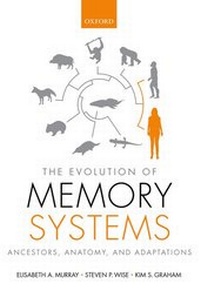
The Evolution of Memory Systems
Ancestors, Anatomy, and Adaptations
Published on 5. October 2017
Book
Paperback/Softback
528 pages
978-0-19-881713-0 (ISBN)
Description
Current theories about human memory have been shaped by clinical observations and animal experiments. This doctrine holds that the medial temporal lobe subserves one memory system for explicit or declarative memories, while the basal ganglia subserves a separate memory system for implicit or procedural memories, including habits. Cortical areas outside the medial temporal lobe are said to function in perception, motor control, attention, or other aspects of executive function, but not in memory.
'The Evolution of Memory Systems' advances dramatically different ideas on all counts. It proposes that several memory systems arose during evolution and that they did so for the same general reason: to transcend problems and exploit opportunities encountered by specific ancestors at particular times and places in the distant past.
Instead of classifying cortical areas in terms of mutually exclusive perception, executive, or memory functions, the authors show that all cortical areas contribute to memory and that they do so in their own ways-using specialized neural representations. The book also presents a proposal on the evolution of explicit memory. According to this idea, explicit (declarative) memory depends on interactions between a phylogenetically ancient navigation system and a representational system that evolved in humans to represent one's self and others. As a result, people embed representations of themselves into the events they experience and the facts they learn, which leads to the perception of participating in events and knowing facts.
'The Evolution of Memory Systems' is an important new work for students and researchers in neuroscience, psychology, and biology.
'The Evolution of Memory Systems' advances dramatically different ideas on all counts. It proposes that several memory systems arose during evolution and that they did so for the same general reason: to transcend problems and exploit opportunities encountered by specific ancestors at particular times and places in the distant past.
Instead of classifying cortical areas in terms of mutually exclusive perception, executive, or memory functions, the authors show that all cortical areas contribute to memory and that they do so in their own ways-using specialized neural representations. The book also presents a proposal on the evolution of explicit memory. According to this idea, explicit (declarative) memory depends on interactions between a phylogenetically ancient navigation system and a representational system that evolved in humans to represent one's self and others. As a result, people embed representations of themselves into the events they experience and the facts they learn, which leads to the perception of participating in events and knowing facts.
'The Evolution of Memory Systems' is an important new work for students and researchers in neuroscience, psychology, and biology.
Reviews / Votes
Capitalizing on major advances in our understanding of both memory and brain evolution, this book provides the first - and long overdue - account of memory systems placed in an evolutionary context. The result is a captivating and comprehensive survey of two histories, the history of the brain and the history of ideas about memory, which culminates in a new and provocative proposal for the origin of memory. Anyone interested in the brain and behaviour, evolution, or the history of science will find The Evolution of Memory Systems a stimulating read. * Morgan Barense, Associate Professor and Canada Research Chair in Cognitive Neuroscience, Department of Psychology, University of Toronto, Canada * The authors convincingly demonstrate that memory systems, and perhaps all neural systems, are best understood in terms of when and why they evolved to meet challenges of the past. Thus, this is a book for those interested in how brains work, and how they differ. This impressive book is like no other in its scope on the successive evolution of memory systems from early vertebrates to present-day humans. I want all my students and co-workers to read it. * Jon H. Kaas, Distinguished Centennial Professor of Psychology, Vanderbilt University, USA * A critical component of defining who we are requires an understanding of our individual past experiences and how they are represented in the brain, as well as how our brain, and in particular memory circuits, evolved in mammals. This book is a tour-de-force on the evolution of memory systems in mammals. It provides a wonderful historical perspective, and an extensive comparative analysis. While the major thrust is to understand human capabilities, particularly circuitry involved in memory, the authors painstakingly review the literature and clearly articulate that these systems did not evolve de novo in humans, but that a basic plan was present in our earliest ancestors. This type of discussion is rarely found in a neuroscience community entrenched in studies of single animal models. Kudos to the authors for writing the most comprehensive and interesting text currently available on this topic. * Leah Krubitzer, MacArthur Fellow, Professor of Psychology, University of California, Davis * Through their combined evolutionary and neuroscience approach the authors beautifully reveal the building blocks of memory systems that combine to produce the complexities of cognition in the human brain. * Trevor W. Robbins CBE, Professor of Cognitive Neuroscience and Experimental Psychology, University of Cambridge, UK * This is an important book for several reasons. First, there is the unique way that the authors formulate their proposals within an evolutionary context, explaining what makes memory special in mammals, in primates, and in humans. Second, their survey of the cognitive neuroscience of memory is guided by an exciting and provocative new taxonomy of memory systems that takes the reader far beyond the hippocampus and medial temporal lobe. * Matthew Rushworth, Professor of Cognitive Neuroscience, Department of Experimental Psychology, University of Oxford, UK *More details
Series
Language
English
Place of publication
Oxford
United Kingdom
Target group
College/higher education
Dimensions
Height: 247 mm
Width: 179 mm
Thickness: 25 mm
Weight
1020 gr
ISBN-13
978-0-19-881713-0 (9780198817130)
Copyright in bibliographic data and cover images is held by Nielsen Book Services Limited or by the publishers or by their respective licensors: all rights reserved.
Schweitzer Classification
Other editions
Additional editions
Elisabeth A. Murray | Steven P. Wise | Kim S. Graham
The Evolution of Memory Systems
Ancestors, Anatomy, and Adaptations
Book
11/2016
Oxford University Press
€136.50
Shipment within 15-20 days
Persons
Author
National Institute of Mental Health in Bethesda, MarylandNational Institute of Mental Health in Bethesda, Maryland, Head of the Laboratory of Neuropsychology
National Institute of Mental Health in Bethesda, MarylandNational Institute of Mental Health in Bethesda, Maryland, Former Chief of the Laboratory of Neurophysiology and Chief of the Section on Neurophysiology of the Laboratory of Systems Neuroscience
University of CardiffUniversity of Cardiff, Professor of Cognitive Neuroscience
Content
- List of abbreviations
- Glossary
- Epigraph
- Part I. Foundations of memory systems
- 1: The history of memory systems
- 2: The history of the brain
- Part II. Architecture of vertebrate memory
- 3: The reinforcement memory systems of early animals
- 4: The navigation memory system of early vertebrates
- 5: The biased-competition memory system of early mammals
- Part III. Primate augmentations
- 6: The manual-foraging memory system of early primates
- 7: The feature memory system of anthropoids
- 8: The goal memory system of anthropoids
- Part IV. Hominin adaptations
- 9: The goal and feature memory systems of hominins
- 10: The social-subjective memory system of hominins
- 11: The origin of explicit memory in hominins
- Part V. Deconstructing and reconstructing memory systems
- 12: Deconstructing amnesia
- 13: Reconstructing memory's past
- Epilogue
- Index
- Glossary
- Epigraph
- Part I. Foundations of memory systems
- 1: The history of memory systems
- 2: The history of the brain
- Part II. Architecture of vertebrate memory
- 3: The reinforcement memory systems of early animals
- 4: The navigation memory system of early vertebrates
- 5: The biased-competition memory system of early mammals
- Part III. Primate augmentations
- 6: The manual-foraging memory system of early primates
- 7: The feature memory system of anthropoids
- 8: The goal memory system of anthropoids
- Part IV. Hominin adaptations
- 9: The goal and feature memory systems of hominins
- 10: The social-subjective memory system of hominins
- 11: The origin of explicit memory in hominins
- Part V. Deconstructing and reconstructing memory systems
- 12: Deconstructing amnesia
- 13: Reconstructing memory's past
- Epilogue
- Index