

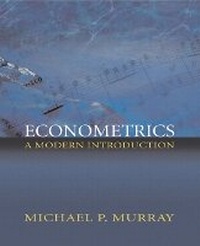
Econometrics
A Modern Introduction: United States Edition
Published on 22. September 2005
Book
Paperback/Softback
976 pages
978-0-321-11361-0 (ISBN)
Description
Econometrics: A Modern Introduction conditions students to think like econometricians right from the start by opening with a unique Monte Carlo exercise, and connects econometrics to economic theory through a series of exemplary econometric analyses presented throughout the text.
More details
Language
English
Place of publication
United States
Publishing group
Pearson Education (US)
Target group
Professional and scholarly
Dimensions
Height: 100 mm
Width: 100 mm
Thickness: 100 mm
Weight
100 gr
ISBN-13
978-0-321-11361-0 (9780321113610)
Copyright in bibliographic data and cover images is held by Nielsen Book Services Limited or by the publishers or by their respective licensors: all rights reserved.
Schweitzer Classification
Other editions
New editions
Book
09/2005
Pearson
€113.88
Article is exhausted; no reprint
Content
OVERVIEW
Part I - The Linear Regression Model
1. What is Econometrics?
2. Choosing Estimators: Intuition and Monte Carlo Methods
3. Linear Estimators and the Gauss-Markov Theorem
4. Blue Estimators for the Slope and Intercept of a Straight Line
5. Residuals
6. Multiple Regression
Part II - Specification and Hypothesis Testing
7. Testing Single Hypotheses in Regression Models
8. Superfluous and Omitted Variables, Multicollinearity and Binary Variables
9. Testing Multiple Hypotheses
Part III - Further Topics in Regression
10. Heteroskedastic Disturbances
11. Autoregressive Disturbances
12. Large Sample Properties Of Estimators: Consistency and Asymptotic Efficiency
13. Instrumental Variables Estimation
14. Systems of Equations
15. Randomized Experiments and Natural Experiments
16. Analyzing Panel Data
17. Forecasting
18. Stochastically Trending Variables
19. Logit and Probit Models: Truncated and Censored Samples
Statistical Appendix
WEB EXTENSION 1 USING CALCULUS AND ALGEBRA FOR THE SIMPLEST CASE: n = 3
WEB EXTENSION 2 LOCAL AVERAGE TREATMENT EFFECTS
WEB EXTENSION 3 GENERALIZED METHOD OF MOMENTS ESTIMATORS AND IDENTIFICATION
WEB EXTENSION 4 MAXIMUM LIKELIHOOD ESTIMATION
WEB EXTENSION 5 ESTIMATORS FOR SYSTEMS OF EQUATIONS
WEB EXTENSION 6 MULTIPLE COINTEGRATING RELATIONSHIPS
WEB EXTENSION 7 LOG-ODDS AND LOGIT MODELS: USING GROUPED DATA
WEB EXTENSION 8 MULTINOMIAL MODELS
Part I - The Linear Regression Model
1. What is Econometrics?
2. Choosing Estimators: Intuition and Monte Carlo Methods
3. Linear Estimators and the Gauss-Markov Theorem
4. Blue Estimators for the Slope and Intercept of a Straight Line
5. Residuals
6. Multiple Regression
Part II - Specification and Hypothesis Testing
7. Testing Single Hypotheses in Regression Models
8. Superfluous and Omitted Variables, Multicollinearity and Binary Variables
9. Testing Multiple Hypotheses
Part III - Further Topics in Regression
10. Heteroskedastic Disturbances
11. Autoregressive Disturbances
12. Large Sample Properties Of Estimators: Consistency and Asymptotic Efficiency
13. Instrumental Variables Estimation
14. Systems of Equations
15. Randomized Experiments and Natural Experiments
16. Analyzing Panel Data
17. Forecasting
18. Stochastically Trending Variables
19. Logit and Probit Models: Truncated and Censored Samples
Statistical Appendix
WEB EXTENSION 1 USING CALCULUS AND ALGEBRA FOR THE SIMPLEST CASE: n = 3
WEB EXTENSION 2 LOCAL AVERAGE TREATMENT EFFECTS
WEB EXTENSION 3 GENERALIZED METHOD OF MOMENTS ESTIMATORS AND IDENTIFICATION
WEB EXTENSION 4 MAXIMUM LIKELIHOOD ESTIMATION
WEB EXTENSION 5 ESTIMATORS FOR SYSTEMS OF EQUATIONS
WEB EXTENSION 6 MULTIPLE COINTEGRATING RELATIONSHIPS
WEB EXTENSION 7 LOG-ODDS AND LOGIT MODELS: USING GROUPED DATA
WEB EXTENSION 8 MULTINOMIAL MODELS