

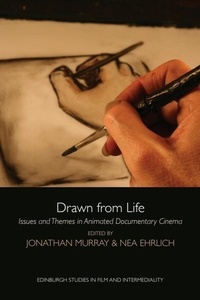
Drawn from Life
Issues and Themes in Animated Documentary Cinema
Published on 25. August 2020
Book
Paperback/Softback
256 pages
978-1-4744-3182-8 (ISBN)
Description
Documentary cinema has always drawn from real life, but an increasing number of contemporary filmmakers are going further still, drawing onscreen images of reality through a range of animated filmmaking techniques. Drawn from Life is the first book to explore the field of animated documentaries from a diverse range of scholarly and practice-based perspectives, exploring and proposing answers to a range of questions that preoccupy twenty-first-century film artists and audiences alike: Why use animation to document? How do such images reflect and influence our understanding and experience of reality, whether public or private, psychological or political? From early cinema to present-day scientific research, military uses, digital art and gaming, this book casts new light on the capacity of the moving image to act as a record of the world around us, challenging the orthodox definitions of documentary cinema.
Reviews / Votes
The work of the editors and chapter authors provides a valuable collection of information, philosophical thought and production considerations that every animation teacher, researcher and practitioner need to read and have handy. It will serve as a reference and provide guidance for their own investigation as well as for that of their students. -- Robert Musburger * Animationstudies 2.0 * Animation has become a vital documentary tool. How and why did this happen? Find the answer in this brilliant assembly of ground-breaking essays. -- Bill Nichols, author of Introduction to Documentary 3rd edition (2017)More details
Series
Language
English
Place of publication
Edinburgh
United Kingdom
Target group
Professional and scholarly
Product notice
Paperback (trade)
Unsewn / adhesive bound
Illustrations
30 black and white illustrations
Dimensions
Height: 229 mm
Width: 155 mm
Thickness: 18 mm
Weight
363 gr
ISBN-13
978-1-4744-3182-8 (9781474431828)
Copyright in bibliographic data and cover images is held by Nielsen Book Services Limited or by the publishers or by their respective licensors: all rights reserved.
Schweitzer Classification
Other editions
Additional editions
E-Book
11/2018
1st Edition
Edinburgh University Press
€28.49
Available for download
Persons
Jonathan Murray is Senior Lecturer in Film and Visual Culture at the University of Edinburgh. He is the author of The New Scottish Cinema (2015) and Discomfort and Joy (2011), a Contributing Writer for Cineaste magazine and co-Principal Editor of Journal of British Cinema and Television. Nea Ehrlich is Lecturer in The Department of the Arts at Ben Gurion University of the Negev in Israel.
Content
Nea Ehrlich and Jonathan Murray, 'Editors' Introduction'
Section 1: Past and Present
1.Pascal Lefevre, 'From Contextualisation to Categorisation of Animated Documentaries'
2.Mihaela Mihailova, 'Before Sound, there was Soul: The Role of Animation in Silent Nonfiction Cinema'
3.Nea Ehrlich, 'Indeterminate and Intermediate or Animated Non-Fiction: Why Now?'
Section 2: Defining Terms and Contexts
4. Paul Ward, 'Animated Documentary, Recollection, 'Re-Enactment' and Temporality'
5. Leon Gurevitch, 'The Documentary Attraction: Animation, Simulation and the Rhetoric of Expertise'
6. Paul Wells, 'Never Mind the Bollackers: Here's the Repositories, Sites and Archives in Non-Fiction Animation'
Section 3: Films and Filmmakers
7. Nanette Kraaikamp, 'Drawings to Remember'
8. Andrew Warstat, 'Adorno, Lewis Klahr and the Shuddering Image'
9. Lawrence Thomas Martinelli, 'The Reasons for Animating Reality: Animated Documentary and Re-enactment in the Work of Jonas Odell'
10. Jonathan Murray, 'Memory Drawn into the Present: Waltz with Bashir and Animated Documentary'
Section 4: Practice-based Perspectives
11. Jonathan Hodgson, 'Making The Trouble with Love and Sex'
12. Samantha Moore, ''Does this look right?' Working inside the collaborative frame'
13. Sheila M. Sofian, 'Creative Challenges in the Production of Documentary Animation'
Section 1: Past and Present
1.Pascal Lefevre, 'From Contextualisation to Categorisation of Animated Documentaries'
2.Mihaela Mihailova, 'Before Sound, there was Soul: The Role of Animation in Silent Nonfiction Cinema'
3.Nea Ehrlich, 'Indeterminate and Intermediate or Animated Non-Fiction: Why Now?'
Section 2: Defining Terms and Contexts
4. Paul Ward, 'Animated Documentary, Recollection, 'Re-Enactment' and Temporality'
5. Leon Gurevitch, 'The Documentary Attraction: Animation, Simulation and the Rhetoric of Expertise'
6. Paul Wells, 'Never Mind the Bollackers: Here's the Repositories, Sites and Archives in Non-Fiction Animation'
Section 3: Films and Filmmakers
7. Nanette Kraaikamp, 'Drawings to Remember'
8. Andrew Warstat, 'Adorno, Lewis Klahr and the Shuddering Image'
9. Lawrence Thomas Martinelli, 'The Reasons for Animating Reality: Animated Documentary and Re-enactment in the Work of Jonas Odell'
10. Jonathan Murray, 'Memory Drawn into the Present: Waltz with Bashir and Animated Documentary'
Section 4: Practice-based Perspectives
11. Jonathan Hodgson, 'Making The Trouble with Love and Sex'
12. Samantha Moore, ''Does this look right?' Working inside the collaborative frame'
13. Sheila M. Sofian, 'Creative Challenges in the Production of Documentary Animation'