

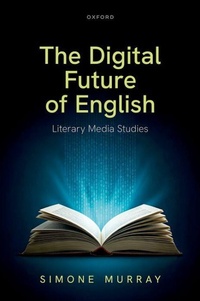
The Digital Future of English
Literary Media Studies
Published on 14. August 2025
Book
Hardback
256 pages
978-0-19-895261-9 (ISBN)
Description
More than any other academic discipline, literary studies is the creation of print culture. How then can it thrive in the digital era? Early 1990s predictions of the book's imminent demise presented a simplistic either/or choice between the legacy of moribund print and triumphalist digital technology. Yet we have grown to experience the two media as complexly interdependent and even complementary. Clearly, digital does not kill print. But literary studies in the digital era cannot simply resume business as usual. It is urgently necessary to reconsider the discipline's founding assumptions in light of digital technology.
The digital era prompts a rethinking of literary studies' object of study, as well as its methods, theories, audiences and pedagogical practices. What counts as literature necessarily shifts in an age of proliferating born-digital texts and do-it-yourself (DIY) online publication. Where should literary studies sit institutionally, and how might it graft contextually-oriented social sciences methods onto its traditionally humanistic mode of textual analysis? Why should literary study continue to marginalize emotional responses to texts when online communities bond via readerly affect? Who is the audience for literary criticism in an age where expertise is routinely challenged yet communication with global book-loving publics has never been technologically easier? Finally, how can we utilize digital tools to rejuvenate literary studies pedagogy and help English staff better connect with millennial-age students?
Literary studies has been convulsed for decades by debates over electronic literature and, more recently, digitally-aided 'distant reading'. But these discussions still mostly confine themselves to demarcating our proper object of study. We need to think more expansively about digital technology's impact on the underpinning tenets of the discipline. Literary Media Studies is pitched at fellow literary scholars, book historians, media theorists, cultural sociologists, digital humanists and those working at the interface of these converging disciplines. It models constructive engagement with contemporary digital culture. Most importantly, it brings a burst of sorely needed optimism to the question of literary studies' digital future.
The digital era prompts a rethinking of literary studies' object of study, as well as its methods, theories, audiences and pedagogical practices. What counts as literature necessarily shifts in an age of proliferating born-digital texts and do-it-yourself (DIY) online publication. Where should literary studies sit institutionally, and how might it graft contextually-oriented social sciences methods onto its traditionally humanistic mode of textual analysis? Why should literary study continue to marginalize emotional responses to texts when online communities bond via readerly affect? Who is the audience for literary criticism in an age where expertise is routinely challenged yet communication with global book-loving publics has never been technologically easier? Finally, how can we utilize digital tools to rejuvenate literary studies pedagogy and help English staff better connect with millennial-age students?
Literary studies has been convulsed for decades by debates over electronic literature and, more recently, digitally-aided 'distant reading'. But these discussions still mostly confine themselves to demarcating our proper object of study. We need to think more expansively about digital technology's impact on the underpinning tenets of the discipline. Literary Media Studies is pitched at fellow literary scholars, book historians, media theorists, cultural sociologists, digital humanists and those working at the interface of these converging disciplines. It models constructive engagement with contemporary digital culture. Most importantly, it brings a burst of sorely needed optimism to the question of literary studies' digital future.
Reviews / Votes
The Future of English is among the first books to grapple with the distinct forms and formats that media production takes on in the networks, communities, and markets comprising what Murray has previously termed the digital literary sphere. It is an invaluable roadmap for the discipline. * Matthew Kirschenbaum, Author of Bitstreams: The Future of Digital Literary Heritage * Murray lays out a bold plan to reinvent and reinvigorate literary studies for the age of digital media. What she proposes is not just to open the discipline to new kinds of object or to embrace new methods of analysis, but to reboot the whole program. I love this book for its audacious scope, its many concrete and practical suggestions, and its resolute optimism regarding possible future forms of bookish scholarship and teaching. * James F. English (U Pennsylvania), Author of The Economy of Prestige: Prizes, Awards, and the Circulation of Cultural Value * Simone Murray offers a refreshingly new take on literary studies for the digital era. Rich in case-studies and institutional insights, The Digital Future of English shows that while print culture remains central to the public sphere, the rise and ramification of digital environments require that we rethink fundamentally what literature is and how we should study it. Integrating cultural sociology, media theory, book history, audience ethnography, and the digital humanities, Murray proposes a 'literary media studies' framework that will be essential reading for scholars and educators grappling with literature's evolving environments. * Guenter Leypoldt (U Heidelberg), Author of Literature's Social Lives: A Socio-Institutional History of Literary Value * Simone Murray continues her ground-breaking work on the digital literary sphere by offering a new disciplinary approach to English. What she calls 'literary media studies' starts from the crucial premise that 'without the book business, there is no literary culture' and then proceeds to model analyses of the digital platforms and institutions that shape reading today. Murray is a bridge-builder between academic and popular readers and makes an airtight case for why literary scholars ignore digital media at our peril. * Aarthi Vadde (Duke U), Co-editor of The Critic as Amateur * An astute assessment of the changing field of literary studies that explains the recent past and argues for rethinking disciplinary paradigms to include and, indeed embrace, digital media and media studies to ensure the vitality of literary studies for the future. This book is a must-read for students and practitioners of literary studies who want to understand how digital media has inspired new reading strategies, objects of study, and debates. * Jessica Pressman (San Diego State U), Author of Bookishness: Loving Books in a Digital Age * Murray's reconceptualization of English as 'literary media studies' clears an inviting path forward for the discipline. Her many useful ideas for what such an enterprise would look like deserve careful consideration and wide debate. * Mark McGurl (Stanford U), Author of Everything and Less: The Novel in the Age of Amazon * The Digital Future of English convincingly paints the bigger picture of what is currently at stake for literary studies and how the discipline needs to change. Reading the book gives me the urge to post quotes from it all over my literature department along with the message: you need to read this! * Karl Berglund (Uppsala U), Author of Reading Audio Readers: Book Consumption in the Streaming Age * Simone Murray's The Digital Future of English: Literary Media Studies is a visionary reimagining of literary studies for the digital age-energetically dismantling outdated text-centric orthodoxies and replacing them with a media-aware framework that centres platforms, institutions, and readerly publics. With optimism and rigorous interdisciplinary insight, Murray doesn't just predict the future of the discipline but actively builds it, showing how digital technologies can revitalize methods, pedagogy, and engagement with literature in the 21st century. * Federico Pianzola (U Groningen), Author of Digital Social Reading: Sharing Fiction in the 21st Century * Simone Murray's new book, The Digital Future of English, demonstrates, quite brilliantly, how 'literary media studies' can pose essential, big-picture questions about the future of our discipline. She provides a compelling analysis of how the study of literature was originally situated within the academy and then shows how that legacy can be reframed---by asking what now counts as literature and who are literary studies' contemporary publics. This book should be required reading for anyone who remains committed to teaching literary texts, in whatever form they might take, and is eager to explore how digital media should transform how we talk about texts and reading pleasure with our students. * Jim Collins (U Notre Dame), Author of Bring on the Books for Everybody: How Literary Culture Became Popular Culture *More details
Language
English
Place of publication
Oxford
United Kingdom
Target group
Professional and scholarly
College/higher education
Product notice
sewn/stitched
Cloth over boards
Dimensions
Height: 236 mm
Width: 164 mm
Thickness: 20 mm
Weight
594 gr
ISBN-13
978-0-19-895261-9 (9780198952619)
Copyright in bibliographic data and cover images is held by Nielsen Book Services Limited or by the publishers or by their respective licensors: all rights reserved.
Schweitzer Classification
Person
Simone Murray is Associate Professor in Literary Studies at Monash University, Melbourne, and an elected Fellow of the Australian Academy of the Humanities. She is author of four previous monographs: Mixed Media: Feminist Presses and Publishing Politics (Pluto Press, 2004) which was awarded the 2005 DeLong Book Prize by the Society for the History of Authorship, Reading and Publishing; The Adaptation Industry: The Cultural Economy of Contemporary Literary Adaptation (Routledge US, 2012); The Digital Literary Sphere: Reading, Writing, and Selling Books in the Internet Era (Johns Hopkins UP, 2018); and Introduction to Contemporary Print Culture: Books as Media (Routledge UK, 2021).
Content
Introduction: Varieties of Digital Literary StudiesaMicro, Macro, Meso 1: Object of Study: Broadening Conceptions of aLiteraturea for the Digital Era 2: Literary Institutions: Situating English between the Humanities and Social Sciences 3: The Problem of Affect: Literary Studies, BookTube, and BookTok 4: Reading Publics: Bridging Scholarly and Popular Bookish Audiences in the Digital Age 5: Machine Learning: Literary Studies Pedagogy in the Digital Era Conclusion: Realizing Literary Media Studies