

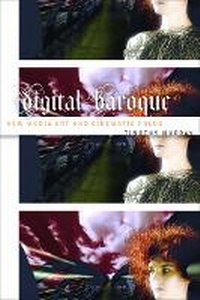
Digital Baroque
New Media Art and Cinematic Folds
Published on 1. December 2008
Book
Hardback
320 pages
978-0-8166-3401-9 (ISBN)
Description
A surprising and original application of theories of new media art
In this intellectually groundbreaking work, Timothy Murray investigates a paradox embodied in the book's title: What is the relationship between digital, in the form of new media art, and baroque, a highly developed early modern philosophy of art? Making an exquisite and unexpected connection between the old and the new, Digital Baroque analyzes the philosophical paradigms that inform contemporary screen arts.
Examining a wide range of art forms, Murray reflects on the rhetorical, emotive, and social forces inherent in the screen arts' dialogue with early modern concepts. Among the works discussed are digitally oriented films by Peter Greenaway, Jean-Luc Godard, and Chris Marker; video installations by Thierry Kuntzel, Keith Piper, and Renate Ferro; and interactive media works by Toni Dove, David Rokeby, and Jill Scott. Sophisticated readings reveal the electronic psychosocial webs and digital representations that link text, film, and computer.
Murray puts forth an innovative Deleuzian psychophilosophical approach-one that argues that understanding new media art requires a fundamental conceptual shift from linear visual projection to nonlinear temporal folds intrinsic to the digital form.
In this intellectually groundbreaking work, Timothy Murray investigates a paradox embodied in the book's title: What is the relationship between digital, in the form of new media art, and baroque, a highly developed early modern philosophy of art? Making an exquisite and unexpected connection between the old and the new, Digital Baroque analyzes the philosophical paradigms that inform contemporary screen arts.
Examining a wide range of art forms, Murray reflects on the rhetorical, emotive, and social forces inherent in the screen arts' dialogue with early modern concepts. Among the works discussed are digitally oriented films by Peter Greenaway, Jean-Luc Godard, and Chris Marker; video installations by Thierry Kuntzel, Keith Piper, and Renate Ferro; and interactive media works by Toni Dove, David Rokeby, and Jill Scott. Sophisticated readings reveal the electronic psychosocial webs and digital representations that link text, film, and computer.
Murray puts forth an innovative Deleuzian psychophilosophical approach-one that argues that understanding new media art requires a fundamental conceptual shift from linear visual projection to nonlinear temporal folds intrinsic to the digital form.
More details
Series
Language
English
Place of publication
Minnesota
United States
Target group
College/higher education
Professional and scholarly
Dimensions
Height: 229 mm
Width: 152 mm
ISBN-13
978-0-8166-3401-9 (9780816634019)
Copyright in bibliographic data and cover images is held by Nielsen Book Services Limited or by the publishers or by their respective licensors: all rights reserved.
Schweitzer Classification
Person
Timothy Murray is professor of comparative literature and English, director of the Society for the Humanities, and curator of the Rose Goldsen Archive of New Media Art at Cornell University. He is the author of Drama Trauma: Specters of Race and Sexuality in Performance, Video, and Art; Like a Film: Ideological Phantasy on Screen, Camera, and Canvas; Theatrical Legitimation: Allegories of Genius in Seventeenth-Century England and France; the coeditor of Repossessions: Psychoanalysis and the Phantasms of Early Modern Culture (Minnesota, 1998); and editor of Mimesis, Masochism, and Mime: The Politics of Theatricality in Contemporary French Thought.