

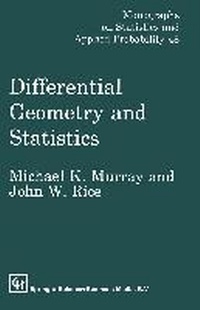
Differential Geometry and Statistics
Published on 1. April 1993
Book
Paperback/Softback
XIII, 272 pages
978-0-412-39860-5 (ISBN)
Description
Several years ago our statistical friends and relations introduced us to the work of Amari and Barndorff-Nielsen on applications of differential geometry to statistics. This book has arisen because we believe that there is a deep relationship between statistics and differential geometry and moreoever that this relationship uses parts of differential geometry, particularly its 'higher-order' aspects not readily accessible to a statistical audience from the existing literature. It is, in part, a long reply to the frequent requests we have had for references on differential geometry! While we have not gone beyond the path-breaking work of Amari and Barndorff Nielsen in the realm of applications, our book gives some new explanations of their ideas from a first principles point of view as far as geometry is concerned. In particular it seeks to explain why geometry should enter into parametric statistics, and how the theory of asymptotic expansions involves a form of higher-order differential geometry. The first chapter of the book explores exponential families as flat geometries. Indeed the whole notion of using log-likelihoods amounts to exploiting a particular form of flat space known as an affine geometry, in which straight lines and planes make sense, but lengths and angles are absent. We use these geometric ideas to introduce the notion of the second fundamental form of a family whose vanishing characterises precisely the exponential families.
Reviews / Votes
"This book does an excellent job of explaining... geometrical ideas from a statistical point of view, using statistical examples as opposed to, for example, dynamical examples to illustrate the geometric concepts. It should prove most helpful in enlarging the typical statistician's working geometric vocabulary."-Short Book Reviews of the ISI
"It is particularly good on the... problem of when to use coordinates and indices, and when to use the more geometric coordinate-free methods. Examples of this are its treatments of the affine connection and of the string theory of Barndorff-Nielsen, both of which are excellent. The first of these concepts is probably the most sophisticated that has been used in statistical applications. It can be viewed in many different ways, not all of which are necessarily useful to the statistician; the approach taken in the book is both relevant and clear."
-Bulletin of London Mathematical Society
More details
Series
Edition
Softcover reprint of the original 1st ed. 1993
Language
English
Place of publication
Oxford
United Kingdom
Publishing group
Taylor & Francis Ltd
Target group
Professional and scholarly
Research
Product notice
sewn/stitched
Cloth over boards
Dimensions
Height: 240 mm
Width: 154 mm
Thickness: 21 mm
Weight
540 gr
ISBN-13
978-0-412-39860-5 (9780412398605)
DOI
10.1007/978-1-4899-3306-5
Schweitzer Classification
Other editions
Additional editions
M.K. Murray
Differential Geometry and Statistics
E-Book
10/2017
Chapman & Hall/CRC
€251.99
Available for download
M.K. Murray | J.W. Rice
Differential Geometry and Statistics
E-Book
10/2017
Chapman & Hall/CRC
€251.99
Available for download
Persons
M.K. Murray
Content
The geometry of exponential families.- Calculus on manifolds.- Statistical manifolds.- Connections.- Curvature.- Information metrics and statistical divergences.- Asymptotics.- Bundles and tensors.- Higher-order geometry.