

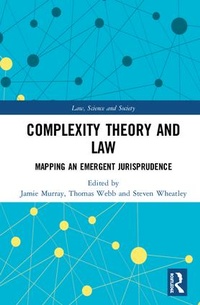
Complexity Theory and Law
Mapping an Emergent Jurisprudence
1st Edition
Published on 31. July 2018
Book
Hardback
288 pages
978-0-415-78609-6 (ISBN)
Description
This collection of essays explores the different ways the insights from complexity theory can be applied to law. Complexity theory - a variant of systems theory - views law as an emergent, complex, self-organising system comprised of an interactive network of actors and systems that operate with no overall guiding hand, giving rise to complex, collective behaviour in law communications and actions. Addressing such issues as the unpredictability of legal systems, the ability of legal systems to adapt to changes in society, the importance of context, and the nature of law, the essays look to the implications of a complexity theory analysis for the study of public policy and administrative law, international law and human rights, regulatory practices in business and finance, and the practice of law and legal ethics. These are areas where law, which craves certainty, encounters unending, irresolvable complexity. This collection shows the many ways complexity theory thinking can reshape and clarify our understanding of the various problems relating to the theory and practice of law.
More details
Series
Language
English
Place of publication
London
United Kingdom
Publishing group
Taylor & Francis Ltd
Target group
College/higher education
Dimensions
Height: 234 mm
Width: 156 mm
Weight
710 gr
ISBN-13
978-0-415-78609-6 (9780415786096)
Copyright in bibliographic data and cover images is held by Nielsen Book Services Limited or by the publishers or by their respective licensors: all rights reserved.
Schweitzer Classification
Other editions
Additional editions
Jamie Murray | Thomas Webb | Steven Wheatley
Complexity Theory and Law
Mapping an Emergent Jurisprudence
Book
12/2019
1st Edition
Routledge
€68.70
Shipment within 15-20 days
Jamie Murray | Thomas Webb | Steven Wheatley
Complexity Theory and Law
Mapping an Emergent Jurisprudence
E-Book
07/2018
1st Edition
Routledge
€61.99
Available for download
Jamie Murray | Thomas Webb | Steven Wheatley
Complexity Theory and Law
Mapping an Emergent Jurisprudence
E-Book
07/2018
1st Edition
Routledge
€61.99
Available for download
Persons
Jamie Murray is Senior Lecturer in Law at Liverpool Hope University.
Thomas E. Webb is Lecturer in Law at the University of Lancaster.
Steven Wheatley is Professor of International Law at the University of Lancaster.
Thomas E. Webb is Lecturer in Law at the University of Lancaster.
Steven Wheatley is Professor of International Law at the University of Lancaster.
Content
Table of Contents
Contributors
Section I - Law's Complexity
Jamie Murray, Thomas E. Webb and Steven Wheatley, Encountering Law's Complexity
JB Ruhl and Daniel M. Katz, Mapping Law's Complexity with "Legal Maps"
Section II - Complexity and the State: Public Law and Policy
Neville Harris, Complexity: Knowing It, Measuring It, Assessing It
Thomas E. Webb, Asylum and Complexity: The Vulnerable Identity of Law as a Complex System
Section III - Complexity Beyond the State: Human Rights and International Law
Steven Wheatley, Explaining Change in the United Nations System: The Curious Status of Security Council Resolution 80 (1950)
Dimitrios Tsarapatsanis, The "Consensus Approach" of the ECtHR as a Rational Response to Complexity
Anna Marie Brennan, Prospects for Prosecuting Non-State Armed Groups under International Criminal Law: Perspectives from Complexity Theory
Section IV Complexity and Business and Finance Regulation
Mark Chinen, Governing Complexity
Michael Leach, Complex Regulatory Space and Banking
Jamie Murray, Regulating for ecological resilience: A new Agenda for Financial Regulation
Section V - Complexity and the Ethics of Law and Legal Practice
Lucy Finchett-Maddock, Nonlinearity, Autonomy and Resistant Law
Minka Woermann, Complexity and the Normativity of Law
Julian Webb, Regulating the Practise of Practice: On Agency and Entropy in Legal Ethics
Contributors
Section I - Law's Complexity
Jamie Murray, Thomas E. Webb and Steven Wheatley, Encountering Law's Complexity
JB Ruhl and Daniel M. Katz, Mapping Law's Complexity with "Legal Maps"
Section II - Complexity and the State: Public Law and Policy
Neville Harris, Complexity: Knowing It, Measuring It, Assessing It
Thomas E. Webb, Asylum and Complexity: The Vulnerable Identity of Law as a Complex System
Section III - Complexity Beyond the State: Human Rights and International Law
Steven Wheatley, Explaining Change in the United Nations System: The Curious Status of Security Council Resolution 80 (1950)
Dimitrios Tsarapatsanis, The "Consensus Approach" of the ECtHR as a Rational Response to Complexity
Anna Marie Brennan, Prospects for Prosecuting Non-State Armed Groups under International Criminal Law: Perspectives from Complexity Theory
Section IV Complexity and Business and Finance Regulation
Mark Chinen, Governing Complexity
Michael Leach, Complex Regulatory Space and Banking
Jamie Murray, Regulating for ecological resilience: A new Agenda for Financial Regulation
Section V - Complexity and the Ethics of Law and Legal Practice
Lucy Finchett-Maddock, Nonlinearity, Autonomy and Resistant Law
Minka Woermann, Complexity and the Normativity of Law
Julian Webb, Regulating the Practise of Practice: On Agency and Entropy in Legal Ethics