

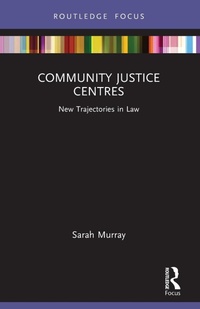
Community Justice Centres
New Trajectories in Law
1st Edition
Published on 31. May 2023
Book
Paperback/Softback
98 pages
978-1-032-13720-9 (ISBN)
Description
This book examines the phenomenon of Community Justice Centres and their potential to transform the justice landscape by tackling the underlying causes of crime.
Marred by recidivism, addiction, family violence, overflowing courtrooms, crippling prison spending and extreme rates of incarceration, the criminal justice system is in crisis. Community Justice Centres seek to combat this by tackling the underlying causes of crime in a particular neighbourhood and working with local people to redesign the experience of justice and enhance the notion of community. A Community Justice Centre houses a court which works with an interdisciplinary team to address the causes of criminality such as drug addiction, cognitive impairment, mental illness, poverty, abuse and intergenerational trauma. The community thus becomes a key agent of change, partnering with the Centre to tackle local issues and improve safety and community cohesion. This book, based on research into this innovative justice model, examines case studies from around the world, the challenges presented by the model and the potential for bringing its learnings into the mainstream.
This book will appeal to academics in law and criminology as well as psychology; it will also be of considerable interest to people working in the criminal justice system, including the police, government policy advisers, psychologists and social workers.
Marred by recidivism, addiction, family violence, overflowing courtrooms, crippling prison spending and extreme rates of incarceration, the criminal justice system is in crisis. Community Justice Centres seek to combat this by tackling the underlying causes of crime in a particular neighbourhood and working with local people to redesign the experience of justice and enhance the notion of community. A Community Justice Centre houses a court which works with an interdisciplinary team to address the causes of criminality such as drug addiction, cognitive impairment, mental illness, poverty, abuse and intergenerational trauma. The community thus becomes a key agent of change, partnering with the Centre to tackle local issues and improve safety and community cohesion. This book, based on research into this innovative justice model, examines case studies from around the world, the challenges presented by the model and the potential for bringing its learnings into the mainstream.
This book will appeal to academics in law and criminology as well as psychology; it will also be of considerable interest to people working in the criminal justice system, including the police, government policy advisers, psychologists and social workers.
More details
Series
Language
English
Place of publication
London
United Kingdom
Publishing group
Taylor & Francis Ltd
Target group
College/higher education
Postgraduate and Undergraduate
Dimensions
Height: 216 mm
Width: 140 mm
Thickness: 6 mm
Weight
138 gr
ISBN-13
978-1-032-13720-9 (9781032137209)
Copyright in bibliographic data and cover images is held by Nielsen Book Services Limited or by the publishers or by their respective licensors: all rights reserved.
Schweitzer Classification
Other editions
Additional editions
Book
09/2021
1st Edition
Routledge
€76.60
Shipment within 15-20 days
E-Book
09/2021
1st Edition
Routledge
€27.49
Available for download
E-Book
09/2021
1st Edition
Routledge
€27.49
Available for download
Person
Dr Sarah Murray is a Professor of Law at the University of Western Australia Law School where she researches in the areas of constitutional law and court innovation.
Content
Preface. Introduction: Court Reform and the Community Justice Centre Experience - Midtown and Beyond. 2 The Community Justice Centre Model. 3 Case studies of Community Justice. 4 Lessons from Community Justice: Evaluations, Boundaries and Obstacles. 5 The Possibilities of Mainstreaming the Model. 6 Conclusion: The Future of Community Justice: Prospects and Challenges.