

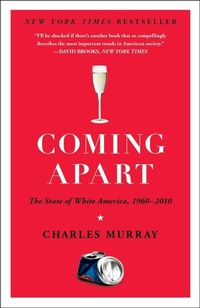
Coming Apart
The State of White America, 1960-2010
Published on 29. January 2013
Book
Paperback/Softback
432 pages
978-0-307-45343-3 (ISBN)
Description
NEW YORK TIMES BESTSELLER • A fascinating explanation for why white America has become fractured and divided in education and class, from the acclaimed author of Human Diversity.
"I'll be shocked if there's another book that so compellingly describes the most important trends in American society."-David Brooks, New York Times
In Coming Apart, Charles Murray explores the formation of American classes that are different in kind from anything we have ever known, focusing on whites as a way of driving home the fact that the trends he describes do not break along lines of race or ethnicity.
Drawing on five decades of statistics and research, Coming Apart demonstrates that a new upper class and a new lower class have diverged so far in core behaviors and values that they barely recognize their underlying American kinship-divergence that has nothing to do with income inequality and that has grown during good economic times and bad.
The top and bottom of white America increasingly live in different cultures, Murray argues, with the powerful upper class living in enclaves surrounded by their own kind, ignorant about life in mainstream America, and the lower class suffering from erosions of family and community life that strike at the heart of the pursuit of happiness. That divergence puts the success of the American project at risk.
The evidence in Coming Apart is about white America. Its message is about all of America.
"I'll be shocked if there's another book that so compellingly describes the most important trends in American society."-David Brooks, New York Times
In Coming Apart, Charles Murray explores the formation of American classes that are different in kind from anything we have ever known, focusing on whites as a way of driving home the fact that the trends he describes do not break along lines of race or ethnicity.
Drawing on five decades of statistics and research, Coming Apart demonstrates that a new upper class and a new lower class have diverged so far in core behaviors and values that they barely recognize their underlying American kinship-divergence that has nothing to do with income inequality and that has grown during good economic times and bad.
The top and bottom of white America increasingly live in different cultures, Murray argues, with the powerful upper class living in enclaves surrounded by their own kind, ignorant about life in mainstream America, and the lower class suffering from erosions of family and community life that strike at the heart of the pursuit of happiness. That divergence puts the success of the American project at risk.
The evidence in Coming Apart is about white America. Its message is about all of America.
More details
Language
English
Place of publication
New York
United States
Publishing group
Random House USA Inc
Product notice
Paperback (trade)
Dimensions
Height: 203 mm
Width: 131 mm
Thickness: 27 mm
Weight
478 gr
ISBN-13
978-0-307-45343-3 (9780307453433)
Copyright in bibliographic data and cover images is held by Nielsen Book Services Limited or by the publishers or by their respective licensors: all rights reserved.
Schweitzer Classification
Other editions
Additional editions

E-Book
01/2012
1st Edition
Crown Forum
€14.99
Available for download
Person
Charles Murray is the W. H. Brady Scholar at the American Enterprise Institute. He first came to national attention in 1984 with Losing Ground. His subsequent books include In Pursuit, The Bell Curve (with Richard J. Herrnstein), What It Means to Be a Libertarian, Human Accomplishment, In Our Hands, and Real Education. He received a bachelor’s degree in history from Harvard and a Ph.D. in political science from the Massachusetts Institute of Technology. He lives with his wife in Burkittsville, Maryland.
Content
Prologue: November 21, 1963 1
Part I
The Formation of a New Upper Class
1. Our Kind of People
2. The Foundations of the New Upper Class
3. A New Kind of Segregation
4. How Thick Is Your Bubble?
5. The Bright Side of the New Upper Class
Part II
The Formation of a New Lower Class
6. The Founding Virtues
7. Belmont and Fishtown
8. Marriage
9. Industriousness
10. Honesty
11. Religiosity
12. The Real Fishtown
13. The Size of the New Lower Class
Part III
Why It Matters
14. The Selective Collapse of American Community
15. The Founding Virtues and the Stuff of Life
16. One Nation, Divisible
17. Alternative Futures
Acknowledgments
Appendix A: Data Sources and Presentation
Appendix B: Supplemental Material for the Segregation Chapter
Appendix C: Supplemental Material for the Chapter on Belmont and
Fishtown
Appendix D: Supplemental Material for the Marriage Chapter
Appendix E: Supplemental Material for the Honesty Chapter
Appendix F: Supplemental Material for the American Community
Chapter
Appendix G: Supplemental Material for the Chapter About the Founding
Virtues and the Stuff of Life
Notes
Bibliography
Index
Part I
The Formation of a New Upper Class
1. Our Kind of People
2. The Foundations of the New Upper Class
3. A New Kind of Segregation
4. How Thick Is Your Bubble?
5. The Bright Side of the New Upper Class
Part II
The Formation of a New Lower Class
6. The Founding Virtues
7. Belmont and Fishtown
8. Marriage
9. Industriousness
10. Honesty
11. Religiosity
12. The Real Fishtown
13. The Size of the New Lower Class
Part III
Why It Matters
14. The Selective Collapse of American Community
15. The Founding Virtues and the Stuff of Life
16. One Nation, Divisible
17. Alternative Futures
Acknowledgments
Appendix A: Data Sources and Presentation
Appendix B: Supplemental Material for the Segregation Chapter
Appendix C: Supplemental Material for the Chapter on Belmont and
Fishtown
Appendix D: Supplemental Material for the Marriage Chapter
Appendix E: Supplemental Material for the Honesty Chapter
Appendix F: Supplemental Material for the American Community
Chapter
Appendix G: Supplemental Material for the Chapter About the Founding
Virtues and the Stuff of Life
Notes
Bibliography
Index