

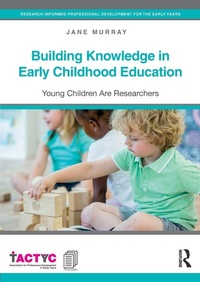
Building Knowledge in Early Childhood Education
Young Children Are Researchers
1st Edition
Published on 27. April 2017
Book
Paperback/Softback
196 pages
978-1-138-93794-9 (ISBN)
Description
A focal point of early childhood education is how young children build knowledge and the ways that practitioners, parents and carers can help them to do so. Many adults find it challenging to identify what knowledge young children are building and how they do so, making it difficult to support young children's learning and development in the most effective ways. This essential guide will help you to identify and develop young children's knowledge and understanding in early years settings, not only in terms of statutory requirements but far beyond them.
Building Knowledge in Early Childhood Education draws on empirical research findings from the Young Children As Researchers (YCAR) project to examine everyday activities and reveal the means that young children use to build knowledge and understanding, as well as exploring the similarities between learning behaviours in early childhood and adult life.
Interweaving everyday activities in practice with research and theory, this book covers:
how young children construct knowledge;
learning, problem-solving and exploring;
concepts and conceptualising in early childhood;
evidence-based decision-making;
how young children behave as researchers.
Offering practical advice and suggestions to create opportunities that identify and facilitate young children's own constructions of knowledge and understanding, this book is essential reading for practitioners, students and all those interested in the theories surrounding young children as researchers.
Building Knowledge in Early Childhood Education draws on empirical research findings from the Young Children As Researchers (YCAR) project to examine everyday activities and reveal the means that young children use to build knowledge and understanding, as well as exploring the similarities between learning behaviours in early childhood and adult life.
Interweaving everyday activities in practice with research and theory, this book covers:
how young children construct knowledge;
learning, problem-solving and exploring;
concepts and conceptualising in early childhood;
evidence-based decision-making;
how young children behave as researchers.
Offering practical advice and suggestions to create opportunities that identify and facilitate young children's own constructions of knowledge and understanding, this book is essential reading for practitioners, students and all those interested in the theories surrounding young children as researchers.
More details
Series
Language
English
Place of publication
London
United Kingdom
Publishing group
Taylor & Francis Ltd
Target group
College/higher education
Professional and scholarly
Illustrations
15 s/w Abbildungen, 4 s/w Photographien bzw. Rasterbilder, 11 s/w Zeichnungen, 18 s/w Tabellen
18 Tables, black and white; 11 Line drawings, black and white; 4 Halftones, black and white; 15 Illustrations, black and white
Dimensions
Height: 246 mm
Width: 174 mm
Thickness: 11 mm
Weight
363 gr
ISBN-13
978-1-138-93794-9 (9781138937949)
Copyright in bibliographic data and cover images is held by Nielsen Book Services Limited or by the publishers or by their respective licensors: all rights reserved.
Schweitzer Classification
Other editions
Additional editions
E-Book
04/2017
Routledge
€49.99
Available for download
E-Book
04/2017
Routledge
€49.99
Available for download
Book
04/2017
1st Edition
Routledge
€215.77
Shipment within 10-20 days
Person
Jane Murray is Senior Lecturer in Early Years Education at the University of Northampton, UK. She is also a qualified headteacher and a former early childhood teacher.
Content
Series editors' preface
Acknowledgements
1. Introduction
2. What does it mean to know?
3. Young children explore
4. Young children find solutions
5. Young children conceptualise
6. Young children base decisions on evidence
7. Conclusions: Young children build knowledge, young children are researchers
Appendices
Acknowledgements
1. Introduction
2. What does it mean to know?
3. Young children explore
4. Young children find solutions
5. Young children conceptualise
6. Young children base decisions on evidence
7. Conclusions: Young children build knowledge, young children are researchers
Appendices