

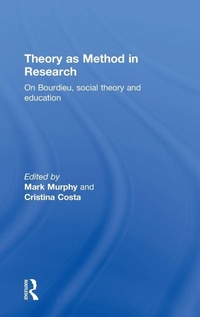
Theory as Method in Research
On Bourdieu, social theory and education
1st Edition
Published on 21. September 2015
Book
Hardback
204 pages
978-1-138-90033-2 (ISBN)
Description
While education researchers have drawn on the work of a wide diversity of theorists over the years, much contemporary theory building in these areas has revolved around the work of Pierre Bourdieu. Theory as Method in Research develops the capacity of students, researchers and teachers to successfully put Bourdieu's ideas to work in their own research and prepare them effectively for conducting Masters and Doctoral scholarships.
Structured around four core themes, this book provides a range of research case studies exploring educational identities, educational inequalities, school leadership and management, and research in teacher education. Issues as diverse as Chinese language learning and identity, school leadership in Australia and the school experience of Afro-Trinidadian boys, are covered, intertwined with a set of innovative approaches to theory application in education research.
This collection brings together, in one comprehensive volume, a set of education researchers who place Pierre Bourdieu's key concepts such as habitus, capital and field at the centre of their research methodologies. Full of insight and innovation, the book is an essential read for practitioners, student teachers, researchers and academics who want to harness the potential of Bourdieu's core concepts in their own work, thereby helping to bridge the gap between theory and method in education research.
Structured around four core themes, this book provides a range of research case studies exploring educational identities, educational inequalities, school leadership and management, and research in teacher education. Issues as diverse as Chinese language learning and identity, school leadership in Australia and the school experience of Afro-Trinidadian boys, are covered, intertwined with a set of innovative approaches to theory application in education research.
This collection brings together, in one comprehensive volume, a set of education researchers who place Pierre Bourdieu's key concepts such as habitus, capital and field at the centre of their research methodologies. Full of insight and innovation, the book is an essential read for practitioners, student teachers, researchers and academics who want to harness the potential of Bourdieu's core concepts in their own work, thereby helping to bridge the gap between theory and method in education research.
More details
Language
English
Place of publication
London
United Kingdom
Publishing group
Taylor & Francis Ltd
Target group
College/higher education
Professional and scholarly
Postgraduate and Professional
Illustrations
3 s/w Zeichnungen, 12 s/w Tabellen
12 Tables, black and white; 3 Line drawings, black and white
Dimensions
Height: 240 mm
Width: 161 mm
Thickness: 16 mm
Weight
496 gr
ISBN-13
978-1-138-90033-2 (9781138900332)
Copyright in bibliographic data and cover images is held by Nielsen Book Services Limited or by the publishers or by their respective licensors: all rights reserved.
Schweitzer Classification
Other editions
Additional editions
Book
09/2015
1st Edition
Routledge
€71.20
Shipment within 10-20 days
E-Book
09/2015
1st Edition
Routledge
€54.99
Available for download
E-Book
09/2015
1st Edition
Routledge
€55.49
Available for download
Persons
Mark Murphy is Reader in Education and Public Policy at the University of Glasgow, UK.
Cristina Costa is a Lecturer in Technology Enhanced Learning in the School of Education, University of Strathclyde, UK.
Cristina Costa is a Lecturer in Technology Enhanced Learning in the School of Education, University of Strathclyde, UK.
Content
Introduction
Introduction: Bourdieu and education research (Mark Murphy and Cristina Costa)
Section 1: Researching Educational Identities
Negotiating Chineseness through Chinese heritage language learning: the role of habitus (Guanglun Michael Mu)
The production of identity capital through school (Jo Warin)
Doxa, digital scholarship and the academy (Cristina Costa and Mark Murphy)
Section 2: Researching Equity in Education
Operationalizing Bourdieu, interrogating intersectionality and the underachievement of primary level Afro-Trinidadian boys (Ravi Rampersad)
Inequalities, parental social capital and children's education (Maria Papapolydorou)
Doing critical educational ethnography with Bourdieu (Katie Fitzpatrick and Stephen May)
Section 3: Researching Educational Leadership and Management
Mobilising Bourdieu to think anew about educational leadership research (Scott Eacott)
Narrative inquiry as a methodology for embedding Bourdieu's tools (Bruce Kloot)
Section 4: Researching Teacher Education
Turning a Bourdieuian lens on the teaching of English in primary schools: linguistic field, linguistic habitus and linguistic capital (Naomi Flynn)
Stimulating conversations between theory and methodology in mathematics teacher education research: Inviting Bourdieu into self-study research (Kathleen Nolan)
Conclusion
Conclusion: Method as theory: (re)exploring the intellectual context of education research (Cristina Costa and Mark Murphy)
Introduction: Bourdieu and education research (Mark Murphy and Cristina Costa)
Section 1: Researching Educational Identities
Negotiating Chineseness through Chinese heritage language learning: the role of habitus (Guanglun Michael Mu)
The production of identity capital through school (Jo Warin)
Doxa, digital scholarship and the academy (Cristina Costa and Mark Murphy)
Section 2: Researching Equity in Education
Operationalizing Bourdieu, interrogating intersectionality and the underachievement of primary level Afro-Trinidadian boys (Ravi Rampersad)
Inequalities, parental social capital and children's education (Maria Papapolydorou)
Doing critical educational ethnography with Bourdieu (Katie Fitzpatrick and Stephen May)
Section 3: Researching Educational Leadership and Management
Mobilising Bourdieu to think anew about educational leadership research (Scott Eacott)
Narrative inquiry as a methodology for embedding Bourdieu's tools (Bruce Kloot)
Section 4: Researching Teacher Education
Turning a Bourdieuian lens on the teaching of English in primary schools: linguistic field, linguistic habitus and linguistic capital (Naomi Flynn)
Stimulating conversations between theory and methodology in mathematics teacher education research: Inviting Bourdieu into self-study research (Kathleen Nolan)
Conclusion
Conclusion: Method as theory: (re)exploring the intellectual context of education research (Cristina Costa and Mark Murphy)