

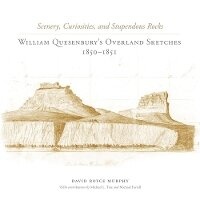
Scenery, Curiosities, and Stupendous Rocks
William Quesenbury's Overland Sketches, 1850-1851
Will be published approx. on 30. December 2011
Book
Hardback
304 pages
978-0-8061-4219-7 (ISBN)
Description
Long before Hollywood brought the landscapes of the American West to movie screens, clever impresarios invented ways of simulating the experience of western travel and selling it to mass audiences. In 1851, entrepreneur John Wesley Jones hired artist William Quesenbury to join such a venture. Quesenbury and other artists traveled the overland trails through Nebraska Territory to sketch the ""scenery, curiosities, and stupendous rocks"" they encountered, and Jones used selected material for his ""Pantoscope,"" a gigantic, scrolling panoramic painting. Scenery, Curiosities, and Stupendous Rocks gathers 71 of Quesenbury's sketches from the Jones expedition and a gold rush trip the year before. These works in pencil are illuminated by eyewitness accounts from the period, modern maps, contemporary photographs, and descriptive notes.
David Royce Murphy, Michael L. Tate, and Michael Farrell set Quesenbury's depictions, including Pikes Peak and Courthouse Rock, in historical context. Their insightful essays offer accounts of the artist's mid-century travels, the worlds of panoramic art and field exploration, and the contemporary conception of natural space. In exploring these topics, the book offers alternate conclusions about the purpose of the sketches. Jones's moving panorama opened in late 1852 under the title ""Pantoscope of California, Nebraska & Kansas, Salt Lake & the Mormons"" and was wildly popular on Boston and New York stages. Today, the Quesenbury sketches are all that remains of Jones's project. The sketches reproduced here, rare records of that ambitious enterprise as well as the sights en route to California gold, offer evidence of the way mid-nineteenth-century Americans envisioned the West.
David Royce Murphy, Michael L. Tate, and Michael Farrell set Quesenbury's depictions, including Pikes Peak and Courthouse Rock, in historical context. Their insightful essays offer accounts of the artist's mid-century travels, the worlds of panoramic art and field exploration, and the contemporary conception of natural space. In exploring these topics, the book offers alternate conclusions about the purpose of the sketches. Jones's moving panorama opened in late 1852 under the title ""Pantoscope of California, Nebraska & Kansas, Salt Lake & the Mormons"" and was wildly popular on Boston and New York stages. Today, the Quesenbury sketches are all that remains of Jones's project. The sketches reproduced here, rare records of that ambitious enterprise as well as the sights en route to California gold, offer evidence of the way mid-nineteenth-century Americans envisioned the West.
More details
Language
English
Place of publication
Oklahoma
United States
Target group
Professional and scholarly
Illustrations
157 black & white illustrations, 13 maps
Dimensions
Height: 279 mm
Width: 279 mm
Thickness: 31 mm
Weight
1794 gr
ISBN-13
978-0-8061-4219-7 (9780806142197)
Copyright in bibliographic data and cover images is held by Nielsen Book Services Limited or by the publishers or by their respective licensors: all rights reserved.
Schweitzer Classification
Persons
David Royce Murphy is Senior Research Architect for the Nebraska State Historical Society and author of numerous articles on architecture and place.
Michael L. Tate is Professor of History Emeritus at the University of Nebraska, Omaha, and author of The Frontier Army in the Settlement of the West and Indians and Emigrants: Encounters on the Overland Trail.
Michael L. Tate is Professor of History Emeritus at the University of Nebraska, Omaha, and author of The Frontier Army in the Settlement of the West and Indians and Emigrants: Encounters on the Overland Trail.