

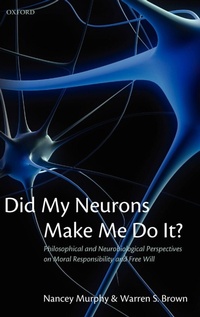
Did My Neurons Make Me Do It?
Philosophical and Neurobiological Perspectives on Moral Responsibility and Free Will
Published on 14. June 2007
Book
Hardback
354 pages
978-0-19-921539-3 (ISBN)
Description
If humans are purely physical, and if it is the brain that does the work formerly assigned to the mind or soul, then how can it fail to be the case that all of our thoughts and actions are determined by the laws of neurobiology? If this is the case, then free will, moral responsibility, and, indeed, reason itself would appear to be in jeopardy. Nancey Murphy and Warren S. Brown here defend a non-reductive version of physicalism whereby humans are (sometimes) the authors of their own thoughts and actions.
Did My Neurons Make Me Do It? brings together insights from both philosophy and the cognitive neurosciences to defeat neurobiological reductionism. One resource is a 'post-Cartesian' account of mind as essentially embodied and constituted by action-feedback-evaluation-action loops in the environment, and 'scaffolded' by cultural resources. Another is a non-mysterious account of downward (mental) causation explained in terms of a complex, higher-order system exercising constraints on lower-level causal processes. These resources are intrinsically related: the embeddedness of brain events in action-feedback loops is the key to their mentality, and those broader systems have causal effects on the brain itself.
With these resources Murphy and Brown take on two problems in philosophy of mind: a response to the charges that physicalists cannot account for the meaningfulness of language nor the causal efficacy of the mental qua mental. Solutions to these problems are a prerequisite to addressing the central problem of the book: how can biological organisms be free and morally responsible? The authors argue that the free-will problem is badly framed if it is put in terms of neurobiological determinism; the real issue is neurobiological reductionism. If it is indeed possible to make sense of the notion of downward causation, then the relevant question is whether humans exert downward causation over some of their own parts and processes. If all organisms do this to some extent, what needs to be added to this animalian flexibility to constitute free and responsible action? The keys are sophisticated language and hierarchically ordered cognitive processes allowing (mature) humans to evaluate their own actions, motives, goals, and rational and moral principles.
Did My Neurons Make Me Do It? brings together insights from both philosophy and the cognitive neurosciences to defeat neurobiological reductionism. One resource is a 'post-Cartesian' account of mind as essentially embodied and constituted by action-feedback-evaluation-action loops in the environment, and 'scaffolded' by cultural resources. Another is a non-mysterious account of downward (mental) causation explained in terms of a complex, higher-order system exercising constraints on lower-level causal processes. These resources are intrinsically related: the embeddedness of brain events in action-feedback loops is the key to their mentality, and those broader systems have causal effects on the brain itself.
With these resources Murphy and Brown take on two problems in philosophy of mind: a response to the charges that physicalists cannot account for the meaningfulness of language nor the causal efficacy of the mental qua mental. Solutions to these problems are a prerequisite to addressing the central problem of the book: how can biological organisms be free and morally responsible? The authors argue that the free-will problem is badly framed if it is put in terms of neurobiological determinism; the real issue is neurobiological reductionism. If it is indeed possible to make sense of the notion of downward causation, then the relevant question is whether humans exert downward causation over some of their own parts and processes. If all organisms do this to some extent, what needs to be added to this animalian flexibility to constitute free and responsible action? The keys are sophisticated language and hierarchically ordered cognitive processes allowing (mature) humans to evaluate their own actions, motives, goals, and rational and moral principles.
Reviews / Votes
This volume is an impressive achievement on the part of Murphy and Brown. They have provided a much-needed synthesis of philosophical and scientific resources dealing with moral responsibility and free will. * Paul N. Markham, Science & Chrisitan Belief * The picture of agency presented here is one well worth pursuing...the general outlines of the view are plausible, and there is a rich research agenda here. * Neil Levy, Metapsychology * fascinating...Did My Neurons Make Me Do It? is a nicely written, engaging book that makes a genuine contribution to the growing literature on mental causation. * Todd Stuart Ganson, Science *More details
Language
English
Place of publication
Oxford
United Kingdom
Target group
Professional and scholarly
Illustrations
38 line drawings
Dimensions
Height: 240 mm
Width: 161 mm
Thickness: 24 mm
Weight
696 gr
ISBN-13
978-0-19-921539-3 (9780199215393)
Copyright in bibliographic data and cover images is held by Nielsen Book Services Limited or by the publishers or by their respective licensors: all rights reserved.
Schweitzer Classification
Other editions
Additional editions
Nancey Murphy | Warren S. Brown
Did My Neurons Make Me Do It?
Philosophical and Neurobiological Perspectives on Moral Responsibility and Free Will
Book
06/2009
Oxford University Press
€66.70
Shipment within 15-20 days
Persons
Content
Introduction: New Approaches to Knotty Old Problems ; 1. Avoiding Cartesian Materialism ; 2. From Causal Reductionism to Self-Directed Systems ; 3. From Mindless to Intelligent Action ; 4. How Can Neural Nets Mean? ; 5. How Does Reason Get Its Grip on the Brain? ; 6. Who's Responsible? ; 7. Neurobiological Reductionism and Free Will ; Postscript