

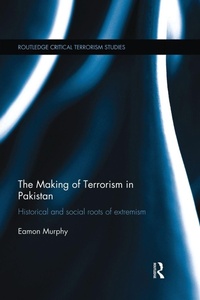
The Making of Terrorism in Pakistan
Historical and Social Roots of Extremism
1st Edition
Published on 12. September 2014
Book
Paperback/Softback
224 pages
978-1-138-81970-2 (ISBN)
Description
This book explains the origins and nature of terrorism in Pakistan and examines the social, political and economic factors that have contributed to the rise of political violence there.
Since 9/11, the state of Pakistan has come to be regarded as the epicentre of terrorist activity committed in the name of Islam. The central argument of this volume suggests that terrorism in Pakistan has, in essence, been manufactured to suit the interests of mundane political and class interests and effectively debunks the myth of 'Islamic terrorism'. A logical consequence of this argument is that the most effective way of combating terrorism in Pakistan lies in addressing the underlying political, social and economic problems facing the country.
After exploring the root causes of terrorism in Pakistan, the author goes on to relate the historical narrative of the development of the Pakistani state to the theories and questions raised by Critical Terrorism Studies (CTS) scholars. The book will therefore make an important contribution to CTS scholarship as well as presenting an analysis of the many complex factors that have shaped the rise of Pakistani terrorism.
This book will be of great interest to students of Critical Terrorism Studies, Asian history and politics, Security Studies and IR in general.
Since 9/11, the state of Pakistan has come to be regarded as the epicentre of terrorist activity committed in the name of Islam. The central argument of this volume suggests that terrorism in Pakistan has, in essence, been manufactured to suit the interests of mundane political and class interests and effectively debunks the myth of 'Islamic terrorism'. A logical consequence of this argument is that the most effective way of combating terrorism in Pakistan lies in addressing the underlying political, social and economic problems facing the country.
After exploring the root causes of terrorism in Pakistan, the author goes on to relate the historical narrative of the development of the Pakistani state to the theories and questions raised by Critical Terrorism Studies (CTS) scholars. The book will therefore make an important contribution to CTS scholarship as well as presenting an analysis of the many complex factors that have shaped the rise of Pakistani terrorism.
This book will be of great interest to students of Critical Terrorism Studies, Asian history and politics, Security Studies and IR in general.
More details
Series
Language
English
Place of publication
London
United Kingdom
Publishing group
Taylor & Francis Ltd
Target group
College/higher education
Professional and scholarly
Illustrations
2 s/w Zeichnungen
2 Line drawings, black and white
Dimensions
Height: 234 mm
Width: 156 mm
Thickness: 13 mm
Weight
371 gr
ISBN-13
978-1-138-81970-2 (9781138819702)
Copyright in bibliographic data and cover images is held by Nielsen Book Services Limited or by the publishers or by their respective licensors: all rights reserved.
Schweitzer Classification
Other editions
Additional editions
E-Book
12/2012
1st Edition
Routledge
€77.99
Available for download
E-Book
12/2012
1st Edition
Routledge
€77.99
Available for download
Book
11/2012
1st Edition
Routledge
€241.80
Shipment within 15-20 days
Person
Eamon Murphy is Adjunct Professor of History and International Relations at Curtin University of Technology in Western Australia. He is co-editor of Contemporary State Terrorism: Theory and Cases (Routledge, 2010).
Content
Preface Foreword Introduction: Overview and Theory 1. Islam in Pakistan: An Overview 2. The Colonial Legacy and the Making of Pakistan: Class, Regionalism and Factional Politics 3. Birth Pains: The Decline of Democracy, Sectarian Violence and the Intractable Problem of Kashmir, 1947 -195 4. Jinnah's Dream Fades: Dictatorship, State Terrorism and the Corrosion of Secularism, 1958 - 1977 5. The Turning Point: Zia-ul Haq and the Islamisation of Pakistan, 1977 - 1988 6. The Afghanistan Jihad and the Making of Terrorism, 1979-1989 7. Reaping the Whirlwind: Politics, Terrorism in Kashmir and Sectarian Violence, 1988 - 2000 8. The Fallout from the US Invasion of Afghanistan: Politics, Terrorism and Sectarian Violence in Pakistan since 9/11 Conclusion: Critical Terrorism Studies, Islam and the Making of Terrorism in Pakistan