

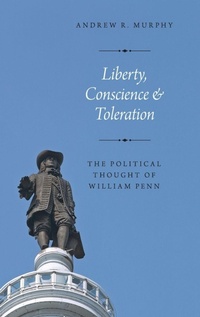
Liberty, Conscience, and Toleration
The Political Thought of William Penn
Published on 24. June 2016
Book
Hardback
320 pages
978-0-19-027119-0 (ISBN)
Description
In a seventeenth-century English landscape populated with towering political and philosophical figures like Hobbes, Harrington, Cromwell, Milton, and Locke, William Penn remains in many ways a man apart. Yet despite being widely neglected by scholars, he was a sophisticated political thinker who contributed mightily to the theory and practice of religious liberty in the early modern Atlantic world. In this long-awaited intellectual biography of William Penn, Andrew
R. Murphy presents a nuanced portrait of this remarkable entrepreneur, philosopher, Quaker, and politician.
Liberty, Conscience, and Toleration focuses on the major political episodes that attracted William Penn's sustained attention as a political thinker and actor: the controversy over the Second Conventicle Act, the Popish Plot and Exclusion Crisis, the founding and settlement of Pennsylvania, and the contentious reign of James II. Through a careful examination of writings published in the midst of the religious and political conflicts of Restoration and Revolutionary England, Murphy
contextualizes the development of Penn's thought in England and America, illuminating the mutual interconnections between Penn's political thought and his colonizing venture in America.
An early advocate of representative institutions and religious freedom, William Penn remains a singular figure in the history of liberty of conscience. His political theorizing provides a window into the increasingly vocal, organized, and philosophically sophisticated tolerationist movement that gained strength over the second half of the seventeenth century. Not only did Penn attempt to articulate principles of religious liberty as a Quaker in England, but he actually governed an American
polity and experienced firsthand the complex relationship between political theory and political practice. Murphy's insightful analysis shows Penn's ongoing significance to the broader study of Anglo-American political theory and practice, ultimately pointing scholars toward a new way of understanding
the enterprise of political theory itself.
R. Murphy presents a nuanced portrait of this remarkable entrepreneur, philosopher, Quaker, and politician.
Liberty, Conscience, and Toleration focuses on the major political episodes that attracted William Penn's sustained attention as a political thinker and actor: the controversy over the Second Conventicle Act, the Popish Plot and Exclusion Crisis, the founding and settlement of Pennsylvania, and the contentious reign of James II. Through a careful examination of writings published in the midst of the religious and political conflicts of Restoration and Revolutionary England, Murphy
contextualizes the development of Penn's thought in England and America, illuminating the mutual interconnections between Penn's political thought and his colonizing venture in America.
An early advocate of representative institutions and religious freedom, William Penn remains a singular figure in the history of liberty of conscience. His political theorizing provides a window into the increasingly vocal, organized, and philosophically sophisticated tolerationist movement that gained strength over the second half of the seventeenth century. Not only did Penn attempt to articulate principles of religious liberty as a Quaker in England, but he actually governed an American
polity and experienced firsthand the complex relationship between political theory and political practice. Murphy's insightful analysis shows Penn's ongoing significance to the broader study of Anglo-American political theory and practice, ultimately pointing scholars toward a new way of understanding
the enterprise of political theory itself.
Reviews / Votes
..".makes ample use of the current scholarship on politics and religion in late seventeenth-century England...a fine contribution to the growing literature advocating a closer relationship between the study of seventeenth-century English politics and the early English Atlantic and imperial world." --Journal of British Studies "[Provides a] careful analysis of Penn's writings and use of examples from early Pennsylvania to illustrate the difficulties implementing theories...[an] excellent guide to Penn's political theories." --Quaker History "Murphy presents a convincing argument that Penn the politician and political theorist belonged to the world of seventeenth-century England, its law, and thought, despite his twice two-year sojourn in Pennsylvania." --Journal of Church and State "Jefferson called William Penn 'the greatest lawgiver the world has produced.' From his time to our own, Penn has enjoyed continuing acclaim. In this profound-and moving-meditation on this remarkable man, Andrew Murphy engages him exactly as he was: the only participant in the greatest era of English social thought who was at once a major political thinker and a major political player, wrestling all his life with the tension between theory and practice. Murphy brings to his study a magisterial command of the sources, a supremely sure judgment, and a fine flowing prose. He has written the best book on Penn of our time and of all time." --Michael Zuckerman, Professor Emeritus of History, University of Pennsylvania "We have been awaiting a study like this for some time-an intellectual biography of William Penn that would take full account of recent work in Atlantic history and would use these new insights to conduct a re-evaluation of his career. There are few early modernists who bridge the divide between political theory and history as effectively as Andrew Murphy does. This is truly an Atlantic history, displaying Murphy's firm grasp of political and religious debates on both sides of the Atlantic. Written with admirable clarity, lLiberty, Conscience, and Toleration is a significant and original contribution to the literature on religious toleration, the founding of Pennsylvania, and American political theory. Its provocative arguments will be debated widely." --Scott Sowerby, Associate Professor of History, Northwestern University "In this remarkable book, Andrew Murphy places Penn in a new light, even moving toward a notion of separation of church and state. He demonstrates a splendid capacity for close reading of the original texts and has complete mastery of both the primary texts and secondary materials. Most importantly, he is able to make complicated situations and seventeenth century texts really clear for the reader." --Mary Maples Dunn, Editor, lPapers of William Penn, and President Emerita, Smith College "Murphy makes a powerful argument for Penn's importance in the development of toleration. Murphy also renders Penn appropriately human-sized, reminding us that, even though Thomas Jefferson proclaimed Penn 'the greatest lawgiver the world has produced' (240), the limits of toleration would continue expanding after Penn."-Brooke Sherrard, American Academy of Religion, Reading Religion'"Murphy's work is both timely and well executed. It deserves to be read (and even reread) by scholars interested in the transatlantic economy of ideas...a close examination of Penn's life affords Murphy the chance to do what he does best - meditate on the meaning and place of liberty of conscience in an Atlantic world desperately seeking to come to terms with burgeoning religious diversity." --H-Net "[Provides a] careful analysis of Penn's writings and use of examples from early Pennsylvania to illustrate the difficulties implementing theories...[an] excellent guide to Penn's political theories." --Quaker History "Murphy presents a convincing argument that Penn the politician and political theorist belonged to the world of seventeenth-century England, its law, and thought, despite his twice two-year sojourn in Pennsylvania." --Journal of Church and State "Jefferson called William Penn 'the greatest lawgiver the world has produced.' From his time to our own, Penn has enjoyed continuing acclaim. In this profound-and moving-meditation on this remarkable man, Andrew Murphy engages him exactly as he was: the only participant in the greatest era of English social thought who was at once a major political thinker and a major political player, wrestling all his life with the tension between theory and practice. Murphy brings to his study a magisterial command of the sources, a supremely sure judgment, and a fine flowing prose. He has written the best book on Penn of our time and of all time." --Michael Zuckerman, Professor Emeritus of History, University of Pennsylvania "We have been awaiting a study like this for some time-an intellectual biography of William Penn that would take full account of recent work in Atlantic history and would use these new insights to conduct a re-evaluation of his career. There are few early modernists who bridge the divide between political theory and history as effectively as Andrew Murphy does. This is truly an Atlantic history, displaying Murphy's firm grasp of political and religious debates on both sides of the Atlantic. Written with admirable clarity, lLiberty, Conscience, and Toleration is a significant and original contribution to the literature on religious toleration, the founding of Pennsylvania, and American political theory. Its provocative arguments will be debated widely." --Scott Sowerby, Associate Professor of History, Northwestern University "In this remarkable book, Andrew Murphy places Penn in a new light, even moving toward a notion of separation of church and state. He demonstrates a splendid capacity for close reading of the original texts and has complete mastery of both the primary texts and secondary materials. Most importantly, he is able to make complicated situations and seventeenth century texts really clear for the reader." --Mary Maples Dunn, Editor, lPapers of William Penn, and President Emerita, Smith College "Murphy makes a powerful argument for Penn's importance in the development of toleration. Murphy also renders Penn appropriately human-sized, reminding us that, even though Thomas Jefferson proclaimed Penn 'the greatest lawgiver the world has produced' (240), the limits of toleration would continue expanding after Penn."-Brooke Sherrard, American Academy of Religion, Reading Religion'"On the whole, Murphy's work is both timely and well executed. It deserves to be read (and even reread) by scholars interested in the transatlantic economy of ideas. Still, while Murphy does an exceptional job tracing the lineaments of Penn's political thought, he at times ignores its relevance to Penn's Quaker loyalties." --H-Net "Murphy's careful analysis of Penn's writings and use of examples from early Pennsylvania to illustrate the difficulties implementing theories should appeal to political scientists - the book's intended audience... My conclusion is that Murphy's excellent guide to Penn's political theories should be supplemented by the Founder's vision of Pennsylvania as a holy experience." --Quaker History "Murphy presents a convincing argument that Penn the politician and political theorist belonged to the world of seventeenth-century England, its law, and thought, despite his twice two-year sojourn in Pennsylvania." --Journal of Church and State "Jefferson called William Penn 'the greatest lawgiver the world has produced.' From his time to our own, Penn has enjoyed continuing acclaim. In this profound-and moving-meditation on this remarkable man, Andrew Murphy engages him exactly as he was: the only participant in the greatest era of English social thought who was at once a major political thinker and a major political player, wrestling all his life with the tension between theory and practice. Murphy brings to his study a magisterial command of the sources, a supremely sure judgment, and a fine flowing prose. He has written the best book on Penn of our time and of all time." --Michael Zuckerman, Professor Emeritus of History, University of Pennsylvania "We have been awaiting a study like this for some time-an intellectual biography of William Penn that would take full account of recent work in Atlantic history and would use these new insights to conduct a re-evaluation of his career. There are few early modernists who bridge the divide between political theory and history as effectively as Andrew Murphy does. This is truly an Atlantic history, displaying Murphy's firm grasp of political and religious debates on both sides of the Atlantic. Written with admirable clarity, lLiberty, Conscience, and Toleration is a significant and original contribution to the literature on religious toleration, the founding of Pennsylvania, and American political theory. Its provocative arguments will be debated widely." --Scott Sowerby, Associate Professor of History, Northwestern University "In this remarkable book, Andrew Murphy places Penn in a new light, even moving toward a notion of separation of church and state. He demonstrates a splendid capacity for close reading of the original texts and has complete mastery of both the primary texts and secondary materials. Most importantly, he is able to make complicated situations and seventeenth century texts really clear for the reader." --Mary Maples Dunn, Editor, lPapers of William Penn, and President Emerita, Smith College "Murphy makes a powerful argument for Penn's importance in the development of toleration. Murphy also renders Penn appropriately human-sized, reminding us that, even though Thomas Jefferson proclaimed Penn 'the greatest lawgiver the world has produced' (240), the limits of toleration would continue expanding after Penn."-Brooke Sherrard, American Academy of Religion, Reading Religion' "Jefferson called William Penn 'the greatest lawgiver the world has produced.' From his time to our own, Penn has enjoyed continuing acclaim. In this profound-and moving-meditation on this remarkable man, Andrew Murphy engages him exactly as he was: the only participant in the greatest era of English social thought who was at once a major political thinker and a major political player, wrestling all his life with the tension between theory and practice. Murphy brings to his study a magisterial command of the sources, a supremely sure judgment, and a fine flowing prose. He has written the best book on Penn of our time and of all time." --Michael Zuckerman, Professor Emeritus of History, University of Pennsylvania "We have been awaiting a study like this for some time-an intellectual biography of William Penn that would take full account of recent work in Atlantic history and would use these new insights to conduct a re-evaluation of his career. There are few early modernists who bridge the divide between political theory and history as effectively as Andrew Murphy does. This is truly an Atlantic history, displaying Murphy's firm grasp of political and religious debates on both sides of the Atlantic. Written with admirable clarity, lLiberty, Conscience, and Toleration is a significant and original contribution to the literature on religious toleration, the founding of Pennsylvania, and American political theory. Its provocative arguments will be debated widely." --Scott Sowerby, Associate Professor of History, Northwestern University "In this remarkable book, Andrew Murphy places Penn in a new light, even moving toward a notion of separation of church and state. He demonstrates a splendid capacity for close reading of the original texts and has complete mastery of both the primary texts and secondary materials. Most importantly, he is able to make complicated situations and seventeenth century texts really clear for the reader." --Mary Maples Dunn, Editor, lPapers of William Penn, and President Emerita, Smith College "Murphy makes a powerful argument for Penn's importance in the development of toleration. Murphy also renders Penn appropriately human-sized, reminding us that, even though Thomas Jefferson proclaimed Penn 'the greatest lawgiver the world has produced' (240), the limits of toleration would continue expanding after Penn."-Brooke Sherrard, American Academy of Religion, Reading Religion' "Jefferson called William Penn 'the greatest lawgiver the world has produced.' From his time to our own, Penn has enjoyed continuing acclaim. In this profound-and moving-meditation on this remarkable man, Andrew Murphy engages him exactly as he was: the only participant in the greatest era of English social thought who was at once a major political thinker and a major political player, wrestling all his life with the tension between theory and practice. Murphy brings to his study a magisterial command of the sources, a supremely sure judgment, and a fine flowing prose. He has written the best book on Penn of our time and of all time." --Michael Zuckerman, Professor Emeritus of History, University of Pennsylvania "We have been awaiting a study like this for some time-an intellectual biography of William Penn that would take full account of recent work in Atlantic history and would use these new insights to conduct a re-evaluation of his career. There are few early modernists who bridge the divide between political theory and history as effectively as Andrew Murphy does. This is truly an Atlantic history, displaying Murphy's firm grasp of political and religious debates on both sides of the Atlantic. Written with admirable clarity, lLiberty, Conscience, and Toleration is a significant and original contribution to the literature on religious toleration, the founding of Pennsylvania, and American political theory. Its provocative arguments will be debated widely." --Scott Sowerby, Associate Professor of History, Northwestern University "In this remarkable book, Andrew Murphy places Penn in a new light, even moving toward a notion of separation of church and state. He demonstrates a splendid capacity for close reading of the original texts and has complete mastery of both the primary texts and secondary materials. Most importantly, he is able to make complicated situations and seventeenth century texts really clear for the reader." --Mary Maples Dunn, Editor, lPapers of William Penn, and President Emerita, Smith CollegeMore details
Other editions
Additional editions
Book
12/2018
Oxford University Press Inc
€44.30
Shipment within 15-20 days
E-Book
05/2016
1st Edition
OUP eBook
€16.49
Available for download
E-Book
05/2016
1st Edition
OUP eBook
€16.49
Available for download
Person
Andrew R. Murphy is Associate Professor of Political Science at Rutgers University. His previous books include Prodigal Nation: Moral Decline and Divine Punishment from New England to 9/11 and Conscience and Community: Revisiting Toleration and Religious Dissent in Early Modern England and America.