

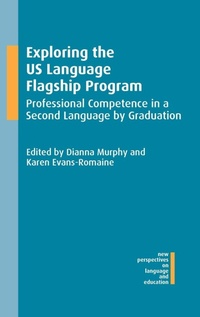
Exploring the US Language Flagship Program
Professional Competence in a Second Language by Graduation
Published on 7. November 2016
Book
Hardback
280 pages
978-1-78309-609-1 (ISBN)
Description
A number of reports in the US have highlighted the country's need for improved second language skills for both national security and economic competitiveness. The Language Flagship program, launched in 2002, aims to raise expectations regarding language proficiency levels at the post-secondary level and to address structural gaps in the curricula of many L2 programs. This federally funded program provides opportunities for US undergraduate students in any specialization to reach a professional level of competence in a targeted second language by graduation. This volume highlights innovative practices that enable students to achieve this goal - even those with no exposure to the second language prior to university. This book explores the rationale and history of the federal program and showcases models and strategies of existing Flagship programs.
Reviews / Votes
The American Council on the Teaching of Foreign Languages (ACTFL) enthusiastically endorses and supports the goals of the Language Flagship initiative to develop and recognize the professional language proficiency of our nation's future leaders. Language Flagship programs are a national model for establishing proficiency outcomes, designing instruction to target benchmarks, and systematically assessing progress towards those targets. The chapters contained in this volume examine the challenges, complexities, opportunities, and successes of the Language Flagship Initiative's innovations for language instruction in post-secondary education. * Elvira Swender, American Council on the Teaching of Foreign Languages, USA * The Language Flagship programs represent a major initiative in language teaching and learning in the first two decades of the 21st century. As university-based Flagship programs have focused on the ambitious goals of high-level language proficiency and intercultural competence, they have naturally served as sites of curricular innovation that can inspire all of us who work in undergraduate language education. The editors have brought together an admirable collection of articles that document the origin of the Flagship, program outcomes, and a range of creative curricular paths that make this volume an essential resource. * Judith E. Liskin-Gasparro, University of Iowa, USA *More details
Series
Language
English
Place of publication
Bristol
United Kingdom
Publishing group
Channel View Publications Ltd
Target group
College/higher education
Dimensions
Height: 240 mm
Width: 161 mm
Thickness: 20 mm
Weight
584 gr
ISBN-13
978-1-78309-609-1 (9781783096091)
Copyright in bibliographic data and cover images is held by Nielsen Book Services Limited or by the publishers or by their respective licensors: all rights reserved.
Schweitzer Classification
Other editions
Additional editions
Dianna Murphy | Karen Evans-Romaine
Exploring the US Language Flagship Program
Professional Competence in a Second Language by Graduation
E-Book
11/2016
Multilingual Matters
€24.49
Available for download
Complete work / Part of the work
Viv Edwards | Phan Le Ha
New Perspectives on Language and Education (Vols 41-50)
Book
Multilingual Matters
€1,032.48
The article will not be published
Persons
Dianna Murphy is Associate Director of the Language Institute and Russian Flagship Program at the University of Wisconsin-Madison. Her research interests are in foreign language education at the postsecondary level, with a focus on students' goals and perspectives on their foreign language learning.
Karen Evans-Romaine is Professor of Russian in the Department of German, Nordic, and Slavic and Director of the Russian Flagship Program at the University of Wisconsin-Madison. Her research interests include Russian language pedagogy and early 20th-century Russian literature, particularly intersections of music and literature.
Karen Evans-Romaine is Professor of Russian in the Department of German, Nordic, and Slavic and Director of the Russian Flagship Program at the University of Wisconsin-Madison. Her research interests include Russian language pedagogy and early 20th-century Russian literature, particularly intersections of music and literature.
Content
Acknowledgements
Abbreviations
Contributors
Karen Evans-Romaine and Dianna Murphy: Introduction
1. Michael Nugent and Robert Slater: The Language Flagship: Creating Expectations and Opportunities for Professional-Level Language Learning in Undergraduate Education
2. Dianna Murphy, Karen Evans-Romaine, Valerie Anishchenkova and Zhuo Jing-Schmidt: Laying the Groundwork: Programmatic Models in US Language Flagship Programs
3. Sandra Freels, Olesya Kisselev and Anna Alsufieva: Adding Breadth to the Undergraduate Curriculum: Flagship Approaches to Interdisciplinary Language Learning
4. Peter John Glanville: The Road Through Superior: Building Learner Independence
5. Victoria Hasko, Robert Moser, Fernanda Guida, Mary Elizabeth Hayes and Viviane Klen Alves: Maximizing Oral Proficiency Development via Telecollaborative Partnerships in the Portuguese Flagship Program
6. Sharon Bain and Madeline K. Spring: Creating Collaborative Communities through Online Cafes
7. Olga Kagan and Cynthia Martin: Heritage Language Learners in Flagship Programs: Motivation, Language Proficiency and Intercultural Communicative Competence
8. Dan Davidson, Nadra Garas and Maria Lekic: Assessing Language Proficiency and Intercultural Development in the Overseas Immersion Context
9. Samuel Eisen: Overseas Internships in Advanced to Professional-Level Language Acquisition
10. Mahmoud Al-Batal and Christian Glakas: Beyond Proficiency Gains: Assessing the Academic, Cultural and Professional Impact of the Flagship Experience on Alumni
11. Thomas J. Garza: Raise the Flag(ship)! Creating Hybrid Language Programs on the Flagship Model
Karen Evans-Romaine and Dianna Murphy: Conclusion
Appendix A
Appendix B
Abbreviations
Contributors
Karen Evans-Romaine and Dianna Murphy: Introduction
1. Michael Nugent and Robert Slater: The Language Flagship: Creating Expectations and Opportunities for Professional-Level Language Learning in Undergraduate Education
2. Dianna Murphy, Karen Evans-Romaine, Valerie Anishchenkova and Zhuo Jing-Schmidt: Laying the Groundwork: Programmatic Models in US Language Flagship Programs
3. Sandra Freels, Olesya Kisselev and Anna Alsufieva: Adding Breadth to the Undergraduate Curriculum: Flagship Approaches to Interdisciplinary Language Learning
4. Peter John Glanville: The Road Through Superior: Building Learner Independence
5. Victoria Hasko, Robert Moser, Fernanda Guida, Mary Elizabeth Hayes and Viviane Klen Alves: Maximizing Oral Proficiency Development via Telecollaborative Partnerships in the Portuguese Flagship Program
6. Sharon Bain and Madeline K. Spring: Creating Collaborative Communities through Online Cafes
7. Olga Kagan and Cynthia Martin: Heritage Language Learners in Flagship Programs: Motivation, Language Proficiency and Intercultural Communicative Competence
8. Dan Davidson, Nadra Garas and Maria Lekic: Assessing Language Proficiency and Intercultural Development in the Overseas Immersion Context
9. Samuel Eisen: Overseas Internships in Advanced to Professional-Level Language Acquisition
10. Mahmoud Al-Batal and Christian Glakas: Beyond Proficiency Gains: Assessing the Academic, Cultural and Professional Impact of the Flagship Experience on Alumni
11. Thomas J. Garza: Raise the Flag(ship)! Creating Hybrid Language Programs on the Flagship Model
Karen Evans-Romaine and Dianna Murphy: Conclusion
Appendix A
Appendix B