

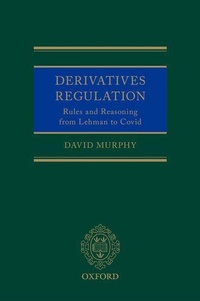
Derivatives Regulation
Rules and Reasoning from Lehman to Covid
Published on 3. March 2022
Book
Hardback
406 pages
978-0-19-284657-0 (ISBN)
Description
Derivatives Regulation - Rules and Reasoning from Lehman to Covid provides an indepth examination of the changes made to the regulation of derivatives that were enacted following the global financial crisis of 2008, considering the motivations behind these changes and including insights from the Covid pandemic.
Key areas of derivatives regulatory reform are examined, including bank capital and leverage rules, the clearing mandate, uncleared margin rules, and the principles for the regulation of central counterparties. After providing an overview of the global financial crisis, the motivations for these reforms in its immediate aftermath are considered, as well as the impact of these rules on the financial system, using insights from the market stress around the onset of the Covid pandemic in 2020.
The book analyses the construction of financial regulation, as well as its nature and how this should be assessed, using tools from the law, economics, and regulatory theory. Global administrative law, cost benefit analysis, and the results of regulatory interventions in other areas throw light on the legitimacy, efficiency, and effectiveness of derivatives regulation. Insights from international political economy are also discussed, situating financial regulation within the regulatory state, while showing how its institutional arrangements shape regulatory outcomes. Suggestions for improving both rules and regulatory processes are considered in the conclusion of the book.
Key areas of derivatives regulatory reform are examined, including bank capital and leverage rules, the clearing mandate, uncleared margin rules, and the principles for the regulation of central counterparties. After providing an overview of the global financial crisis, the motivations for these reforms in its immediate aftermath are considered, as well as the impact of these rules on the financial system, using insights from the market stress around the onset of the Covid pandemic in 2020.
The book analyses the construction of financial regulation, as well as its nature and how this should be assessed, using tools from the law, economics, and regulatory theory. Global administrative law, cost benefit analysis, and the results of regulatory interventions in other areas throw light on the legitimacy, efficiency, and effectiveness of derivatives regulation. Insights from international political economy are also discussed, situating financial regulation within the regulatory state, while showing how its institutional arrangements shape regulatory outcomes. Suggestions for improving both rules and regulatory processes are considered in the conclusion of the book.
More details
Language
English
Place of publication
Oxford
United Kingdom
Target group
Professional and scholarly
Product notice
sewn/stitched
Cloth over boards
Dimensions
Height: 237 mm
Width: 163 mm
Thickness: 32 mm
Weight
807 gr
ISBN-13
978-0-19-284657-0 (9780192846570)
Copyright in bibliographic data and cover images is held by Nielsen Book Services Limited or by the publishers or by their respective licensors: all rights reserved.
Schweitzer Classification
Other editions
Additional editions
E-Book
03/2022
1st Edition
OUP Oxford
€152.99
Available for download
Person
David Murphy is a visiting professor in practice in the Law Department at the London School of Economic and Political Science. He is a leading expert on derivatives regulation, central clearing, and prudential policy, having published extensively in these areas, and worked in both bank and central counterparty policy at national and international levels.
Content
Preface
Introduction
1: Core Ideas in Derivatives
2: The 2008 Crisis
3: The Financial System during Covid
4: The Basel 3 Leverage Ratio
5: Risk-based Capital Regulation
6: Clearing and Collateralisation
7: Central Counterparties and their Regulation
8: Legal Perspectives on Financial Regulation
9: The Quantitative Analysis of Financial Regulation
10: Derivatives Regulation as Modelling
11: Perspectives from Social and Political Science
12: Rules and Arrangements in Derivatives Regulation
Introduction
1: Core Ideas in Derivatives
2: The 2008 Crisis
3: The Financial System during Covid
4: The Basel 3 Leverage Ratio
5: Risk-based Capital Regulation
6: Clearing and Collateralisation
7: Central Counterparties and their Regulation
8: Legal Perspectives on Financial Regulation
9: The Quantitative Analysis of Financial Regulation
10: Derivatives Regulation as Modelling
11: Perspectives from Social and Political Science
12: Rules and Arrangements in Derivatives Regulation