

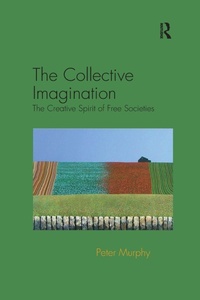
The Collective Imagination
The Creative Spirit of Free Societies
1st Edition
Published on 24. May 2017
Book
Paperback/Softback
264 pages
978-1-138-11708-2 (ISBN)
Description
The Collective Imagination explores the social foundations of the human imagination. In a lucid and wide-ranging discussion, Peter Murphy looks at the collective expression of the imagination in our economies, universities, cities, and political systems, providing a tour-de-force account of the power of the imagination to unite opposites and find similarities among things that we ordinarily think of as different. It is not only individuals who possess the power to imagine; societies do as well. A compelling journey through various peak moments of creation, this book examines the cities and nations, institutions and individuals who ply the paraphernalia of paradoxes and dialogues, wry dramaturgy and witty expression that set the act of creation in motion. Whilst exploring the manner in which, through the media of pattern, figure, and shape, and the miracles of metaphor, things come into being, Murphy recognises that creative periods never last: creative forms invariably tire; inventive centres inevitably fade. The Collective Imagination explores the contemporary dilemmas and historic pathos caused by this-as cities and societies, periods and generations slip behind in the race for economic and social discovery. Left bewildered and bothered, and struggling to catch up, they substitute empty bombast, faded glory, chronic dullness or stolid glumness for initiative, irony, and inventiveness. A comprehensive audit of the creativity claims of the post-modern age - that finds them badly wanting and looks to the future - The Collective Imagination will appeal to sociologists and philosophers concerned with cultural theory, cultural and media studies and aesthetics.
Reviews / Votes
A Yankee Book Peddler UK Core Title for 2012 A Yankee Book Peddler US Core Title for 2012 Classified as 'Research Essential' by Baker & Taylor YBP Library Services 'The Collective Imagination is quite simply a tour de force. It traverses the grand landscape of creativity and its sources. It explores with original and persuasive clarity the links, in nations and regions, between economic prosperity and creative individuals. Its argumentcarries fateful implications for Western countries today-highlighting political failure, economic policy stupidity, and a blindness to the factors necessary for innovation, and thereby for social vitality.' John Carroll, La Trobe University, Australia 'The Collective Imagination is a fascinating and kaleidoscopic work. It constitutes one of the most illuminating and comprehensive explorations of that mysterious and elusive dimension of human experience: acts of creation ... any future discussion of creativity that did not engage with The Collective Imagination would be deficient.' Craig Browne, Thesis ElevenMore details
Language
English
Place of publication
London
United Kingdom
Publishing group
Taylor & Francis Ltd
Target group
College/higher education
Dimensions
Height: 234 mm
Width: 156 mm
Thickness: 14 mm
Weight
406 gr
ISBN-13
978-1-138-11708-2 (9781138117082)
Copyright in bibliographic data and cover images is held by Nielsen Book Services Limited or by the publishers or by their respective licensors: all rights reserved.
Schweitzer Classification
Other editions
Additional editions
E-Book
03/2016
Routledge
€64.49
Available for download
E-Book
03/2016
Routledge
€64.49
Available for download
Book
05/2012
1st Edition
Routledge
€231.00
Shipment within 10-20 days
Person
Peter Murphy is Adjunct Professor in the School of Humanities and Social Sciences at La Trobe University, Australia. He is the author of Universities and Innovation Economies, and Civic Justice, and co-author of Dialectic of Romanticism, Creativity and the Global Knowledge Economy, Global Creation, and Imagination.
Content
Contents: Introduction; Part I The Media of Creation: Imagination; Wit; Paradox; Metaphor. Part II Collective Creation: Art; Economy; Society; Politics; References; Index.