

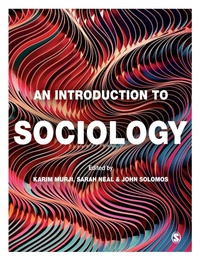
An Introduction to Sociology
1st Edition
Published on 29. November 2021
Book
Paperback/Softback
528 pages
978-1-5264-9279-1 (ISBN)
Description
An Introduction to Sociology is your essential guide to understanding the social forces that shape our lives and the world around us.
This innovative textbook introduces you to the key theories, themes, and concepts in the discipline of sociology and helps you to develop as a sociologist by providing comprehensive coverage of all the main areas of study. Presenting you with the history, current debates and recent research developments for each topic, this book covers everything from classical sociologies and traditional subjects such as class, families, and religion, through to more progressive areas like digital society, social media, migration, and the interconnectedness of modern global society. The book's extensive coverage means it can be used throughout your studies, from first year to final year.
Key features:
Each chapter is written by an internationally renowned expert who uses specialist insight and the latest research to provide a reliable and up-to-date overview.
Includes a selection of unique learning features such as "Hear from the Expert" boxes and "Key Cases" from around the world, as well as reflective activities and revision questions that will enhance your knowledge.
Features a section titled "What is sociology useful for?" which includes chapters on the public value of sociology and the role of sociology in contemporary society.
The book is supported by a wide-ranging collection of online teaching and learning resources including exclusive video content from SAGE Video, links to SAGE Journal Articles, sample essay questions, and a selection of multiple-choice questions.
This definitive text is perfect for first-year sociology undergraduates and anyone studying sociology at university or college level.
This innovative textbook introduces you to the key theories, themes, and concepts in the discipline of sociology and helps you to develop as a sociologist by providing comprehensive coverage of all the main areas of study. Presenting you with the history, current debates and recent research developments for each topic, this book covers everything from classical sociologies and traditional subjects such as class, families, and religion, through to more progressive areas like digital society, social media, migration, and the interconnectedness of modern global society. The book's extensive coverage means it can be used throughout your studies, from first year to final year.
Key features:
Each chapter is written by an internationally renowned expert who uses specialist insight and the latest research to provide a reliable and up-to-date overview.
Includes a selection of unique learning features such as "Hear from the Expert" boxes and "Key Cases" from around the world, as well as reflective activities and revision questions that will enhance your knowledge.
Features a section titled "What is sociology useful for?" which includes chapters on the public value of sociology and the role of sociology in contemporary society.
The book is supported by a wide-ranging collection of online teaching and learning resources including exclusive video content from SAGE Video, links to SAGE Journal Articles, sample essay questions, and a selection of multiple-choice questions.
This definitive text is perfect for first-year sociology undergraduates and anyone studying sociology at university or college level.
Reviews / Votes
Each chapter of this particularly comprehensive and thoughtful Introduction to Sociology has the great virtue of being written by a particularly knowledgeable expert able to convey what it means to approach a topic sociologically. The book provides a perfect foundation for the first years of study for students who want to understand social reality through more complex and accurate analytical lenses. As such, it is an essential tool for undergraduate intellectual development.-- Professor Michele Lamont An Introduction to Sociology provides new and up to date insights into persistent social issues. Through its 28 chapters, the volume covers topics ranging from digital society and the environment to migration and employment. Material is presented in an accessible format that will appeal to a wide range of readers from A-Level to undergraduates and will be a useful, practical teaching resource for lectures.
-- Louise Ryan This superb introduction to sociological thinking and research covers a rich variety of themes and approaches. In a multifaceted way and with timely examples, it introduces both classical sociological research fields, such as working life and criminology, and rapidly developing fields of study on digital society and environmental sociology. Its up-to-date focus on decolonial and global perspectives, and intersectional perspectives on race, gender and class make it essential reading for new sociology students and inspiration to lecturers teaching sociology courses. -- Suvi Keskinen
More details
Language
English
Place of publication
London
United Kingdom
Target group
College/higher education
Dimensions
Height: 246 mm
Width: 189 mm
Thickness: 29 mm
Weight
1009 gr
ISBN-13
978-1-5264-9279-1 (9781526492791)
Copyright in bibliographic data and cover images is held by Nielsen Book Services Limited or by the publishers or by their respective licensors: all rights reserved.
Schweitzer Classification
Other editions
New editions
Karim Murji | Sarah Neal | John Solomos
An Introduction to Sociology
Book
04/2026
2nd Edition
SAGE Publications Ltd
€50.00
Shipment within 15-20 days
Additional editions
Karim Murji | Sarah Neal | John Solomos
An Introduction to Sociology
E-Book
11/2021
1st Edition
SAGE Publications Ltd
€73.49
Available for download
Karim Murji | Sarah Neal | John Solomos
An Introduction to Sociology
E-Book
11/2021
1st Edition
SAGE Publications Ltd
€73.49
Available for download
Persons
Karim Murji is Professor of Social Policy at the University of West London. His research covers areas such as racism, urban studies migration, and policing; and publications include Racism, Policy and Politics (Policy Press, 2017). plus many papers from an ESRC-funded project on the Open City. With Sarah Neal he was the Editor of Current Sociology, and before that of Sociology. He is a Trustee of the Sociological Review Foundation. Sarah Neal is Professor of Sociology in the School of Sociological Studies, Politics and International Relations at the University of Sheffield. Sarah's research engages with everyday social life in urban and rural places with a focus on ethnicity, multiculture, race and migration; communities and belonging. She has recently completed research projects investigating leisure practices and urban space; citizenship and religion in primary school worlds and the impact of Brexit in rural geographies. Sarah is widely published with a range of monographs and journal articles. With Karim Murji she was an editor of Current Sociology (2017-2024) and Sociology (2013-2017) and she is a member of the editorial board for Ethnic and Racial Studies.
John Solomos is Professor Emeritus of Sociology at the University of Warwick. He has researched and written widely on the history and contemporary forms of race and ethnic relations in Britain, theories of race and racism, the politics of race, equal opportunity policies, multiculturalism and social policy, race and football, and racist movements and ideas. His most recent book is Antiracism: A Critique (Polity Press 2025). He has been Joint-Editor and Editor-in-Chief of the international journal Ethnic and Racial Studies since 1995. The journal publishes16 issues a year by Routledge. He is also co-editor of the book series on Racism, Resistance and Social Change for Manchester University Press (with Satnam Virdee and Aaron Winter).
John Solomos is Professor Emeritus of Sociology at the University of Warwick. He has researched and written widely on the history and contemporary forms of race and ethnic relations in Britain, theories of race and racism, the politics of race, equal opportunity policies, multiculturalism and social policy, race and football, and racist movements and ideas. His most recent book is Antiracism: A Critique (Polity Press 2025). He has been Joint-Editor and Editor-in-Chief of the international journal Ethnic and Racial Studies since 1995. The journal publishes16 issues a year by Routledge. He is also co-editor of the book series on Racism, Resistance and Social Change for Manchester University Press (with Satnam Virdee and Aaron Winter).
Content
Part One Thinking Sociologically
Introduction to Part One
Chapter 1 Approaching Sociology
Chapter 2 What is Sociological about the Digital Society?
Chapter 3 What is Sociological about the Environment?
Chapter 4 What is Sociological about Crime?
Chapter 5 What is Society?
Chapter 6 Sociology of an Interconnected World
Part Two Theories and Methods
Introduction to Part Two
Chapter 7 Classical Sociologies
Chapter 8 Contemporary Social Theory
Chapter 9 Beyond the Qualitative/Quantitative Divide
Chapter 10 Visual and Digital Methods of Research
Part Three Inequalities and Identities
Introduction to Part Three
Chapter 11 Class
Chapter 12 Gender
Chapter 13 Race
Chapter 14 Age
Part Four Connecting the Personal and the Social
Introduction to Part Four
Chapter 15 Families and Households
Chapter 16 Intimacies, and Relationships
Chapter 17 Work
Chapter 18 Health
Chapter 19 Education
Chapter 20 Religion
Part Five Sociological Frontiers
Introduction to Part Five
Chapter 21 Cultures and Consumption
Chapter 22 War and Violence
Chapter 23 Science and Technology
Chapter 24 Migrations
Chapter 25 Social Movements
Part Six What is Sociology Useful For?
Introduction to Part Six
Chapter 26 Sociology as a Science?
Chapter 27 Public Sociology
Chapter 28 Using Sociology
Introduction to Part One
Chapter 1 Approaching Sociology
Chapter 2 What is Sociological about the Digital Society?
Chapter 3 What is Sociological about the Environment?
Chapter 4 What is Sociological about Crime?
Chapter 5 What is Society?
Chapter 6 Sociology of an Interconnected World
Part Two Theories and Methods
Introduction to Part Two
Chapter 7 Classical Sociologies
Chapter 8 Contemporary Social Theory
Chapter 9 Beyond the Qualitative/Quantitative Divide
Chapter 10 Visual and Digital Methods of Research
Part Three Inequalities and Identities
Introduction to Part Three
Chapter 11 Class
Chapter 12 Gender
Chapter 13 Race
Chapter 14 Age
Part Four Connecting the Personal and the Social
Introduction to Part Four
Chapter 15 Families and Households
Chapter 16 Intimacies, and Relationships
Chapter 17 Work
Chapter 18 Health
Chapter 19 Education
Chapter 20 Religion
Part Five Sociological Frontiers
Introduction to Part Five
Chapter 21 Cultures and Consumption
Chapter 22 War and Violence
Chapter 23 Science and Technology
Chapter 24 Migrations
Chapter 25 Social Movements
Part Six What is Sociology Useful For?
Introduction to Part Six
Chapter 26 Sociology as a Science?
Chapter 27 Public Sociology
Chapter 28 Using Sociology