

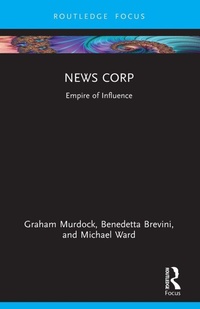
News Corp
Empire of Influence
1st Edition
Published on 21. May 2026
Book
Paperback/Softback
156 pages
978-1-032-18549-1 (ISBN)
Description
A comprehensive scholarly look at the dominance, power, and influence of News Corp as one of the most potent communication giants of current times.
Drawing on a wealth of empirical evidence, this book offers an authoritative, wide-ranging, and accessible analysis of the development, operations, and political influence of the most widely commented on media company of modern times, directed by the world's most famous media mogul, Rupert Murdoch. It details News Corp's ownership and control, traces its global expansion in print, television, and film, examines the crises that have prompted sell-offs, withdrawals, and retrenchment, and explores losses and gains in its responses to the rise of digital media. The book explores Rupert Murdoch's close relations with successive prime ministers and presidents, examines the mobilisation of his news outlets to make and break political reputations, and details the consistent promotion of right-wing populist ideology on a range of key issues across the company's tabloid outlets.
This is an invaluable resource to students and scholars of global media industries, the political economy of media, media policy, and media and politics.
Drawing on a wealth of empirical evidence, this book offers an authoritative, wide-ranging, and accessible analysis of the development, operations, and political influence of the most widely commented on media company of modern times, directed by the world's most famous media mogul, Rupert Murdoch. It details News Corp's ownership and control, traces its global expansion in print, television, and film, examines the crises that have prompted sell-offs, withdrawals, and retrenchment, and explores losses and gains in its responses to the rise of digital media. The book explores Rupert Murdoch's close relations with successive prime ministers and presidents, examines the mobilisation of his news outlets to make and break political reputations, and details the consistent promotion of right-wing populist ideology on a range of key issues across the company's tabloid outlets.
This is an invaluable resource to students and scholars of global media industries, the political economy of media, media policy, and media and politics.
More details
Series
Language
English
Place of publication
London
United Kingdom
Publishing group
Taylor & Francis Ltd
Target group
College/higher education
Postgraduate and Undergraduate Advanced
Product notice
Paperback (trade)
Illustrations
29 s/w Tabellen
29 Tables, black and white
Dimensions
Height: 216 mm
Width: 140 mm
Thickness: 9 mm
Weight
201 gr
ISBN-13
978-1-032-18549-1 (9781032185491)
Copyright in bibliographic data and cover images is held by Nielsen Book Services Limited or by the publishers or by their respective licensors: all rights reserved.
Schweitzer Classification
Other editions
Additional editions
Book
09/2024
1st Edition
Routledge
€79.00
Shipment within 10-20 days
E-Book
09/2024
1st Edition
Routledge
€31.49
Available for download
E-Book
09/2024
1st Edition
Routledge
€31.49
Available for download
Persons
Graham Murdock is Emeritus Professor of Culture and Economy at Loughborough University, UK. He is internationally known for his work in the sociology and political economy of communication. He has held visiting professorships at the universities of Auckland, Bergen, Brussels, California, Curtin, and Fudan in Shanghai. His writings are available in 21 languages. His books include, as co-editor, Money Talks: Media, Markets, Crisis (2015), Carbon Capitalism and Communication: Confronting Climate Crisis (2017), and Contested Connections: Pandemic and Digital Media (2022), and, as co-author, Researching Communications (2021).
Benedetta Brevini is Visiting Professor at the Institute for Public Knowledge, New York University, USA, and Associate Professor of Political Economy of Communication at the University of Sydney, Australia. Before joining the academy, she worked as a journalist in Milan, New York and London for CNBC, RAI, and The Guardian. She is the author of several books including Public Service Broadcasting Online (2013), Amazon: Understanding a Global Communication Giant (2020), and Is AI Good for the Planet (2022), and the editor of Beyond Wikileaks (2013), Carbon Capitalism and Communication: Confronting Climate Crisis (2017), and Climate Change and the Media (2018).
Michael Ward teaches Australian media as part of Boston University's global program in Sydney and is a sessional academic in media and communication at the University of Sydney, Australia. He was a senior executive with the Australian Broadcasting Corporation.
Benedetta Brevini is Visiting Professor at the Institute for Public Knowledge, New York University, USA, and Associate Professor of Political Economy of Communication at the University of Sydney, Australia. Before joining the academy, she worked as a journalist in Milan, New York and London for CNBC, RAI, and The Guardian. She is the author of several books including Public Service Broadcasting Online (2013), Amazon: Understanding a Global Communication Giant (2020), and Is AI Good for the Planet (2022), and the editor of Beyond Wikileaks (2013), Carbon Capitalism and Communication: Confronting Climate Crisis (2017), and Climate Change and the Media (2018).
Michael Ward teaches Australian media as part of Boston University's global program in Sydney and is a sessional academic in media and communication at the University of Sydney, Australia. He was a senior executive with the Australian Broadcasting Corporation.
Content
1. An Empire in Decline?
2. History: The Making of a Global Media Conglomerate
3. Digital Disruptions: Threats, Opportunities and Missed Chances
4. Economic Profile: Properties, Revenues, Market Shares
5. Political Profile: Ownership, Control, Influence
6. Cultural Profile: Tabloid Tales and Populist Politics
7. Revaluations
2. History: The Making of a Global Media Conglomerate
3. Digital Disruptions: Threats, Opportunities and Missed Chances
4. Economic Profile: Properties, Revenues, Market Shares
5. Political Profile: Ownership, Control, Influence
6. Cultural Profile: Tabloid Tales and Populist Politics
7. Revaluations