

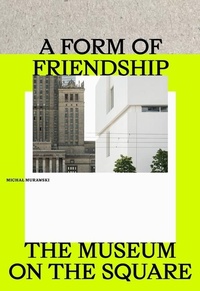
A Form of Friendship
The Museum on the Square
Published on 11. February 2025
Book
Hardback
290 pages
978-83-67598-15-6 (ISBN)
Description
A subjective, candid, multi-vocal story about the creation of the building of the Museum of Modern Art in Warsaw.
Warsaw's Parade Square, where the MSN building designed by Thomas Phifer stands, is a unique place and a meaningful context for the Museum. The square, over which the Palace of Culture looms, was Poland's center of communist state life. Later, it was the arena for the formation of Polish capitalism, with market stalls and gleaming office towers sprouting up around it. This is where fierce land reprivatization disputes erupted, and where newcomers to Warsaw first arrive on trains and buses-including refugees from Ukraine under attack from Russia.
Michal Murawski interweaves these threads, pinpointing the "spatio-temporal and infrastructural nexus" in which the new Museum exists, and proposing an institutional "ideology" to emerge from it.
The author's tour-de-force essay introduces a narrative, further explored through conversations with experts in art, architecture, and activism. A timeline summarizes the complex history of MSN's new building.
The guide throughout this story is Alina Szapocznikow's 1954 sculpture Friendship, which for almost forty years welcomed those entering the Palace, only to later disappear from view, and now returns, albeit in an amputated form, to the square-in the Museum of Modern Art.
Warsaw's Parade Square, where the MSN building designed by Thomas Phifer stands, is a unique place and a meaningful context for the Museum. The square, over which the Palace of Culture looms, was Poland's center of communist state life. Later, it was the arena for the formation of Polish capitalism, with market stalls and gleaming office towers sprouting up around it. This is where fierce land reprivatization disputes erupted, and where newcomers to Warsaw first arrive on trains and buses-including refugees from Ukraine under attack from Russia.
Michal Murawski interweaves these threads, pinpointing the "spatio-temporal and infrastructural nexus" in which the new Museum exists, and proposing an institutional "ideology" to emerge from it.
The author's tour-de-force essay introduces a narrative, further explored through conversations with experts in art, architecture, and activism. A timeline summarizes the complex history of MSN's new building.
The guide throughout this story is Alina Szapocznikow's 1954 sculpture Friendship, which for almost forty years welcomed those entering the Palace, only to later disappear from view, and now returns, albeit in an amputated form, to the square-in the Museum of Modern Art.
More details
Language
English
Place of publication
Warsaw
Poland
Target group
Professional and scholarly
Illustrations
50 color plates
Dimensions
Height: 235 mm
Width: 160 mm
Thickness: 22 mm
Weight
648 gr
ISBN-13
978-83-67598-15-6 (9788367598156)
Copyright in bibliographic data and cover images is held by Nielsen Book Services Limited or by the publishers or by their respective licensors: all rights reserved.
Schweitzer Classification
Person
Michal Murawski is an anthropologist of architecture and cities and associate professor of critical area studies at the School of Slavonic and East European Studies, University College London. Murawski is the author of The Palace Complex: A Stalinist Skyscraper, Capitalist Warsaw and a City Transfixed, coeditor of Anti-Atlas: Critical Area Studies from the East of the West, and Re-Centering the City: Global Mutations of Socialist Modernity. Murawski is also co-convenor of PPV (Perverting the Power Vertical: Politics and Aesthetics), a research platform based at UCL.