

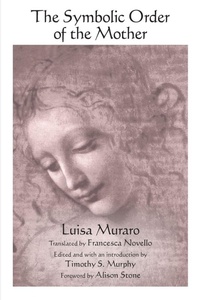
The Symbolic Order of the Mother
Published on 2. January 2019
Book
Paperback/Softback
162 pages
978-1-4384-6764-1 (ISBN)
Description
Argues that affirming the irreducible differences between men and women can lead to more transformative politics than the struggle for abstract equality between the sexes.
In The Symbolic Order of the Mother Luisa Muraro identifies the bond between mother and child as ontologically fundamental to the development of culture and politics, and therefore as key to achieving truly emancipatory political change. Both corporeal development and language acquisition, which are the sources of all thinking, begin in this relationship. However, Western civilization has been defined by men, and Muraro recalls the admiration and envy she felt for the great philosophers as she strove to become one herself, as well as the desire for independence that opposed her to her mother. This conflict between philosophy and culture on the one hand and the relationship with the mother on the other constitutes the root of patriarchy's symbolic disorder, which blocks women's (and men's) access to genuine freedom. Muraro appeals to the feminist practice of gratitude to the mother and the recognition of her authority as a model of unconditional nurture and support that must be restored. This, she argues, is the symbolic order of the mother that must overcome the disorder of patriarchy. The mediating power of the mother tongue constitutes a symbolic order that comes before all others, for both women and men.
In The Symbolic Order of the Mother Luisa Muraro identifies the bond between mother and child as ontologically fundamental to the development of culture and politics, and therefore as key to achieving truly emancipatory political change. Both corporeal development and language acquisition, which are the sources of all thinking, begin in this relationship. However, Western civilization has been defined by men, and Muraro recalls the admiration and envy she felt for the great philosophers as she strove to become one herself, as well as the desire for independence that opposed her to her mother. This conflict between philosophy and culture on the one hand and the relationship with the mother on the other constitutes the root of patriarchy's symbolic disorder, which blocks women's (and men's) access to genuine freedom. Muraro appeals to the feminist practice of gratitude to the mother and the recognition of her authority as a model of unconditional nurture and support that must be restored. This, she argues, is the symbolic order of the mother that must overcome the disorder of patriarchy. The mediating power of the mother tongue constitutes a symbolic order that comes before all others, for both women and men.
Reviews / Votes
"The Symbolic Order of the Mother by the Italian philosopher and feminist Luisa Muraro is the first work translated into English (2018) from a brilliant and original body of works." - KULT_onlineMore details
Series
Language
English
Place of publication
Albany, NY
United States
Target group
Professional and scholarly
US School Grade: College Graduate Student and over
Product notice
Paperback (trade)
Dimensions
Height: 229 mm
Width: 152 mm
Thickness: 9 mm
Weight
245 gr
ISBN-13
978-1-4384-6764-1 (9781438467641)
Copyright in bibliographic data and cover images is held by Nielsen Book Services Limited or by the publishers or by their respective licensors: all rights reserved.
Schweitzer Classification
Other editions
Additional editions
Luisa Muraro | Timothy S. Murphy
The Symbolic Order of the Mother
E-Book
12/2017
1st Edition
De Gruyter
from
€81.99
Available for download
Persons
Luisa Muraro is Professor Emeritus of Philosophy at the University of Verona, Italy. Francesca Novello is an instructor at the University of Oklahoma. Timothy S. Murphy is Houston-Truax-Wentz Professor and Regents Professor of English at Oklahoma State University.
Content
Foreword
Alison Stone
Translator's Note
Francesca Novello
Introduction: From Separation to Creative Difference
Timothy S. Murphy
Author's Note to the English-Language Edition
Preface
1. The Difficulty of Beginning
2. Knowing How to Love the Mother as a Sense of Being
3. The Word, a Gift from the Mother
4. Or the One in Her Place
5. The Circle of Flesh
6. The Abyssal Distance
Notes
Index
Alison Stone
Translator's Note
Francesca Novello
Introduction: From Separation to Creative Difference
Timothy S. Murphy
Author's Note to the English-Language Edition
Preface
1. The Difficulty of Beginning
2. Knowing How to Love the Mother as a Sense of Being
3. The Word, a Gift from the Mother
4. Or the One in Her Place
5. The Circle of Flesh
6. The Abyssal Distance
Notes
Index