

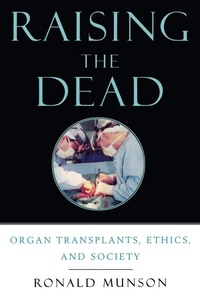
Raising the Dead
Organ transplants, ethics, and society
Published on 28. October 2004
Book
Paperback/Softback
304 pages
978-0-19-517801-2 (ISBN)
Description
Ronald Munson plunges us into the tense and tangled world of organ transplantation. Using vivid, often gut-wrenching cases as points of departure, Munson shows us how transplants are performed, decisions are made, and ethical and social issues arise. Fast-paced and readable, the science and medicine lucidly explained, this book forces us to confront the human and moral dimensions of using donor organs to save lives.
Munson uses case examples to explore, explain, and try to resolve a handful of crucial problems arising from acquiring and allocating donor organs. Should "social worth" count in allotting organs? Should we ignore the "dead-donor rule" and take organs from infants born lacking a brain? Should we permit people to sell one of their kidneys? Should organs be removed from people who aren't yet brain dead? Can children become living donors? He also explores the promises and perils of transplanting animal organs into people, and the promise that stem-cell engineering will permit physicians to repair damaged organs or replace them with new copies.
Munson uses case examples to explore, explain, and try to resolve a handful of crucial problems arising from acquiring and allocating donor organs. Should "social worth" count in allotting organs? Should we ignore the "dead-donor rule" and take organs from infants born lacking a brain? Should we permit people to sell one of their kidneys? Should organs be removed from people who aren't yet brain dead? Can children become living donors? He also explores the promises and perils of transplanting animal organs into people, and the promise that stem-cell engineering will permit physicians to repair damaged organs or replace them with new copies.
Reviews / Votes
In the wake of the catastrophic losses of World War II, Soviet citizens sought to rebuild their lives and families. In this groundbreaking study, Nakachi examines the efforts of women, doctors, and health officials to counter the fierce pronatalism of the state. Her book is indispensable reading for anyone interested in the ongoing struggle over women's reproductive rights. * Wendy Z. Goldman, co-author of Fortress Dark and Stern: The Soviet Home Front during World War II * Raising the Dead makes a quantum leap forward in our understanding of gender, reproduction, and family planning after World War II. Distinguished by impressive archival sleuthing and crystal clear prose, Nakachi's book is a landmark study that will inform and inspire a new generation of work. * Paula A. Michaels, author of Lamaze: An International History * Mie Nakachi's brilliant book shows conclusively the combination of incompetence and insensitivity in postwar pronatalist policies that criminalized abortion, restricted divorce, and liberated men from parental responsibility for children born out of wedlock. Nakachi shows how the authorities jerry-rigged the system to try to accomplish multiple goals at the same time, leaving only doctors and women themselves to advocate for women's rights to control their own fertility. This book is a must-read for anyone who wants to know not only about reproduction in the context of a demographic disaster but also about the workings of Soviet policy makers who often operated from hidden motivations that they shared only in behind-the-scenes documents. * Elizabeth A. Wood, author of The Baba and the Comrade: Gender and Politics in Revolutionary Russia * A monumental and gripping study of the politics of the family and reproduction in the USSR under and after Stalin. Among other things, Nakachi explains how the world's first law to recognize a woman's right to abortion came about in 1955, and in a country without a modern feminist movement. * Timothy J. Colton, author of Russia: What Everyone Needs to Know *More details
Language
English
Place of publication
New York
United States
Target group
Health care providers, members of the transplant community, professors and students of bioethics, bioethicists, medical and biological researchers, general readers interested in medicine and society.
Dimensions
Height: 229 mm
Width: 152 mm
Thickness: 18 mm
Weight
496 gr
ISBN-13
978-0-19-517801-2 (9780195178012)
Copyright in bibliographic data and cover images is held by Nielsen Book Services Limited or by the publishers or by their respective licensors: all rights reserved.
Schweitzer Classification
Other editions
Additional editions
Book
06/2002
Oxford University Press Inc
€104.80
Shipment within 15-20 days
E-Book
01/2002
1st Edition
OUP USA
€24.99
Available for download
E-Book
01/2002
1st Edition
OUP USA
€24.99
Available for download
Person
Ronald Munson is Professor of Philosophy of Science and Medicine, University of Missouri-St. Louis. He is the author of Intervention and Reflection, the most widely used medical ethics textbook in the US, and of three novels.
Content
1. A Modern Lazarus: Robby Benson's heart ; 2. Mickey Mantle's liver: Part I - the case ; 3. Mickey Mantle's liver: Part II - the issues ; 4. That others may live: the dead donor rule and anencephalic infants ; 5. Kidney for sale: is it ever right to sell your kidney? ; 6. Donors of last resort: protecting vulnerable people ; 7. Kurosawa in California: The baby Fae case and unproven treatments ; 8. But are they really dead? Is no heartbeat enough for death? ; 9. Xenotransplantation: Part I - chasing the dream ; 10. Xenotransplantation: Part II - fearing the worst, hoping for the best ; 11. Grow your own organs: stem-cell engineering and regenerative medicine