

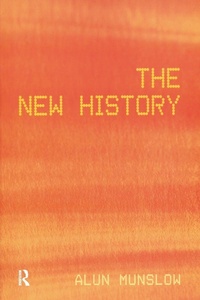
The New History
1st Edition
Published on 13. November 2003
Book
Paperback/Softback
244 pages
978-0-582-47282-2 (ISBN)
Description
The notion of 'history' has always been one strenuously debated by both academics and the wider population. This deeply provocative re-thinking of our engagement with the past by one of the world's leading post-modern historians takes that debate one step further.
Alun Munslow re-assesses history in the light of post-modernism and other intellectual challenges which have questioned the primacy of the modernist epistemology of empiricism. In an original and stimulating vision of history that will intrigue all those seriously interested in the subject, Munslow argues that history is not only about the sources, but a literary construction.
Munslow concludes that history, as a cultural narrative about the past can never tell us what the past really means. This far reaching conclusion is based on the radical idea that the content of history is defined as much by the nature of the language used to represent and interpret that content as it is by research into the sources. This suggests that history does not produce the most likely meaning of the past but rather can only generate alternative meanings.
The lead volume in a major new series on historical thinking and practice, this is an accessible yet absorbing study that breaks new ground in discussing the stage history is at now, and perhaps most engagingly, the direction it will take in the future.
Alun Munslow re-assesses history in the light of post-modernism and other intellectual challenges which have questioned the primacy of the modernist epistemology of empiricism. In an original and stimulating vision of history that will intrigue all those seriously interested in the subject, Munslow argues that history is not only about the sources, but a literary construction.
Munslow concludes that history, as a cultural narrative about the past can never tell us what the past really means. This far reaching conclusion is based on the radical idea that the content of history is defined as much by the nature of the language used to represent and interpret that content as it is by research into the sources. This suggests that history does not produce the most likely meaning of the past but rather can only generate alternative meanings.
The lead volume in a major new series on historical thinking and practice, this is an accessible yet absorbing study that breaks new ground in discussing the stage history is at now, and perhaps most engagingly, the direction it will take in the future.
More details
Series
Language
English
Place of publication
London
United Kingdom
Publishing group
Taylor & Francis Ltd
Target group
Professional and scholarly
Dimensions
Height: 234 mm
Width: 156 mm
Thickness: 13 mm
Weight
377 gr
ISBN-13
978-0-582-47282-2 (9780582472822)
Copyright in bibliographic data and cover images is held by Nielsen Book Services Limited or by the publishers or by their respective licensors: all rights reserved.
Schweitzer Classification
Other editions
Additional editions

Person
Alun Munslow is editor of the journal Rethinking History. He is the author of 3 history books already, and is one of the big names in History and Theory in the UK
Content
Introduction: What is History?
Section One: Epistemology and Historical Knowing
1. The History of Historical Thinking
2. Inference, Causation, Agency and Meaning
Section Two: Referentiality, Evidence and Practice
3. Evidence, Reality and Correspondence
4. Objectivity, Truth and Relativism in History
Section Three: Theory and Concept
5. The History of Social Theory
6. Constructing Histories
Section Four: Writing the Past as History
7. Narrative and Representation
8. History as Historiography
Conclusion
Guide to Further Reading
Notes
Section One: Epistemology and Historical Knowing
1. The History of Historical Thinking
2. Inference, Causation, Agency and Meaning
Section Two: Referentiality, Evidence and Practice
3. Evidence, Reality and Correspondence
4. Objectivity, Truth and Relativism in History
Section Three: Theory and Concept
5. The History of Social Theory
6. Constructing Histories
Section Four: Writing the Past as History
7. Narrative and Representation
8. History as Historiography
Conclusion
Guide to Further Reading
Notes