

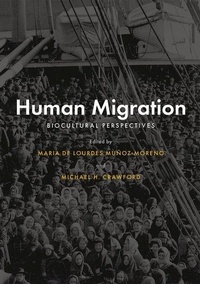
Human Migration
Biocultural Perspectives
Published on 22. November 2021
Book
Hardback
296 pages
978-0-19-094596-1 (ISBN)
Description
Studying human migratory patterns can help us make sense of evolution, biology, linguistics, and so much more.
Human Migration takes readers through population development and their respective origins to create a comprehensive picture of human migratory patterns. This book explores human migration as a major contributor to globalization that facilitates gene flow and the exchange of cultures and languages. It also traces evolutionary success of a hybrid population, the Black Caribs, after their forced relocation from St. Vincent Island to the Bay Islands and Central America.
The volume is split into four sections: Theoretical Overview; Ancient DNA and Migration; Regional Migration; Culture and Migration: and Disease and Migration. This division allows for a seamless transition between a broad range of topics, including molecular genetics, linguistics, cultural anthropology, history, archaeology, demography, and genetic epidemiology. Assembled by volume editors and migration specialists Maria de Lourdes Munoz-Moreno and Michael H. Crawford, Human Migration creates an opportunity for researchers, professionals, and students from different fields to review and discuss the most recent trends and challenges surrounding migration, genetics, and anthropology.
Human Migration takes readers through population development and their respective origins to create a comprehensive picture of human migratory patterns. This book explores human migration as a major contributor to globalization that facilitates gene flow and the exchange of cultures and languages. It also traces evolutionary success of a hybrid population, the Black Caribs, after their forced relocation from St. Vincent Island to the Bay Islands and Central America.
The volume is split into four sections: Theoretical Overview; Ancient DNA and Migration; Regional Migration; Culture and Migration: and Disease and Migration. This division allows for a seamless transition between a broad range of topics, including molecular genetics, linguistics, cultural anthropology, history, archaeology, demography, and genetic epidemiology. Assembled by volume editors and migration specialists Maria de Lourdes Munoz-Moreno and Michael H. Crawford, Human Migration creates an opportunity for researchers, professionals, and students from different fields to review and discuss the most recent trends and challenges surrounding migration, genetics, and anthropology.
More details
Language
English
Place of publication
New York
United States
Target group
College/higher education
Product notice
sewn/stitched
Cloth over boards
Illustrations
67 images
Dimensions
Height: 263 mm
Width: 179 mm
Thickness: 18 mm
Weight
671 gr
ISBN-13
978-0-19-094596-1 (9780190945961)
Copyright in bibliographic data and cover images is held by Nielsen Book Services Limited or by the publishers or by their respective licensors: all rights reserved.
Schweitzer Classification
Other editions
Additional editions
E-Book
08/2021
OUP eBook
€57.99
Available for download
E-Book
08/2021
OUP eBook
€57.99
Available for download
Persons
Maria de Lourdes Munoz-Moreno was born in Mexico City, Mexico. She is a Research Professor in the Department of Genetics and Molecular Biology at the Centro de Investigacion y de Estudios Avanzados (CINVESTAV-IPN). Munoz-Moreno was a Postdoctoral Researcher in the Department of Pathology and Visiting Fellow for "Advanced Research Experience" at the National Institute of Health in Maryland. Later, she was Visiting Professor in the Department of Genetics at Case Western Reserve University School of Medicine. Munoz-Moreno did a sabbatical year at the Laboratory of Biological Anthropology at the University of Kansas from 2015 to 2016 to start a collaborative research project with Dr. Michael H. Crawford. The main focus of this research was on the population genetics of pre-Hispanic and contemporary Mexicans.
Michael H. Crawford was born in Shanghai, China, but he lived in displaced persons camps in the Philippine Islands (Tubabao) and Australia (Urunquinty). He earned his PhD in anthropology and genetics in 1967 from the University of Washington, Seattle. Crawford was Professor of Anthropology and Genetics at the University of Kansas for 50 years prior to retirement in 2020. In 1976, he established the Laboratory of Biological Anthropology. Over the years, he has mentored 41 PhDs and 20 post-doctoral fellows. Crawford has conducted field investigations in Mexico, the Caribbean, Siberia, the Aleutian Islands, Italy, and India. He has published more than 300 peer-reviewed articles in national and international journals.
Michael H. Crawford was born in Shanghai, China, but he lived in displaced persons camps in the Philippine Islands (Tubabao) and Australia (Urunquinty). He earned his PhD in anthropology and genetics in 1967 from the University of Washington, Seattle. Crawford was Professor of Anthropology and Genetics at the University of Kansas for 50 years prior to retirement in 2020. In 1976, he established the Laboratory of Biological Anthropology. Over the years, he has mentored 41 PhDs and 20 post-doctoral fellows. Crawford has conducted field investigations in Mexico, the Caribbean, Siberia, the Aleutian Islands, Italy, and India. He has published more than 300 peer-reviewed articles in national and international journals.
Editor
Research-Professor, Department of Genetics and Molecular BiologyResearch-Professor, Department of Genetics and Molecular Biology, Centro de Investigacion y de Estudios Avanzados
Emeritus Professor, Biological Anthropology, Department of AnthropologyEmeritus Professor, Biological Anthropology, Department of Anthropology, University of Kansas
Content
Chapter 1: Introduction, Maria de Lourdes Munoz-Moreno and Michael H. Crawford Theoretical Overview Chapter 2: Genomic Insights into the Out-of-Africa Dispersal(s) of Modern Humans, Mark Stoneking Chapter 3: Unangan (Aleut) Migrations: Causes and Consequences, Michael H. Crawford, Sarah Alden, Randy David, and Kristine Beaty Chapter 4: Early Peopling of the Americas: A Paleogenetics Perspective, Constanza de la Fuente, J. Victor Moreno-Mayar, and Maanasa Raghavan Ancient DNA and Migration Chapter 5: An Arctic Lens for American Migration: Integrating Genomics, Archaeology and Paleoecology, Dennis H. O'Rourke, Justin Tackney, and Lauren Norman Chapter 6: Mitochondrial DNA Analysis and Pre-Hispanic Maya Migrations: Languages, and Climate Influence, Maria de Lourdes Munoz-Moreno, Mirna Isabel Ochoa-Lugo, Gerardo Perez-Ramirez, Kristine G. Beaty, Adrian Martinez Meza, and Michael H. Crawford Chapter 7: Mitochondrial DNA Haplotype Identification of Pre-Hispanic Human Remains Discovered in the Puyil Cave, Tabasco-Mexico, from the Archaic and Classical Periods, Maria Teresa Navarro-Romero, Maria de Lourdes Munoz-Moreno, and Enrique Alcala-Castaneda Regional Migration Chapter 8: A Genetic Perspective on the Origin and Migration of the Samoyedic-Speaking Populations from Siberia, Tatiana Karafet, Ludmila P. Osipova, and Michael F. Hammer Chapter 9: Linguistic Diversity and Human Migrations in Gabon, Franz Manni and John Nerbonne Chapter 10: Migration Patterns in the Republic of Sakha (Yakutia), Larissa Tarskaia, A.G. Egorova, A.S. Barashkova, S.A. Sukneva, and W. Leonard Chapter 11: Rapid, Adaptive Human Evolution Facilitated by Admixture in the Americas, Emily T. Norris, Lavanya Rishishwar, and I. King Jordan Chapter 12: Y-chromosome Diversity in Aztlan Descendants and Its Implications for the History of Central Mexico, R. Gomez, T.G. Schurr, and M.A. Meraz-Rios Chapter 13: Migration of Garifuna: Evolutionary Success Story, Michael H. Crawford, Christine Phillips-Krawczak, Kristine G. Beaty, and Noel Boaz Culture and Migration Chapter 14: Out of Africa, Again: African Migration to Europe in the Twenty-First Century, Majid Hannoum Chapter 15: Yurimaguas and the Lower Huallaga River Valley: A Biocultural Approach to Migration and Urbanization in Peruvian Amazonia, Randy David and Bartholomew Dean Chapter 16: Causes of Migration to and from the Ch'orti' Maya Area of Guatemala, Honduras, and El Salvador, Brent E. Metz Chapter 17: Evidence of Human Migration: Xibablba in the Puyil Cave, Puxcatan, Tabasco, Enrique Alcala-Castaneda Chapter 18: Migration of the Zoques to the Mountain Region of Tabasco: Linguistic and Archaeological Perspectives, Eladio Terreros-Espinosa Disease and Migration Chapter 19: Impact of Human Migration on the Spread of Arboviral Diseases at the US-Mexico Border, Alvaro Diaz-Badillo and Maria de Lourdes Munoz-Moreno Chapter 20: Major Impact of Massive Migration on Spread of Epidemic Mycobacterium Tuberculosis Strains, Igor Mokrousov Conclusion, Michael H. Crawford and Maria de Lourdes Munoz-Moreno Index