

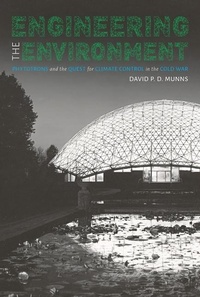
Engineering the Environment
Phytotrons and the Quest for Climate Control in the Cold War
Will be published approx. on 14. May 2017
Book
Hardback
384 pages
978-0-8229-4474-4 (ISBN)
Description
Promising an end to global hunger and political instability, huge climate-controlled laboratories known as phytotrons spread around the world to thirty countries after the Second World War. The United States built nearly a dozen, including the first at Caltech in 1949. Made possible by computers and other novel greenhouse technologies of the early Cold War, phytotrons enabled plant scientists to experiment on the environmental causes of growth and development of living organisms. Subsequently, they turned biologists into technologists who, in their pursuit of knowledge about plants, also set out to master the machines that controlled their environment.
Engineering the Environment tells the forgotten story of a research program that revealed the shape of the environment, the limits of growth and development, and the limits of human control over complex technological systems. As support and funding for basic science dwindled in the mid-1960s, phytotrons declined and ultimately disappeared-until, nearly thirty years later, the British built the Ecotron to study the impact of climate change on biological communities. By revisiting this history of phytotrons, David Munns reminds us of the vital role they can play in helping researchers unravel the complexities of natural ecosystems in the Anthropocene.
Engineering the Environment tells the forgotten story of a research program that revealed the shape of the environment, the limits of growth and development, and the limits of human control over complex technological systems. As support and funding for basic science dwindled in the mid-1960s, phytotrons declined and ultimately disappeared-until, nearly thirty years later, the British built the Ecotron to study the impact of climate change on biological communities. By revisiting this history of phytotrons, David Munns reminds us of the vital role they can play in helping researchers unravel the complexities of natural ecosystems in the Anthropocene.
Reviews / Votes
This volume provides a glimpse into the scientific questions asked by different groups around the globe, and how their efforts have provided a foundation for current understanding, but also the impetus for how tools need to be developed to answer complex questions. * Choice * Engineering the Environment offers a lively history of a mostly forgotten but ultimately fascinating scientific instrument. This compelling story of phytotrons and the dreams and disappointments of the technologist-biologists who built them brings new insights and much-needed diversity to the historiography of twentieth-century biology. * Helen Anne Curry, University of Cambridge * David Munns has written a carefully grounded and clearly worded account of a subject that is at once important, complex, and woefully neglected. This book will be stimulating to readers interested not only in the ways the phytotron recast the relationship between genes and environment, but also to a much larger group interested broadly in climate change and agricultural technology. * Joseph A. November, University of South Carolina * Engineering the Environment is an entertaining read, whether connecting his subjects to sci-fi, or dramatising the waxing and waning of phytotron fortunes, Munns' enthusiasm for the idea of environmental biology and his sympathy for the designers of these buildings is infectious. * Journal of the History of Biology * Engineering the Environment offers up a history of a little known, but very Cold War, category of facilities known as "phytotrons."...Munns's book uses plant physiology...as a way to explore the space between the Big Science of the physicists and the control fantasies of the computer scientists. * Alex Wellerstein, Stevens Institute of Technology *More details
Language
English
Place of publication
Pittsburgh PA
United States
Target group
Professional and scholarly
Product notice
sewn/stitched
Cloth over boards
Illustrations
29 b&w Illustrations
Dimensions
Height: 240 mm
Width: 161 mm
Thickness: 32 mm
Weight
676 gr
ISBN-13
978-0-8229-4474-4 (9780822944744)
Copyright in bibliographic data and cover images is held by Nielsen Book Services Limited or by the publishers or by their respective licensors: all rights reserved.
Schweitzer Classification
Other editions
Additional editions

David P. D. Munns
Engineering the Environment
Phytotrons and the Quest for Climate Control in the Cold War
E-Book
07/2017
David & Charles
€58.99
Available for download
Person
David P. D. Munns is associate professor of history at John Jay College, City University of New York.