

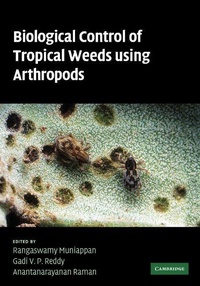
Biological Control of Tropical Weeds Using Arthropods
Published on 25. October 2012
Book
Paperback/Softback
508 pages
978-1-107-41126-5 (ISBN)
Description
Weeds are a major constraint to agricultural production, particularly in the developing world. Cost-efficient biological control is a self-sustaining way to reduce this problem, and produces fewer non-target effects than chemical methods, which can cause serious damage to the environment. This book covers the origin, distribution, and ecology of twenty model invasive weed species, which occur in habitats from tropical to temperate to aquatic. Sustainable biological control of each weed using one or more arthropods is discussed. The aim is to provide ecological management models for use across the tropical world, and to assist in the assessment of potential risks to native and economic plants. This is a valuable resource for scientists and policy makers concerned with the biological control of invasive tropical plants.
Reviews / Votes
Review of the hardback: 'This is an impressive and comprehensive treatment of the subject presented in a readable and accessible style ... should be of considerable use to practitioners in the field and equally to policy makers ... It is likely that this treatise will remain the most relevant and seminal treatment of the subject for some good time ahead.' Biologist Review of the hardback: '... good source of information supported by 1700 references, supplemented with figures, and it is well indexed. The text is a valuable resource for scientists and policy makers ...' Journal of Agricultural Science Review of the hardback: '... a useful resource for professionals working on biological control of invasive tropical plants as it provides guidelines for techniques and approaches that can serve the introduction of biological weed management in developing countries. The insights into insect and weed ecology provided by the various case studies will be of interest to both entomologists and weed scientists.' Experimental AgricultureMore details
Language
English
Place of publication
Cambridge
United Kingdom
Target group
Professional and scholarly
Product notice
Paperback (trade)
Dimensions
Height: 244 mm
Width: 170 mm
Thickness: 27 mm
Weight
867 gr
ISBN-13
978-1-107-41126-5 (9781107411265)
Copyright in bibliographic data and cover images is held by Nielsen Book Services Limited or by the publishers or by their respective licensors: all rights reserved.
Schweitzer Classification
Other editions
Additional editions
Rangaswamy Muniappan | Gadi V. P. Reddy | Anantanarayanan Raman
Biological Control of Tropical Weeds Using Arthropods
E-Book
04/2009
1st Edition
Cambridge University Press
€58.99
Available for download
Rangaswamy Muniappan | Gadi V. P. Reddy | Anantanarayanan Raman
Biological Control of Tropical Weeds Using Arthropods
Book
03/2009
Cambridge University Press
€120.50
Shipment within 15-20 days
Persons
Content
1. Biological control of weeds in the tropics and sustainability R. Muniappan, G. V. P. Reddy and A. Raman; 2. Acacia nilotica ssp. Indica (L.) Willd. ex Del. (Mimosaceae) K. Dhileepan; 3. Australian Acacia species (Mimosaceae) in South Africa F. Impson, J. H. Hoffmann and C. Kleinjan; 4. Ageratina adenophora (Sprengel) R. King and H. Robinson (Asteraceae) R. Muniappan, A. Raman and G. V. P. Reddy; 5. Azolla filiculoides Lamarck (Nostocaceae) M. P. Hill and A. J. McConnachie; 6. Cabomba caroliniana Gray (Cabombaceae) S. Schooler, W. Cabrera-Walsh and M. H. Julien; 7. Invasive cactus species (Cactaceae) H. Zimmermann, C. Moran and J. H. Hoffmann; 8. Chromolaena odorata (L.) R. King and H. Robinson (Asteraceae) C. Zachariades, M. Day, R. Muniappan and G. V. P. Reddy; 9. Clidemia hirta (L.) D. Don (Melastomataceae) P. Conant; 10. Coccinia grandis (L.) Voigt (Cucurbitaceae) R. Muniappan, G. V. P. Reddy and A. Raman; 11. Eichhornia crassipes (Mart.) Solms-Laub. (Pontederiaceae) J. A. Coetzee, M. P. Hill, M. H. Julien, T. D. Center and H. A. Cordo; 12. Lantana camara Linn. (Verbenaceae) M. D. Day and M. P. Zalucki; 13. Mimosa diplotricha C. Wright ex Sauvalle (Mimosaceae) L. S. Kuniata; 14. Mimosa pigra L. (Leguminosae) T. A. Heard and Q. Paynter; 15. Parthenium hysterophorus L. (Asteraceae) K. Dhileepan and L. Strathie; 16. Passiflora mollissima (HBK) Bailey (Passifloraceae) G. P. Markin; 17. Pistia stratiotes L. (Araceae) P. Neuenschwander, M. H. Julien, T. D. Center and M. P. Hill; 18. Prosopis species (Leguminosae) R. D. van Klinken, J. H. Hoffmann, H. G. Zimmermann and A. P. Roberts; 19. Salvinia molesta D. S. Mitchell (Salviniaceae) M. H. Julien, M. P. Hill and P. W. Tipping; 20. Solanum mauritianum Scopoli (Solanaceae) T. Olckers; 21. Application of natural antagonists including arthropods to resist weedy Striga (Scrophulariaceae) in tropical agroecosystems J. Sauerborn and D. Mueller-Stoever; 22. Biological control of weeds in India J. Rabindra and B. S. Bhumannavar; 23. The role of International Institute of Tropical Agriculture in weed biological control F. Beed and T. Dubois; 24. The role of Secretariat of the Pacific Community in the biological control of weeds in the Pacific Islands region - past, present and future activities W. Orapa; Index.